AxIndex, Edition 9
SNAPSHOT
Our Top 3:
1) Supreme Court Blows Lid Off Redistricting:
A full-scale redistricting battle is underway following the Supreme Court’s rollback of key Voting Rights Act protections, opening the door for aggressive mid-decade map changes. Republicans are moving quickly in Southern states like Louisiana, Alabama, and Tennessee to redraw districts ahead of November, while Democrats are preparing countermeasures in blue states, many of which may not take effect until 2028. With only a handful of seats likely to decide the House, even incremental changes could make all the difference. Ongoing litigation, however, means the final battlefield remains fluid and increasingly dependent on court decisions.
2) Energy Costs and Economic Anxiety Become a Political Liability:
Rising energy prices tied to the Iran conflict are becoming a growing political challenge, with 60% of Americans saying military action has increased recession risk and majorities reporting real changes to spending and travel behavior. Financial strain is rising across the electorate, including among key Republican constituencies like non-college white voters and GOP-leaning independents. Just 21% of voters expect gas prices to improve over the next year, reinforcing a pessimistic outlook. The trajectory raises the stakes for Republicans, as the midterms risk becoming a referendum not just on foreign policy, but on economic stewardship and cost-of-living pressures.
3) AI Enters as a New Political Battleground - Down Ballot Elections:
Artificial intelligence is quickly moving from a niche policy issue to a major political force, with well-funded groups stepping into legislative races to back candidates aligned with their vision for AI’s future. Much of the activity is focused on state and down-ballot contests, where decisions on data, infrastructure, and regulation are being made, and where outside spending can have a real impact. Competing factions are already forming, with pro-growth and more regulatory approaches shaping candidate support. As AI policy becomes more tangible to voters and tied to local impacts like energy use and jobs, it is poised to become a more visible and contested issue heading into November.
National Sentiment Tracking
Gas Price Pain Drives Economic Backlash as Iran War Drags On
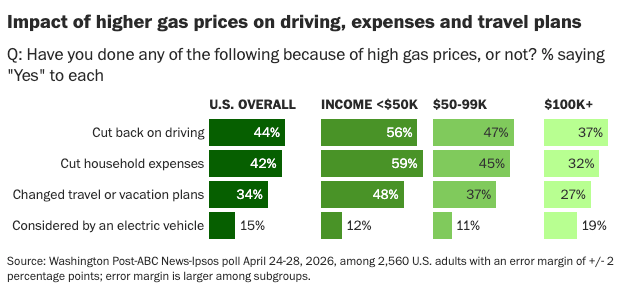
A new Washington Post-ABC News-Ipsos poll finds 60 percent of Americans say the U.S. military action has increased the risk of recession. More than 4 in 10 say gas prices are causing them to drive less and cut household expenses, more than 3 in 10 have changed travel or vacation plans, and 6 in 10 report at least one of these impacts. Only 21 percent expect gas prices to improve over the next year, while half expect them to get worse.
The trajectory is troubling for Republicans hoping to move past the pain by November. Since the war began on February 28, the share of Americans who say they are "falling behind financially" has climbed from 17 to 23 percent, and the share saying they are "not as well off" as when Trump took office has jumped from 33 to 40 percent. The movement is sharpest among the coalition Republicans can least afford to lose: non-college White respondents are up 9 points, and Republican-leaning independents are up 13. The big question is whether the White House can engineer relief at the pump before the midterms, or whether persistent price pressure cements the conflict as a referendum on economic stewardship as much as foreign policy. Read More.
Congressional Disapproval Ties Record High at 86 Percent
A new Gallup poll finds approval of Congress has fallen to 10 percent, just above its all-time low of 9 percent, while disapproval has climbed to 86 percent, tying the record high. The drop has been driven largely by Republicans, whose approval has fallen sharply from a 63 percent peak in March 2025. Just 11 percent of independents and 3 percent of Democrats approve of the job Congress is doing, the latter essentially matching the group's record low of 2 percent.
Three of the five disapproval peaks since 1974 have coincided with a government shutdown or the threat of one, and the current Department of Homeland Security shutdown is now in its 10th week. Gallup also points to GOP frustration that Congress has not passed legislation, including the SAVE Act, broader tensions over war powers tied to the Iran conflict, the political weight of high gas prices, and two recent ethics scandals that forced member resignations. The big question is whether conditions improve quickly enough to avoid the institutional drag bleeding into incumbent races, or whether an 86 percent disapproval environment hardens into a broader anti-Washington midterm narrative.
Read More.
HOUSE HIGHLIGHTS
Polling At A Glance
House
RCP Average Generic Ballot: 48.5 Dem - 42.8 GOP (D +5.7)
On this day in:
2022: 46.7 GOP - 42.9 Dem (R+3.8)
2018: 45.6 Dem - 39.6 GOP (D+6.0)
Retirements

For context, during the first Trump term, there were 52 retirements from the House.
Webster Retirement Brings GOP Departures to 36 as DeSantis Unveils New Florida Map
Eight-term Florida Republican Daniel Webster announced his retirement on April 28, becoming the 36th House Republican to forgo reelection this cycle and exceeding the record of 34 GOP retirements set in the 2018 midterm. Webster's announcement came one day after Governor Ron DeSantis unveiled a new Florida congressional map designed to give Republicans up to four pickup opportunities, with Webster's 11th District remaining a seat that would have backed Trump by 16 points in 2024 according to Inside Elections.
The departure reflects a broader institutional churn that has accelerated through April: 56 House members have now announced they will not seek reelection, the highest total in over three decades, and the average tenure of retiring Republicans has fallen to five terms. The retirement wave compounds Speaker Mike Johnson's challenge of defending a razor-thin majority, even as open seats in friendlier districts open the door for fresher GOP nominees.
Read More.
Democrats Expand the Map, Betting on a Broader Battlefield
House Democrats are moving aggressively to widen the 2026 battlefield, with the DCCC adding new targets, including in traditionally red states like Texas, as they look to capitalize on early momentum. The committee is recruiting candidates and investing in districts that were previously off the board, aiming to force Republicans to defend more seats at a time when their majority is already narrow. This expansion strategy reflects growing confidence, driven by strong special-election performance and a favorable national environment, but it also carries risk: stretching resources too broadly could dilute impact in must-win races. Still, if the environment continues to trend their way, a larger map could significantly improve Democrats’ chances of reclaiming the House. Read More.
House Super PACs Lock In Massive $425M Ad Spending Blitz
House-aligned super PACs have reserved more than $425 million in advertising ahead of the 2026 midterms, signaling an early, high-stakes battle for control of the chamber.
The spending is heavily concentrated in key battleground districts, with tens of millions already targeted at competitive regions like Texas’ Rio Grande Valley, where both parties are fighting for critical seats.
Early ad reservations allow groups to lock in lower rates and dominate airwaves before the fall, underscoring just how narrow the House map is and how aggressively both sides are preparing to compete for a handful of decisive districts. Read More.
Redistricting
Redistricting Arms Race Accelerates After Supreme Court Ruling
The Supreme Court’s move weakening key Voting Rights Act protections has sparked an aggressive mid-decade redistricting push, with both parties racing to redraw maps ahead of 2026. Republicans hold an early edge, with several states already enacting new maps and targeting additional seats.
Louisiana has become a central battleground, where Gov. Jeff Landry is attempting to delay primaries to fast-track a redraw that could eliminate Democratic-leaning Black-majority districts, though legal challenges could still block the effort. Across the South, similar GOP-led pushes are underway, while Democrats are eyeing counter-moves in blue states, many of which may not take effect until 2028.
With House control likely to hinge on a narrow margin, even small map changes could have an outsized impact, but ongoing litigation means the final battlefield remains highly uncertain. Read More.
Virginia Redistricting Stuck in Legal Limbo Ahead of Filing Deadlines
Virginia’s mid-decade redistricting effort remains uncertain as the state Supreme Court weighs whether to uphold a voter-approved referendum allowing Democrats to redraw the congressional map. With candidate filing deadlines approaching, campaigns are operating without clarity on which map will be in place.
At stake is a potential shift of up to four House seats, but legal challenges could delay or derail those gains, making Virginia one of the most consequential and unsettled battlegrounds heading into November.
Read More.
SENATE HIGHLIGHTS
Polling At A Glance
Recent Polls
Emerson (LA GOP Primary): Fleming 28, Letlow 27, Cassidy (i) 21
University of Texas (TX General): Talarico (D) 42, Paxton (R) 34
University of Texas (TX General): Talarico (D) 40, Cornyn (R-i) 33
Detroit Chamber/Glengariff (MI Dem Primary): Stevens 25, El-Sayed 23, McMorrow 16
Atlanta Journal-Constitution (GA GOP Primary): Collins 23, Carter 13, Dooley 11, McColumn 1, Coyne 1
Retirements
So far, 11 Senators have announced their retirement from the chamber at the end of the current Congress.

Maine Senate Race Shifts After Mills Exit
Janet Mills abruptly dropped out of the Maine Senate race, citing a lack of financial resources after being outraised and outpolled by progressive challenger Graham Platner.
Her exit clears the path for Platner to become the Democratic nominee against Susan Collins in one of the most critical Senate battlegrounds of 2026.
Why it matters: The collapse of a top-tier, establishment-backed recruit underscores broader Democratic divisions and raises questions about candidate quality and viability in must-win Senate races. Read More.
Paxton Leads Cornyn in Tight Texas GOP Runoff
Texas Attorney General Ken Paxton is narrowly leading Sen. John Cornyn in the Republican Senate runoff, with a new University of Houston poll showing Paxton ahead 48% to 45% — well within the margin of error and signaling a highly competitive May 26 showdown.
The race underscores a broader divide within the GOP: Paxton continues to consolidate support among MAGA-aligned voters, while Cornyn is backed by more traditional Republican donors and establishment groups.
A prolonged and expensive intraparty fight is creating potential vulnerabilities for Republicans in a state they typically dominate, especially as early general election polling shows the Democratic nominee running competitively against both candidates.
Read More.
IN THE STATES
AI Emerges as New Power Player in Down-Ballot Races
A growing network of pro-AI groups is beginning to shape legislative races, pouring millions into endorsements and ads to back candidates aligned with expanding the technology.
These efforts are largely focused on state and lower-level federal races, where policy decisions around AI regulation, data use, and infrastructure are increasingly being made, and where outside spending can have outsized influence. At the same time, competing AI-aligned groups are backing different candidates, signaling an emerging divide between pro-growth and pro-regulation factions within the tech policy space.
Why it matters: AI is quickly becoming a political issue with real money behind it, turning what was once a niche policy debate into a new front in campaign spending, particularly in lower-profile races that could ultimately determine how the technology is governed.
Read More.
Ohio & Indiana Primaries Offer Early Read on 2026 Map
Voters in Ohio and Indiana are heading to the polls in early contests that could shape the midterm battlefield. In Ohio, high-profile races include a competitive Senate contest, a crowded governor’s race, and key House primaries, all in a state that has trended Republican but remains a top Democratic target.
In Indiana, the spotlight is on Republican primaries where Trump-aligned challengers are targeting GOP incumbents who broke with the party on redistricting, turning the races into a test of loyalty within the party.
These early primaries are less about general election outcomes and more about internal party dynamics, offering a first look at voter enthusiasm, ideological divides, and how Trump continues to shape GOP politics heading into November. Read More.
EMERGING NARRATIVES
GOP Centers Midterm Message on Costs and Immigration
New NRSC polling shows Senate Republicans are zeroing in on cost-of-living and immigration as their core midterm message, with 42% of swing voters naming affordability as their top concern and immigration ranking highest among low-propensity Trump voters.
The data also finds voters broadly blaming government spending and federal debt for rising costs, reinforcing GOP plans to lean into tax relief, spending cuts, and border security as central campaign themes.
Why it matters: Republicans see these issues as a path to mobilize both swing voters and less reliable Trump supporters, two groups likely to determine control of the Senate in November.
Read More.
ON THE HORIZON
Upcoming Elections:
May 5:
Indiana Primary
Ohio Primary
May 12:
Nebraska Primary
West Virginia Primary
North Carolina Runoff
May 16:
Louisiana Primary
May 19:
Alabama Primary
Georgia Primary
Idaho Primary
Kentucky Primary
Oregon Primary
Pennsylvania Primary