AxIndex, Edition 7
SNAPSHOT
Our Top 3:
1)
Redistricting Fight Comes Down to Florida and Virginia
The mid-decade redistricting battle has narrowed to two final battlegrounds, with high-stakes fights unfolding in Florida and Virginia just weeks before key deadlines. Democrats are pushing an aggressive map in Virginia amid voter skepticism, while Republicans in Florida face legal hurdles and internal concerns about overreach. With limited time for other states to act, decisions in these two states could shift multiple House seats and play a decisive role in chamber control.
2) GOP Unveils Massive Financial Edge in Senate Battlegrounds
Republicans are ramping up a nearly $350 million super PAC strategy to defend and expand their Senate majority across an eight-state map. The scale and early timing of the spending, particularly in states like Ohio and North Carolina, signal how competitive the battlefield is becoming. With Democrats needing to flip four seats, the GOP’s financial advantage could allow them to define races early and shape outcomes in a tight cycle.
3) Democratic Momentum Builds Through State-Level Infrastructure and Wins
Democrats are pairing record-breaking candidate recruitment with continued gains in state legislative races, signaling early midterm momentum. The party is expanding its map across dozens of chambers and hundreds of districts, including full slates in traditionally red states. Combined with recent special election wins, these efforts position state races as a key front in shaping redistricting, policy, and the broader 2026 landscape.
National Sentiment Tracking
"DOUBLE HATERS" COULD DECIDE THE MIDTERMS
A new CNN poll shows that roughly a quarter of voters hold negative views of both parties, so-called “double haters,” but currently break toward Democrats by a wide margin, favoring them by 31 points on the generic ballot. This marks a notable shift from recent cycles, where these voters helped power Republican gains, including in 2022.
Despite that edge, support is driven more by opposition to Republicans and Donald Trump than enthusiasm for Democrats, whose favorability remains low. These voters consistently cite dissatisfaction with both parties, viewing Democrats as ineffective or too liberal and Republicans as too aligned with Trump or out of touch. In a midterm environment likely shaped by turnout and anti-incumbent sentiment, this bloc remains highly volatile but could prove decisive if Democrats maintain their current advantage. Read More.
HOUSE HIGHLIGHTS
Polling At A Glance
House
RCP Average Generic Ballot: 47.6 Dem - 41.6 GOP (D +6.0)
On this day in
:2022: 46.1 GOP - 42.5 Dem (R+3.6
)2018: 46.3 Dem - 38.8 GOP (D+7.5)
GOP ALLIES LAUNCH $10M AD BLITZ TO SELL TRUMP TAX CUTS
A major conservative group aligned with House Speaker Mike Johnson is launching a $10 million national ad campaign to promote the GOP’s “Working Families Tax Cuts Act,” timing the effort around Tax Day to highlight benefits like expanded tax cuts, no taxes on tips, and overtime pay. The campaign will run across dozens of competitive districts, aiming to reinforce Republicans’ economic message as voters begin filing returns.
The push reflects a broader GOP strategy to center the midterm debate on tax relief and affordability, particularly as the party faces political headwinds tied to inflation, rising energy costs, and geopolitical tensions. Democrats, meanwhile, are attacking the law as disproportionately benefiting wealthy individuals, setting up a clear economic contrast that is likely to define House messaging heading into 2026. Read More.
GEORGIA SPECIAL ELECTION TESTS GOP STRENGTH IN DEEP-RED DISTRICT
A closely watched Georgia House special election to replace former Rep. Marjorie Taylor Greene has advanced to a runoff between Democrat Shawn Harris and Republican Clay Fuller, with Harris drawing national attention and significantly outraising his opponent. Despite the financial edge and high-profile Democratic support, the district remains heavily Republican, making a Democratic upset a long shot.
Still, the race is being closely monitored for what it could signal about GOP turnout and vulnerability in safe districts. With Republicans holding a razor-thin House majority, even a single unexpected loss could have outsized implications for control of the chamber, especially in a low-turnout special election where enthusiasm can swing outcomes. Read More.
Retirements
Notable retirements from Congress are beginning to come out as the election year gets underway. The current total sits at 57 incumbent members (21 Democrats / 36 Republicans) of the House who have announced they are not seeking re-election.
For context, during the first Trump term, there were 52 retirements from the House.
GOP RETIREMENT WAVE CONTINUES WITH GRAVES EXIT
Rep. Sam Graves, a 13-term Missouri Republican and chair of the House Transportation and Infrastructure Committee, announced he will retire at the end of his term, adding to a growing list of GOP departures ahead of the 2026 midterms. While his safely Republican district is unlikely to change hands, his exit marks the loss of a senior lawmaker with significant policy influence and institutional knowledge.
Graves’ retirement reflects broader dynamics shaping the cycle, including expectations of a challenging midterm environment for Republicans and increasing generational turnover in Congress. The continued wave of departures could expand the number of open seats and contribute to a more fluid and competitive electoral landscape heading into November. Read More.
Redistricting
FLORIDA AND VIRGINIA EMERGE AS FINAL REDISTRICTING BATTLEGROUNDS
Florida and Virginia have become the last major fronts in the mid-decade redistricting fight, with both states facing political and legal uncertainty just weeks before key deadlines. In Virginia, Democrats are pushing an aggressive map that could eliminate multiple Republican-leaning districts, but early polling shows voter skepticism, with a majority viewing mid-cycle redistricting as a “bad idea.” The fight has drawn tens of millions in outside spending, underscoring the national stakes tied to House control (read more).
In Florida, Republicans are weighing a similarly aggressive redraw but face internal concerns about overreach potentially backfiring in a shifting political environment, along with legal constraints from anti-gerrymandering laws. The effort is also tied to a pending Supreme Court decision that could reshape redistricting rules nationwide (read more). With limited time for other states to act, outcomes in Florida and Virginia could have an outsized impact on the 2026 House map.
SENATE HIGHLIGHTS
GOP SUPER PAC UNVEILS $350M PLAN TO DEFEND SENATE MAJORITY
The Senate Leadership Fund is rolling out a nearly $350 million strategy to defend Republican control of the Senate, targeting an eight-state battleground that includes key defensive races in Ohio, North Carolina, Maine, Iowa, and Alaska, while also going on offense in Michigan, Georgia, and New Hampshire. The group is frontloading spending to lock in ad rates and define races early, with particularly heavy investments planned in Ohio and North Carolina.
The scale and early timing of the spending underscore how competitive the Senate map is becoming, even in states that have trended Republican. With Democrats needing to flip four seats to take control, the GOP’s financial advantage and ability to shape the airwaves early could prove decisive in close races, especially as outside groups and primaries further complicate the battlefield. Read More.
Retirements
So far, 10 Senators have announced their retirement from the chamber at the end of the current Congress.
Polling At A Glance
Recent Polls
The Alabama Poll (AL GOP Primary): Moore 23, Marshall 21, Hudson 19, Walker 3
Emerson (FL General): Moody (R-i) 46, Vindman (D) 38
Emerson (FL General): Moody (R-i) 45, Muijica (D) 38
Emerson (FL General): Moody (R-i) 47, Nixon (D) 36
Emerson (KY GOP Primary): Barr 28, Cameron 21, Morris 15
Emerson (KY Dem Primary): Booker 36, McGrath 18, Stevenson 3, Romans 2, Thompson 2
Quantus (NC General): Cooper (D) 49, Whatley (R) 44
IN THE STATES
DEMOCRATS RAMP UP HISTORIC CANDIDATE RECRUITMENT FOR MIDTERMS
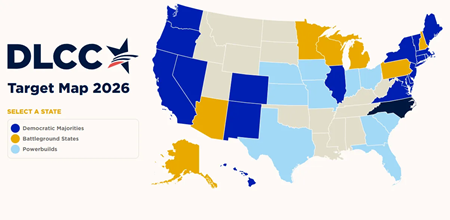
Democrats are reporting record-breaking candidate recruitment in state legislative races, signaling growing momentum ahead of the 2026 midterms. According to the DLCC, the party is fielding candidates at unprecedented levels across battleground and traditionally red states, including full slates in places like Texas, North Carolina, and Arizona, an early indicator of competitiveness and engagement.
The expanded target map spans dozens of chambers and hundreds of districts, reflecting a strategy to compete broadly rather than focus narrowly on traditional battlegrounds. Party officials argue that even modest gains across this map could shift control of key legislatures, influence redistricting, and shape policy outcomes in presidential swing states. By investing early and widely, Democrats are positioning state races as a central battleground with potential downstream impacts on the national political landscape. Read More.
WISCONSIN SUPREME COURT RACE HIGHLIGHTS STAKES IN KEY BATTLEGROUND
Wisconsin voters are deciding a state Supreme Court race that, while not expected to change the court’s liberal majority, could shape legal outcomes in one of the nation’s most competitive states. The court has played a central role in resolving disputes between the GOP legislature and Democratic governor, including past rulings on election procedures and abortion policy.
Though officially nonpartisan, the race reflects clear partisan divides, with endorsements from national figures and messaging focused on issues like abortion, democracy, and cost of living. With justices serving 10-year terms, the outcome could influence future rulings on redistricting and election law, giving the race outsized importance in a state likely to be central to the 2026 midterms and beyond. Read More.
EMERGING NARRATIVES
BIRTHRIGHT CITIZENSHIP CASE ELEVATES IMMIGRATION AS A CORE 2026 ISSUE
The Supreme Court appeared broadly skeptical of President Donald Trump’s effort to end birthright citizenship during oral arguments, with justices across the ideological spectrum questioning the legal basis of the policy. Trump’s executive order, which would deny citizenship to children born in the U.S. to undocumented immigrants and temporary visa holders, has been blocked by lower courts and faces significant constitutional hurdles under the 14th Amendment.
Even conservative justices raised concerns about overturning long-standing precedent, warning it could create legal uncertainty and unintended consequences for millions of people. The case is elevating immigration—and constitutional interpretation—back to the forefront of national politics, with the potential to energize both parties’ bases and shape messaging ahead of the 2026 midterms. Read More.
MAHA COALITION RESHAPES TRUMP-ERA COALITION POLITICS
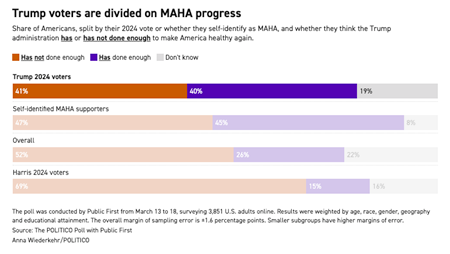
New polling suggests a growing alignment between Trump supporters and Robert F. Kennedy Jr.’s “Make America Healthy Again” movement, creating an unconventional coalition that cuts across traditional party lines. The overlap is driven by shared skepticism of government, public health institutions, and corporate influence. While still fluid, this coalition could complicate turnout and persuasion models in key states. If it holds, it may force both parties to recalibrate messaging around health, trust, and institutional credibility heading into 2026. Read More.
ON THE HORIZON
Upcoming Elections:
April 16:
NJ-11 Special General
April 21:
Virginia Redistricting Amendment
May 5:
Ohio Primary
Indiana Primary