AxIndex, Edition 4
SNAPSHOT
Our Top 3:
1) Supreme Court Tariff Ruling Reignites Trade and Cost Debates: The Supreme Court’s decision limiting presidential tariff authority reasserts congressional control over trade policy and introduces new uncertainty around future tariffs and supply chains. By elevating trade actions into a separation-of-powers and consumer cost debate, the ruling is likely to pull tariffs back into campaign messaging, reinforcing affordability narratives and sharpening contrasts over economic leadership.
2) Big Tech Policy Money Is Rewriting Campaign Agendas: Outside groups are pouring millions into advertising and political activity tied to artificial intelligence and cryptocurrency policy, elevating emerging tech regulation from a niche debate to a mainstream campaign issue. Competing narratives frame oversight as consumer protection versus a threat to innovation, and the influx of industry spending is pressuring candidates to define clear positions early.
3) Mid-Cycle Redistricting Fight Moves to the Courts: Legal fights over congressional maps are intensifying in nearly a dozen states, with challenges and potential redraws in places like Virginia, New York, and Utah creating uncertainty just months before ballots are finalized. At the center is Louisiana v. Callais, a Supreme Court case that could alter Voting Rights Act protections governing minority-majority districts, while state courts weigh changes that could shift individual seats. Together, these rulings could redraw the battlefield late in the cycle and play a decisive role in determining control of the House.
National Sentiment Tracking
NIMBY RISING: DATA CENTERS TRIGGER LOCAL CONCERNS DESPITE BROAD INDIFFERENCE
A new POLITICO/Public First poll finds most Americans remain unfamiliar with data centers and largely neutral about their expansion nationwide, but support softens when projects are proposed locally. While respondents associate facilities with economic growth and job creation, concerns rise around electricity demand, water use, and community impacts when development occurs nearby.
The findings suggest public opinion is still fluid: the data center boom tied to AI and cloud computing is not yet politically polarized, but rising energy costs and infrastructure strain could quickly shift sentiment. Read More.
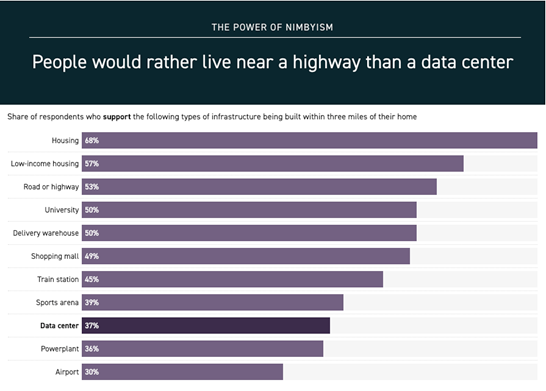
The poll surveyed 2,093 U.S. adults from Jan. 16 to 19, and has an overall margin of error of ±2 percentage points. Smaller subgroups have higher margins of error. Source: The POLITICO Poll with Public First Anna Wiederkehr/POLITICO
ONGOING AFFORDABILITY ANXIETY REMAINS THE DOMINANT CONCERNS FOR AMERICANS
A new YouGov–MarketWatch poll finds more than 80% of Americans say affordability has not improved, with nearly half saying it has worsened and only a small share reporting improvement. Rising costs for groceries, insurance, housing, and healthcare continue to strain household budgets, even as broader economic indicators stabilize.
Moreover, two-thirds of respondents say Washington is not taking affordability seriously, underscoring persistent frustration with political leaders and reinforcing cost-of-living pressures as the dominant voter concern heading into the election cycle. Read More.
HOUSE HIGHLIGHTS
DEMOCRATS BUILD EARLY FUNDRAISING EDGE
Democratic challengers are significantly outraising Republican challengers in the most competitive House districts, according to a Reuters analysis of campaign finance reports. In roughly 30 battleground races, Democratic candidates targeting GOP-held seats raised about $50 million combined, more than double the roughly $20 million raised by Republican challengers in Democratic-held districts.
The early financial advantage gives Democrats momentum as they seek to flip the few seats needed to reclaim the House majority, though incumbents from both parties continue to dominate overall fundraising, and outside spending remains a major wildcard.
Read More.
Polling At A Glance
Polling:
RCP Average Generic Ballot: 47.5 Dem - 42.7 GOP (D +4.8)
On this day in:
2022: 45.3 GOP - 42.0 Dem (R+3.3)
2018: 45.1 Dem - 37.1 GOP (D+8.0)
Retirements
Notable retirements from Congress are beginning to come out as the election year gets underway. The current total sits at 51 incumbent members (21 Democrats / 30 Republicans) of the House who have announced they are not seeking re-election.
For context, during the first Trump term, there were 52 retirements from the House.
Redistricting
MID-CYCLE REDISTRICTING FIGHT MOVES TO THE COURTS
Legal battles over congressional maps are accelerating across nearly a dozen states, with court rulings now poised to shape the House majority just months before the election. Lawsuits and redraw efforts in states including Missouri, Florida, Virginia, New York, Utah, and Wisconsin are creating uncertainty for campaigns and election officials as primary season approaches.
The most consequential case, Louisiana v. Callais, could reshape national maps by revisiting Voting Rights Act protections that influence majority-minority districts. While a decision is expected later this year, states are preparing for rapid redraws that could alter district lines on short notice.
Read More.
UTAH REDISTRICTING RULING KEEPS DEMOCRATIC OPPORTUNITY ALIVE
A federal court rejected Republican efforts to block Utah’s court-ordered congressional map, clearing the way for districts that could give Democrats a viable path to one of the state’s four House seats in 2026. The map consolidates Democratic-leaning Salt Lake County rather than splitting it across multiple districts, and the court declined to intervene so close to the election calendar. The decision underscores how court rulings, even in reliably Republican states, are actively reshaping competitiveness and could influence the fight for House control.
Read More.
SENATE HIGHLIGHTS
Retirements
So far, 9 Senators have announced their retirement from the chamber at the end of the current Congress.
TEXAS GOP SENATE PRIMARY INTENSIFIES AS EARLY VOTING BEGINS
Early voting is underway in Texas’s high-stakes Republican Senate primary, where incumbent Sen. John Cornyn faces strong challenges from Attorney General Ken Paxton and Rep. Wesley Hunt in what could be the toughest race of Cornyn’s career. Recent polling shows Paxton leading with roughly 38% support, followed by Cornyn and Hunt, with a runoff widely expected if no candidate secures a majority.
The contest has grown increasingly combative, with candidates attacking one another’s records and positioning themselves as the strongest conservative voice, while heavy advertising spending and national attention underscore the seat’s importance.
Why it matters: The primary highlights ideological divisions within the Texas GOP and could shape general-election competitiveness in a critical Senate race, making the outcome consequential for national party strategy and Senate control. Read More.
Polling At A Glance
Recent Polls
Change Research (NC General) Cooper (D) 50, Whatley (R) 40
Quantus Insights (GA GOP Primary) Collins 36, Carter 11, Dooley 9
IN THE STATES
MICHIGAN SPECIAL ELECTION DRAWS NATIONAL ATTENTION
Democrats are pouring resources into the May special election for Michigan’s 35th state Senate district, viewing the race as critical to maintaining control of the chamber and as an early test of voter sentiment ahead of the midterms. The Democratic Legislative Campaign Committee has labeled it a “spotlight” contest, underscoring its strategic importance.
The outcome could shape legislative power in Lansing for the remainder of the year while offering an early signal of turnout dynamics and party momentum heading into 2026.
Read More.
EMERGING NARRATIVES
SUPREME COURT TARIFF RULING RESHAPES TRADE AUTHORITY
The Supreme Court struck down the administration’s sweeping global tariffs, ruling the president exceeded emergency powers and reaffirming that Congress holds authority over tariff policy. The decision disrupts a central economic tool, raises questions about refunds on collected duties, and signals that future trade actions will face greater legal scrutiny even as the White House explores alternative tariff pathways.
Tariffs and their impact on consumer costs and supply chains remain politically salient, but future actions are likely to be more contentious and procedurally constrained.
Read More.
SPECIAL-INTEREST MONEY IS SHAPING THE TECH POLICY AGENDA
Outside spending tied to artificial intelligence and cryptocurrency policy is rapidly scaling ahead of the midterms, signaling a new phase of issue advocacy centered on emerging technologies. Millions of dollars in ads are seeking to shape public opinion on AI regulation, with competing campaigns framing oversight as either essential consumer protection or a threat to U.S. innovation and competitiveness.
At the same time, the cryptocurrency industry has amassed a massive political war chest, approaching $200 million, to support candidates aligned with its regulatory priorities and oppose critics, underscoring its growing influence in congressional races.
Technology policy is becoming a major battleground for outside spending, with well-funded industry groups working to shape both election outcomes and the regulatory environment. As AI governance and digital asset rules move toward the center of economic policy debates, special-interest investment is accelerating the nationalization of these issues and elevating them as defining campaign narratives in 2026.
ON THE HORIZON
Upcoming Elections:
March 3:
Arkansas, North Carolina, Texas
March 10:
Mississippi
March 17:
Illinois
March 31:
Arkansas Runoff
April 16:
NJ-11 Special General