AxIndex, Edition 2

Our Top 3:

1) Backlash Over Federal Immigration Enforcement Intensifies: National outrage has surged after two fatal shootings by federal immigration agents in Minneapolis, complicating the Trump administration’s immigration strategy and turning ICE enforcement into a central campaign issue.


2) More Redistricting Moves Continue to Pop: Republicans’ appeal of a court ruling throwing out New York City’s only GOP-held House district comes as Democrats simultaneously push mid-decade redistricting efforts in Maryland and pursue a ballot move in Virginia to reclaim map-drawing power.


3) High Profile Names Shake Up Senate Races: The 2026 map is drawing marquee names as Julia Letlow, Michele Tafoya, and Alexander Vindman launch Senate bids in their respective states, signaling both parties’ intent to nationalize key races early and reshaping the battleground well ahead of November.


National Sentiment Tracking


Even Before MN Shooting, Voters Overwhelmingly Disapprove of ICE
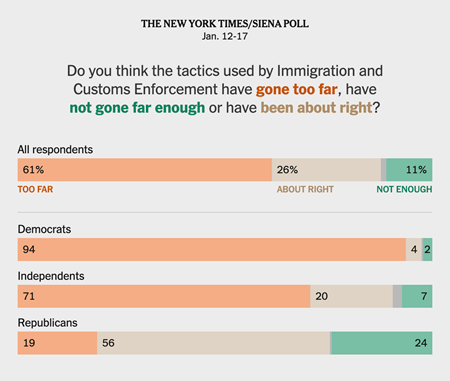
A new New York Times / Siena University poll shows deep public unease with how the Trump administration is handling immigration enforcement: while about half of voters approve of President Trump’s deportation policies and his handling of the U.S.–Mexico border, a substantial majority disapprove of Immigration and Customs Enforcement’s job performance and say ICE’s tactics have “gone too far,” with 63% disapproving of the agency’s work and 61% saying its approach is excessive, including many independents and some Republicans, reflecting widespread concern over interior raids and recent fatal encounters with federal agents.

House Highlights


Polling At A Glance

Polling
RCP Average Generic Ballot: 45.7 Dem - 41.2 GOP (D +4.5)
On this day in:
2022: 47.1 GOP - 43.0 Dem (R+4.1)
2018: 46.7 Dem - 38.8 GOP (D+7.9)

Cook Ratings
CA-13 Toss Up to Lean D
CA-25 Likely D to Solid D
CA-47 Likely D to Solid D
CO-05 Solid R to Likely R
CT-05 Likely D to Solid D
FL-07 Solid R to Likely R
IA-03 Lean R to Toss Up
IL-17 Likely D to Solid D
MI-03 Likely D to Solid D
NM-02 Toss Up to Lean D 
NY-04 Toss Up to Lean D
NY-17 Lean R to Toss Up
NY-18 Likely D to Solid D
NY-22 Likely D to Solid D
OH-09 Lean R to Toss Up
PA-17 Likely D to Solid D
TN-05 Solid R to Likely R
TX-34 Lean R to Toss Up


Retirements


Notable retirements from Congress are beginning to come out as the election year gets underway. The current total sits at 49 incumbent members (21 Democrats / 28 Republicans) of the House who have announced they are not seeking re-election. 


For context, during the first Trump term, there were 52 retirements from the House. 


Florida Republican Vern Buchanan to retire from Congress

Vern Buchanan’s decision not to seek reelection adds to a growing list of Florida Republican departures. Buchanan, the No. 2 Republican on the House Ways and Means Committee, is leaving behind a district that backed Trump by more than 15 points in 2024, making the GOP primary the decisive contest and the eventual Republican nominee the clear favorite in November. Read More.


Redistricting


GOP Appeals Ruling Tossing NYC’s Only Republican House Seat

Republicans have appealed to New York’s highest court after a judge invalidated the boundaries of the state’s only Republican-held congressional district, Rep. Nicole Malliotakis’ Staten Island–Brooklyn seat, finding that the current map dilutes Black and Hispanic voters’ power and ordering the state’s independent redistricting panel to redraw lines by Feb. 6; the legal battle highlights broader national fights over gerrymandering and control of the U.S. House as both parties jockey for advantage ahead of the 2026 elections. Read More.


Redistricting heats up in Maryland and Virginia

In Maryland, Democratic Gov. Wes Moore’s Redistricting Advisory Commission has advanced a proposed mid-decade redraw of the state’s congressional map, including changes aimed at reshaping the 1st District to be more favorable for Democrats, as state leaders consider how hard to push back against Republican map gains elsewhere. In Virginia, Democratic lawmakers have moved a constitutional amendment to the April 2026 ballot that would let the legislature redraw U.S. House districts mid-decade, a bid to counter recent GOP-friendly maps and potentially net more Democratic seats. Both states’ efforts reflect strategic moves in the broader fight over control of the U.S. House ahead of the 2026 midterms. Read More.


Senate Highlights


Retirements

So far, 9 Senators have announced their retirement from the chamber at the end of the current Congress. 


Julia Letlow Enters Louisiana Senate Race

Rep. Julia Letlow has entered the Louisiana Republican primary for U.S. Senate, challenging incumbent Sen. Bill Cassidy after receiving a Trump endorsement encouraging her to run. Letlow, who represents Louisiana’s 5th Congressional District, framed her candidacy as a call for a more consistent conservative voice and leaned heavily into Trump’s backing as she launched her campaign.


Cassidy, a two-term senator, remains supported by Senate GOP leadership but continues to face backlash from the party’s right flank over his vote to convict Trump during the second impeachment trial. With Louisiana solidly Republican, the May GOP primary is expected to be the decisive contest, and Letlow’s entry makes the race one of the most closely watched intraparty battles of the 2026 cycle. Read More. 


Former NFL Sideline Star Enters Minnesota Senate Race

Former NFL sideline reporter Michele Tafoya has entered the Republican primary for Minnesota’s open U.S. Senate seat, giving national GOP leaders a high-profile recruit in a state Democrats have long dominated but where Republicans see a rare pickup opportunity; her candidacy — backed by key GOP figures — intensifies a crowded primary and signals the party’s intent to seriously contest a race that could be critical to the fight for Senate control in 2026. Read More.


Former impeachment witness Alex Vindman Joins FL Senate Dem Primary

Retired Army Lt. Col. Alexander Vindman, best known for testifying against President Trump during the 2019 Ukraine impeachment, has announced his Democratic bid for the U.S. Senate in Florida’s 2026 special election, setting up a high-profile challenge to Republican Sen. Ashley Moody as Democrats eye a foothold in a state that has trended GOP in recent cycles. Read More.


Polling at a glance

Recent Polls
UNH (NH General): Pappas (D) 50, Sununu (R) 45
UNH (NH General): Pappas (D) 52, Brown (R) 42
UNH (NH GOP Primary): Sununu 48, Brown 25
UNH (NH Dem Primary): Pappas 65, Manzur 11, Sullivan 2
Remington (AL GOP Primary): Marshall 26, Moore 13, Hudson 10, Walker 2, Murphy 1
Carolina Forward/Change Res. (NC General): Cooper 47, Whatley 42
TIPP (NC General): Cooper 48, Whatley 24


In the States


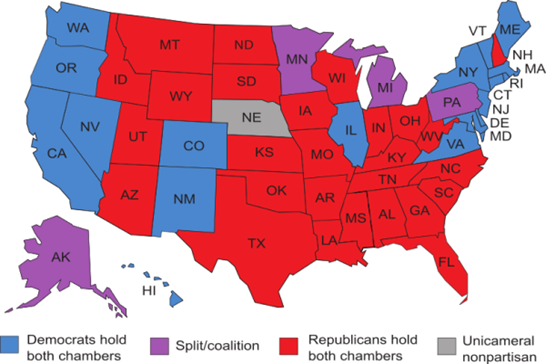
More State Legislative Chambers Seen as Competitive in 2026 Midterms

A new Sabato’s Crystal Ball analysis finds 15 state legislative chambers across the country are competitive heading into the 2026 midterms, more than at a similar point in the 2022 or 2024 cycles, with Republicans defending more chambers than Democrats and nine rated as toss-ups, highlighting an unusually dynamic battlefield at the state level where control of legislatures could shift and even break GOP supermajorities in key states this fall. Read More.

Emerging Narratives


Enforcement Reshapes the 2026 Immigration Narrative


The Minneapolis shooting involving federal immigration agents has prompted a noticeable recalibration in the immigration debate, with the White House dispatching senior adviser Tom Homan and signaling a more measured approach to enforcement messaging amid heightened public scrutiny, while the administration continues to defend its broader border strategy. Recent events have shifted attention toward how immigration policies are carried out, giving Democrats an opportunity to emphasize oversight and restraint, while Republicans work to refine how they talk about enforcement as the 2026 campaign environment takes shape around public confidence and trust. Read more.


On the Horizon


Upcoming Elections:

TX-18 Runoff: January 31 (Early Voting begins January 21)

NJ-11 Primary: February 5

NJ-11 General: April 16

2026 Midterms: November 3
July 15, 2026
SNAPSHOT
By Bob Salera July 9, 2026
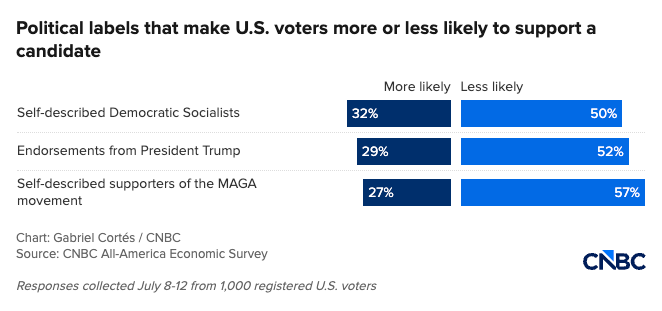
The DSA Surge: What Socialist Primary Wins Mean for Business and the Policy Landscape In the span of two election cycles, the Democratic Socialists of America have gone from insurgent outsiders to a genuine force inside the Democratic Party. A new analysis of DSA's national endorsement record shows 25 primary wins across 15 states so far in the 2025-2026 cycle, a 62 percent success rate stretching from New York city councils to congressional primaries in Pennsylvania and Colorado. The trend is accelerating, and its implications run well beyond the halls of Congress. A Narrow Majority and a Familiar Problem The most immediate political concern is what happens on Capitol Hill if Democrats win the House with a thin margin. Hakeem Jeffries would face the same arithmetic Kevin McCarthy encountered with the House Freedom Caucus: a small group of ideologically committed members can hold a majority hostage. McCarthy was driven from the speakership in October 2023 by fewer than ten members. A larger DSA-aligned caucus, operating from the opposite end of the spectrum with fresh electoral mandates and no institutional loyalty to leadership, could prove equally disruptive. The Squad has already shown a willingness to break with Democratic leadership on appropriations, foreign policy, and procedural votes. More members with the same ideological profile and stronger grassroots backing would only amplify that dynamic. The Bigger Story Is Not Congress Congress gets the attention, but state legislatures and local governments set the conditions in which businesses actually operate. DSA candidates have won primaries in Georgia's state house, Minnesota's city councils, and city councils from New Jersey to Wisconsin to Arizona. These offices are pipelines. Today's Ithaca city councilmember is tomorrow's state legislator. The ideology rarely moderates as candidates advance. DSA's tracker shows an overall candidate win rate just above 50 percent since 2016, but the trend line matters: their 2025 cycle rate hit 62 percent, among the highest in their history. They are getting better at targeting winnable races, recruiting credible candidates, and turning out their base in low-turnout primaries where a motivated minority can determine outcomes. What It Means for Business in Blue States DSA's platform is not a vague progressive wish list. It calls for high progressive taxation, aggressive labor mandates, rent control, restructuring or defunding police, and opposition to most market-rate development. In jurisdictions where DSA-backed officials hold real power, those positions have translated into tangible policy. Minneapolis, where DSA holds several city council seats, has moved aggressively on landlord restrictions and business tax increases. San Francisco, where DSA-backed supervisor Dean Preston held power for years, saw some of the most restrictive commercial policies of any major American city before his 2024 defeat. Chicago's DSA aldermanic bloc has been a consistent source of opposition to development and public safety investment. These are not abstract ideological disputes. They represent direct compliance costs, operational risk, and a fundamentally less hospitable environment for investment. The National Drag, the State-Level Threat Nationally, a Democratic Party increasingly defined by its socialist wing faces real structural vulnerabilities. The 2024 results underscored how badly economic anxiety and perceptions of ideological overreach damage Democrats with working-class voters. An overtly socialist brand does not win back those voters. In competitive states and districts, it is a liability. But DSA does not need to win nationally to reshape policy. In blue states, a narrow legislative majority is enough to pass sweeping changes to tax policy, labor law, zoning, and regulatory structure. The voters most affected by those policies often have no political recourse. They cannot flip the state, and moving is not always an option. The Bottom Line DSA's electoral growth is not a narrative. It is a documented trend with a consistent track record across eight years and nearly 300 tracked candidates. For business and advocacy organizations, the lesson is that down-ballot primaries are where the policy environment is actually determined. A city council race in Milwaukee or a state house primary in Georgia does not generate national headlines, but it shapes the regulatory and tax climate that affects daily operations. Monitoring these races, engaging early, and understanding who holds office at every level of government matters more now than at any point in recent memory. The decisions being made in city council chambers today are the legislation being voted on in state capitals in five years.
By Ashlee Stephenson July 7, 2026
President Ashlee Rich Stephenson joined Steve Scully on SiriusXM POTUS to discuss the U.S. Senate landscape. Ashlee stated, "If I'm a Democratic operative, I'm hoping Haley Stevens pulls this out. Nominating a Democratic Socialist of America-backed candidate to run statewide in a true battleground would present real challenges for Democrats. If we start seeing Democratic Socialist of America candidates winning Senate nominations in states like Michigan, it signals a broader shift with implications that extend to the Electoral College, the presidency, and the future of free enterprise." And prior to the breaking news on Platner re-evaluating his campaign, they also covered Maine's Senate race, where Ashlee argued that Sen. Susan Collins remains in a strong position. Collins' long-standing reputation and the value Mainers place on character make the race far more challenging for Democrats than many expected, turning what was once viewed as a top pickup opportunity into a much more difficult path. Watch the full analysis of the 2026 U.S. Senate landscape here:
By Kelly McElhaney July 1, 2026
State of Play: Five Things We Are Tracking As Congress limps into the July 4th recess, it appears that the legislative agenda will remain in gridlock. The ongoing disagreements will ultimately define the remainder of the summer and fall calendar. SAVE America Act rebellion is freezing the House floor. A group of House conservatives have twice blocked procedural rules this week, demanding that leadership force action on the SAVE America Act. The faction has stalled many must-pass items and sent members home early for the second week in a row. Speaker Johnson needs near-unanimous GOP support to move anything with such a razor-thin majority. FY27 NDAA a victim of House Gridlock. The House Armed Services Committee has released a $1.15 trillion topline NDAA, with Chairman Rogers framing it around industrial base revitalization and getting to the administration's defense spending target. As of this week, the bill is caught in the SAVE America Act crossfire, with Rep. Anna Paulina Luna's push to attach the voter ID measure via amendment threatening to sink it in the Senate, where it needs Democratic votes to clear a filibuster. FY27 appropriations are inching forward. The House has passed two FY27 spending bills (MilCon-VA and Agriculture-FDA) and was set to take up the State Foreign Operations bill this week before the SAVE Act revolt punted it again. With the Senate in recess for two weeks, and the end of the fiscal year fast approaching, the path to a full-year deal versus another continuing resolution remains in question. Surface transportation reauthorization is racing against a September 30 deadline. With the IIJA's five-year authorization set to expire on September 30, the House T&I Committee advanced the bipartisan $580 billion BUILD America 250 Act (H.R. 8870) out of committee with a bipartisan 62-2 vote in May championed by Chairman Graves and Ranking Member Larsen. Floor time has not yet been announced, but committee leadership is hopeful it will be secured before the August recess. The Senate hasn't released its proposal yet, but early signals suggest strong continuity with the House version, with a streamlined return to the legislation’s original core functions. The urgency to move is driven by a very real funding problem: the Highway Trust Fund is projected to run dry by 2028, the House bill addresses this with a new EV and hybrid fees. Senate Appropriations markups keep getting delayed. Movement is expected once the Senate returns from its two-week recess. Senate Appropriations has postponed its full-committee markups of Agriculture-FDA, Commerce-Justice-Science, Legislative Branch, and MilCon-VA for the fourth time. Defense Subcommittee Chairman Mitch McConnell's hospitalization left Republicans short a vote. He is anticipated to return later this month.
July 1, 2026
SNAPSHOT
By Mischa Martin June 26, 2026
More Than a Phone Call: The Real Work of Effective Advocacy Government relations is not just about knowing who to call. It is about identifying the right person, knowing why to call them, and how to frame the conversation when you do. Recently, a client who is a healthcare provider reached out for support. They had supported a licensing change that moved them into a new category, a shift that made sense as a way to better align oversight with the services being delivered. What nobody anticipated was that the change triggered simultaneous obligations under two separate, similar state statutes. Two divisions within the same agency were now required to conduct independent maltreatment investigations of the same event on sequential timelines, leaving staff on administrative leave for months and operations significantly disrupted — with most allegations ultimately unfounded. The provider had attempted to resolve the issues but was frustrated. They needed a strategy. Step One: Understand the Law A side-by-side analysis of both statutes mapped jurisdiction, investigation requirements, and timelines. It identified the precise point of overlap and, just as importantly, room within existing law to coordinate that had not yet been explored. Without that foundation, there is no credible position, no realistic solution, and no productive conversation with anyone who has authority to act. Step Two: Know Your Audience The framing had to acknowledge what both statutes were designed to protect while making clear the current process was producing a significant burden without additional protective value. Understanding the agency's own position and constraints was essential to developing a message they could act on rather than defend against. Step Three: Engage the Agency First The first call was not to a legislator. It was to the agency. Going to them first signals good faith and allows them to be part of the solution. A legislative fix takes a session. An administrative accommodation can be processed within weeks. The agency reviewed the analysis, agreed that the duplication did not serve the intent of either statute, and agreed to streamline the process within existing authority. Step Four: Build Toward a Long-Term Solution The streamlining was a meaningful win and not the finish line. The statutory ambiguity remains, and both sides recognized that a legislative fix is likely necessary to fully resolve the issue. The short-term work built the trust to get there together. Effective advocacy is not a single conversation. Done well, it does not just solve the problem at hand. It builds the foundation to resolve greater future issues. And the agencies and legislators who are part of that process are far more likely to become partners in solving the next problem too.