AxIndex, Edition 1
Our Top 3:
1) Redistricting Chaos Creeps Into 2026 Planning: Ongoing redistricting battles in Wisconsin and Florida are creating uncertainty for House candidates as filing deadlines approach.
2) Economic Anxiety Ends 2025 On A Low Note: While inflation headlines have softened, voter frustration with the state of the economy sat at -33 at the end of the year, its lowest since July 2024.
3) Notable Retirements Are Beginning To Pop: A growing number of senior lawmakers in Washington have begun announcing plans to step aside, signaling early turnover ahead of 2026. At the state level, Tim Walz announced he will not seek reelection, a decision that follows a period of heightened scrutiny and controversy in Minnesota and sets off an open-seat race in a closely watched state with an open Senate seat for the Democrats to defend.
National Sentiment Tracking
Voters Still Concerned About Costs Over Everything Else
Compared with polling from last year, inflation and prices remain the top voter concern, though the share citing it as the single most important issue has softened modestly as inflation cools. Even with that dip, cost-related issues continue to crowd out all others: inflation (26%), healthcare (12%), and jobs and the economy (11%) together account for nearly half of voter concern. Immigration (10%) and civil rights (9%) remain on the list but are secondary, suggesting that voters are still filtering political debates through an affordability lens rather than ideological ones. Read More.
What This Means
For candidates and outside groups heading into 2026, economic framing is unavoidable. Even when talking about healthcare, immigration, or regulation, voters are looking for answers to how policies affect household costs, wages, and financial stability.
Voter Groups Shift In Support For Trump
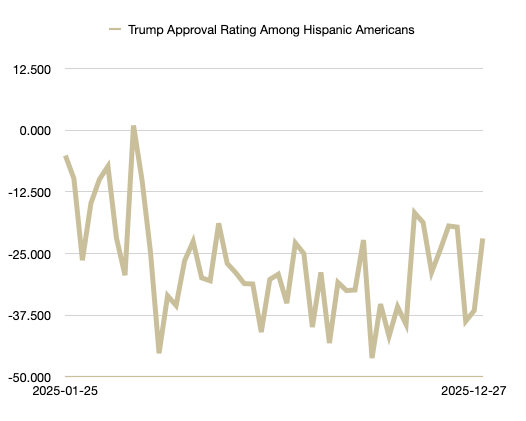
A new Economist/YouGov poll covering January 2–5, 2026, finds mixed movement in President Donald Trump’s job approval: his standing improved among men and Hispanic voters compared with the prior week, while approval among Republicans and women declined. Despite those shifts within subgroups, Trump’s overall approval remains down nationally, reflecting broader voter dissatisfaction.
Then & now context matters. Today, Trump’s RealClearPolitics average sits at 43.8% approve / 52.6% disapprove (-8.8). On the same point in 2018, his approval was lower, and opposition was far deeper: 39.4% approve / 56.0% disapprove (-16.6). While approval is still down, the narrower gap today points to a sturdier base of support than during his first term.
Key takeaways:
- Men & Hispanic voters: Trump’s approval ticked up in the latest numbers.
- Republicans & women: Both groups showed declining support for his performance compared with recent polling.
Overall national picture: This nuanced movement highlights how demographic coalitions are shifting subtly and could influence messaging strategies for both parties in 2026.
Record Share of Americans Now Identify as Independents
A new Gallup poll finds that 45% of U.S. adults now identify as political independents, the highest level on record and above previous peaks of 43% in 2014, 2023, and 2024. Meanwhile, identification with the two major parties is evenly split, 27% Democrat and 27% Republican, meaning the independent bloc now dwarfs both party cores. Younger generations, especially Gen Z, are driving much of this growth in independent identity.
House Highlights
GOP Rep. Doug LaMalfa Dies at 65
Representative Douglas LaMalfa, who diligently served California's 1st District for 13 years, passed away last week. LaMalfa, a fourth-generation rice farmer, was a champion for agriculture and wildfire prevention during his time in Congress.
With his passing, the Republicans' majority in the House shrank even further. The current split stands at 218-213. California will need to call a special election to replace LaMalfa, which could come as late as June. Read More.
Polling At A Glance
Polling
RCP Average Generic Ballot: Dem 46.2 – GOP 42.2 (D+4.0)
On this day in:
2022: GOP 42.8 – Dem 41.8 (R+1.0)
2018: Dem 48.3 – GOP 37.1 (D+11.2)
Cook Ratings
Changes:
WA-08: Likely D to Solid D
Retirements
Notable retirements from Congress are beginning to come out as the election year gets underway. The current total sits at 47 incumbent members (21 Democrats / 26 Republicans) of the House who have announced they are not seeking re-election.
For context, during the first Trump term, there were 52 retirements from the House.
Rep. Neal Dunn Announces Retirement
Rep. Neal Dunn announced he will not seek re-election to the U.S. House in 2026. Dunn served five terms representing Florida’s 2nd Congressional District. This decision creates an open seat in Florida’s 2nd District, which is rated an R+8. Read More.
Rep. Steny Hoyer (D-MD) Announces Retirement
Rep. Hoyer, the longest-serving Democrat currently in the U.S. House, confirmed he will retire at the end of his term. He has represented Maryland's 5th District in the House since 1981 and served for decades in Democratic leadership roles. Read More.
Redistricting
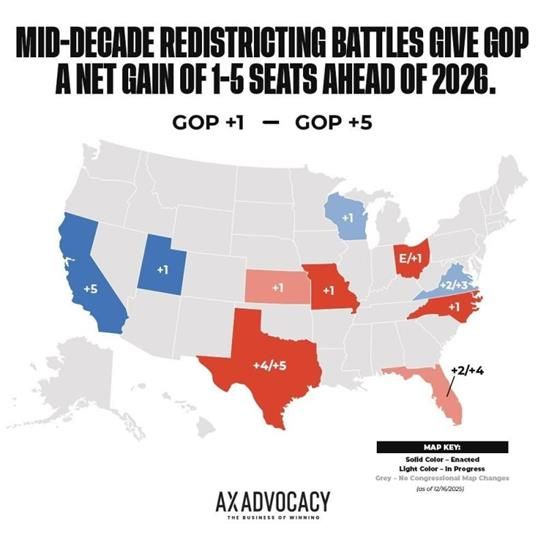
AxAdvocacy has been tracking all the latest shifts in redistricting. Above is the latest redistricting update based on recent events and projections for the new year, not taking into consideration potential dynamic shifts, such as the outcome in the Voting Rights Act cases.
Florida to hold special redistricting session ahead of 2026 midterms
Florida Gov. Ron DeSantis has announced a special legislative session in late April 2026 for the state legislature to redraw the state’s congressional districts, a rare mid-decade redistricting effort aimed at reflecting population changes and potentially benefiting Republicans ahead of the November elections. Republicans could gain up to five seats under a new map. Read More.
Wisconsin redistricting fight may stretch past 2026 midterms
Two lawsuits challenging Wisconsin’s current congressional maps, which now favor Republican candidates, are moving through the courts, but recent hearings suggest they likely won't be resolved in time to change the districts for the November 2026 elections. One case’s attorneys argue new maps could be in place before next year’s vote, but judges signaled that a more extended timeline, potentially into 2027, is more realistic. That means current boundaries will probably remain for the upcoming midterms unless the court accelerates its schedule. Read More.
Senate Highlights
Retirements
So far, 9 Senators have announced their retirement from the chamber at the end of the current Congress.
Mary Peltola Enters Alaska Senate Race, Boosting Democratic Hopes
Former U.S. Rep. Mary Peltola officially announced her campaign for the 2026 U.S. Senate seat in Alaska, challenging two-term Republican incumbent Dan Sullivan. Peltola, the first Alaska Native elected to Congress, is pitching a populist platform centered on lowering costs and putting Alaska’s interests first. Her entry provides Democrats with one of their strongest recruits in a deeply Republican state, where Trump won by double digits in 2024, and elevates Alaska from a long shot to a plausibly competitive Senate contest in the fight for control of the chamber. Campaigns will first meet in a top-four ranked-choice primary in August, with the general election in November. Read More.
Walz Exit Could leave two open seats in MN
Gov. Tim Walz’s decision not to seek reelection is rippling across Minnesota politics, compounding instability in a state already facing an open U.S. Senate seat after Tina Smith announced her retirement. The shake-up has intensified speculation that Amy Klobuchar could enter the governor’s race, a move that would further scramble the Democratic field and force a rapid recalibration in both statewide contests. While Minnesota remains blue-leaning, overlapping open races, crowded primaries, and late-breaking candidate decisions are raising the risk of a more chaotic and competitive cycle than either party initially anticipated. Read More.
Polling at a glance
Recent Polls
Emerson: IL Dem Primary: Krishnamoorthi 31, Stratton 10, Kelly 8, Ryan 2, Maxwell 1, Botsford 1, Dean 1
Emerson: IL GOP Primary: Tracy 6, Tillman 3, Evans 3, Long 2, Capparelli 2, Chlebek 1
Cook Ratings
Changes:
AK (Sullivan) Solid R to Lean R
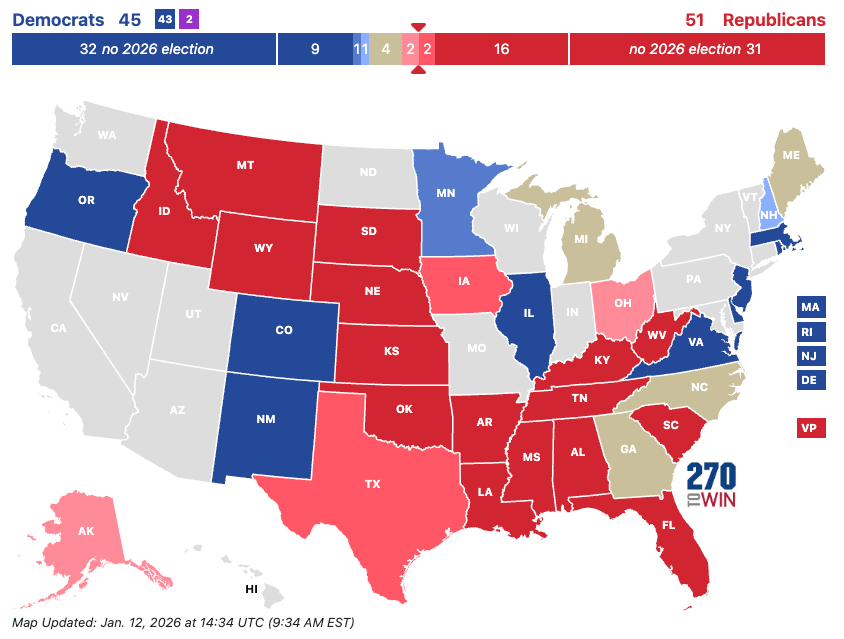
Cook Political Ratings
Emerging Narratives
Signaling from the President
President Trump has signaled openly that Republicans face a tough path in the 2026 midterm elections, warning GOP lawmakers that failing to retain control of Congress could even lead to another impeachment push by Democrats.
Trump’s comments come as internal aides urge him to pivot more toward kitchen-table issues like the economy and healthcare that matter to general election voters. Recent polling shows Trump’s approval on the economy hovering near one-third of Americans, reflecting widespread voter dissatisfaction with economic leadership and reinforcing concerns about Republican prospects in November. Read More.
On the Horizon
Upcoming Elections:
TX-18 Runoff: January 31 (Early Voting begins January 21)
NJ-11 Primary: February 5
NJ-11 General: April 16
2026 Midterms: November 3