AxIndex, Edition 11


SNAPSHOT


Our Top 3:


1) Affordability Is the Defining Issue and Neither Party Has Closed the Deal:

Fifty-three percent of Americans say the cost of living is the worst they can remember, and nearly half blame Trump. But Democrats haven't consolidated around a message, as incumbents from Iowa's Miller-Meeks district to California's Central Valley face challengers running almost entirely on healthcare and cost of living. Republican strategists believe an Iran war resolution could reset the economic narrative, but with gas prices projected to stay elevated for months, Oklahoma's minimum wage ballot fight is a reminder that voters across the spectrum are looking for answers neither party is fully delivering.


2) Redistricting Is the Biggest Structural Variable of the Cycle:
Republicans have enacted new maps in seven states so far and project gains of up to 14 seats, while Democrats eye offsetting pickups in California and blue states. Legal battles in Alabama, Florida, and Louisiana will determine whether the maps hold, and both parties are already war-gaming 2028. The clearest proof of redistricting's power came in Texas, where two Democratic incumbents were forced into the same seat, ending Al Green's two-decade career. Louisiana's erasure of Cleo Fields' district and Georgia's pending special session show the effort is still accelerating, even as courts push back.


3) The Infrastructure of Political Information Is Under Pressure:

Democrats' path to a Senate majority runs through states that are proving messier than expected. In Maine, Graham Platner holds a consistent polling lead over Susan Collins but recent personal controversy has begun moving prediction markets. In Alaska, a second Dan Sullivan in the race risks siphoning votes from the incumbent in what was already a tighter-than-expected contest. In Texas, Ken Paxton's primary win over John Cornyn, fueled by a last-minute Trump endorsement and a deep grassroots base, shifted Cook's rating to lean Republican, but Paxton enters the general with a proven three-statewide-win record and Trump's full backing in a state that hasn't elected a Democrat to the Senate in decades. The map is fluid, but still Republicans have more advantages to fall back on.


National Sentiment Tracking


The Iran War Is Becoming an Economic Albatross

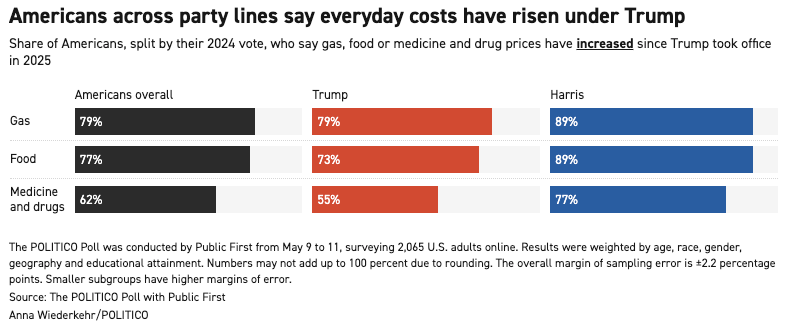
Six months into Trump's second term, the affordability problem that defined Biden's political collapse is now defining Trump's. A new POLITICO/Public First poll finds 53 percent of Americans say the cost of living is the worst they can remember, virtually unchanged from November, and nearly half still place primary economic blame on Trump rather than Biden. A plurality say their finances have worsened since he took office, including 18 percent of his own 2024 voters.

The Iran war is the compounding variable. More than 60 percent of Americans, including majorities of both Trump and Harris voters, say the conflict has made things more expensive, and Trump's own supporters are evenly split on whether he has done enough to protect them from the fallout. Republican strategists are increasingly candid that a resolution is the clearest path to an improved economic picture before November, but gas prices are projected to stay elevated for months, and the White House's "short-term disruptions" message is landing poorly with voters already feeling the pinch.
Read More.

HOUSE HIGHLIGHTS

Polling At A Glance

House
RCP Average Generic Ballot: 47.9 Dem - 40.3 GOP (D +7.6)
On this day in:
2022: 45.7 GOP - 43.8 Dem (R+1.9)
2018: 43.0 Dem - 39.8 GOP (D+3.2)


Cook Ratings
Recent Changes:
LA-06: Solid D -> Solid R


Retirements

For context, during the first Trump term, there were 52 retirements from the House. 

Incumbent Democrats Face a Wave of Primary Challenges

Four House incumbents have already lost re-election bids this year, and roughly a dozen more face serious threats ahead, with the heaviest action on the Democratic side. The challenges fall into two categories: generational and ideological. In California, well-funded younger Democrats are taking on entrenched incumbents like Reps. Mike Thompson and Brad Sherman. In Connecticut, former Hartford Mayor Luke Bronin has outraised Rep. John Larson and won the state party endorsement. Justice Democrats, meanwhile, has endorsed a slate of progressive challengers targeting incumbents in Colorado, New York, Michigan, and Missouri, where former Rep. Cori Bush is mounting a comeback against Rep. Wesley Bell.


The most combustible primary may be in California, where Republican Reps. Ken Calvert and Young Kim are locked in a brutal incumbent-on-incumbent race triggered by Democratic redistricting, a contest that has devolved into attacks over Trump loyalty and a decades-old scandal. Republicans, as one strategist put it, will lose a great member either way.
Read More.

California's 13th Is a Bellwether Worth Watching Again

California's redrawn 13th Congressional District is shaping up as one of the cycle's most closely watched House races. The seat has been decided by fewer than 600 votes in each of the last two elections, with Republican John Duarte and Democrat Adam Gray trading it back and forth in 2022 and 2024. Gray now holds it under new lines approved by voters through Proposition 50, which shifted the district to include more of Stockton and is rated more favorable to Democrats by Cook Political Report.

Gray's main threat is likely Republican Kevin Lincoln II, Stockton's former mayor, who has secured endorsements from both Trump and House Speaker Mike Johnson. With the new map tilting slightly bluer but Lincoln's profile competitive, the 13th could once again be the last House race called this cycle.
Read More.

Iowa's 1st: A Toss-Up for the Third Time Running

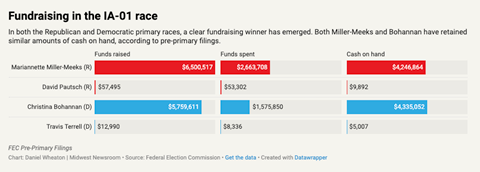
Iowa's 1st Congressional District, rated a toss-up by Cook Political Report and Sabato's Crystal Ball, is gearing up for what could be a third straight matchup between Republican Rep. Mariannette Miller-Meeks and Democrat Christina Bohannan. 


Miller-Meeks won their 2024 rematch by just 799 votes after a recount. Both face primary challengers Tuesday, though neither is considered seriously threatened. Miller-Meeks is up against self-proclaimed MAGA Republican David Pautsch, who lost to her by 12 points in 2024. Bohannan faces healthcare worker Travis Terrell in the Democratic primary.


Both frontrunners are running heavily on healthcare, Bohannan attacking Miller-Meeks' vote for the One Big Beautiful Bill Act and its Medicaid cuts, and Miller-Meeks defending the vote as targeting waste and fraud. Trump won the district by 8 points in 2024, and Republicans currently outnumber registered Democrats by more than 26,000 in the district, a headwind Bohannan will need to overcome again in November. Read More.

Redistricting Ends Al Green's Two-Decade Career

Freshman Rep. Christian Menefee defeated veteran Rep. Al Green in a Democratic primary runoff on May 27, ending the 78-year-old's two-decade congressional career. The race was a direct product of Texas Republicans' mid-decade redistricting, which merged their previously neighboring Houston-area districts and forced the incumbents into the same seat. Green's defeat carried an additional dimension: pro-cryptocurrency super PAC Fairshake spent millions to unseat him over his opposition to the industry and claimed credit for the outcome.


Menefee framed his win in explicitly anti-redistricting terms, telling supporters Republicans "drew maps designed to dilute our power." Green signaled he isn't finished, telling supporters "this is not the end." Read More.

Redistricting

Louisiana Eliminates a Second Democratic Seat

Louisiana Republicans passed a new congressional map Friday erasing Rep. Cleo Fields' district, which stretched from Shreveport to Baton Rouge, while redrawing Rep. Troy Carter's New Orleans-based seat to largely mirror his 2022 district. The move was made possible by the Supreme Court's recent decision narrowing the Voting Rights Act. Gov. Jeff Landry, who invoked emergency authority to cancel May primaries and push House races to November 3, is expected to sign the map.

The process drew pushback even from Republicans, with Rep. Clay Higgins calling it a "Frankenstein-looking thing" drawn in secret. Legal challenges are likely, including from plaintiffs in Louisiana v. Callais. The outcome is part of a redistricting wave now spanning 10 states, several of which remain tied up in court.
Read More.

Redistricting Wave Hits Turbulence in Alabama and South Carolina

Trump's mid-decade redistricting push suffered a pair of setbacks Tuesday. In South Carolina, the state Senate rejected a Republican plan to cancel ongoing congressional primaries and redraw districts to eliminate Rep. Jim Clyburn's seat, with some GOP senators citing conscience and timing as early voting was already underway. In Alabama, a federal three-judge panel blocked a Republican-drawn map, ruling it "intentionally discriminated based on race," and ordered the continued use of a court-imposed map with two majority-Black districts. Alabama's AG vowed an immediate appeal to the Supreme Court.


Republicans did notch wins elsewhere. A Florida state judge declined to block new GOP-drawn maps that could yield as many as four additional Republican seats, and a federal court refused to temporarily halt Tennessee's redrawn districts. The broader scoreboard remains tilted toward Republicans, who project gains of up to 14 seats from redistricting efforts, while Democrats eye five potential pickups from California's new voter-approved map and one from a court-imposed Utah map. Legal battles in Alabama, Florida, Tennessee, and Louisiana ensure the final tally won't be settled before November. Read More.

The Next Gerrymandering Wave Is Already Taking Shape

With midterm maps barely settled, both parties are already positioning for another round of redistricting ahead of 2028. Republicans have adopted new maps in seven states so far this cycle, but left Democratic seats intact in several of them, including Louisiana, Missouri, and potentially Texas, flagging those as targets for elimination in the next round. Georgia Gov. Brian Kemp has already called a June special session to redraw the state's map following the Supreme Court's decision barring race-based districts, and Indiana, Kansas, and South Carolina are also on the GOP's 2028 target list.


Democrats are vowing a coordinated response. House Minority Leader Hakeem Jeffries identified seven blue states, New York, New Jersey, Washington, Oregon, Colorado, Illinois, and Maryland, where the party is already eyeing new maps. It's important to note that most Democratic-controlled states require voter referendums before new lines can take effect, a higher bar than the unilateral legislative action available to Republicans in states like Texas. Still, election analysts assess that Democrats may have more untapped map opportunities heading into 2028 than Republicans do. Back to the drawing board. Read More.

SENATE HIGHLIGHTS

Polling At A Glance

Recent Polls

Trafalgar Group (SC GOP Primary): Graham 52, Lynch 28, Mitchell 4, Dismukes 3, Herrmann 3, Cowen 2
UNH (ME General): Platner (D) 51, Collins (R-i) 42
TIPP (MI Dem Primary): Stevens 35, El-Sayed 31, McMorrow 13
TIPP(MI General): El-Sayed (D) 43, Rogers (R) 42
TIPP(MI General): Stevens (D) 48, Rogers (R) 41
TIPP(MI General): McMorrow (D) 45, Rogers (R) 42


Cook Ratings
Recent Changes
TX: Likely GOP -> Lean GOP

Retirements

So far, 11 Senators have announced their retirement from the chamber at the end of the current Congress.


Paxton Defeats Cornyn in Texas Senate Runoff

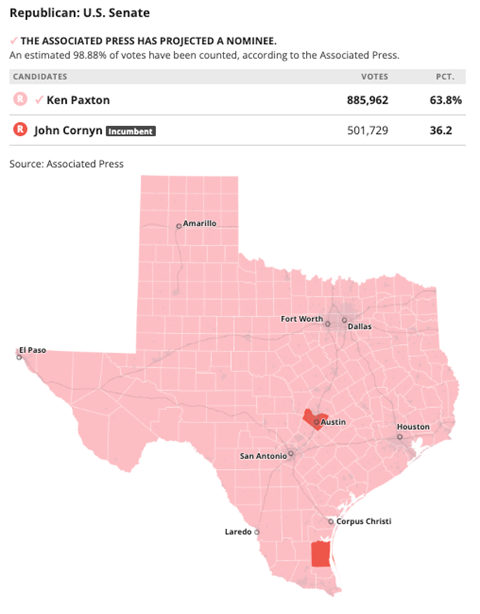
Attorney General Ken Paxton defeated Sen. John Cornyn in the Texas Republican Senate primary runoff on May 26, ending Cornyn's four-decade electoral career. Trump's last-minute endorsement proved decisive, overcoming a nearly 9-to-1 spending advantage in Cornyn's favor. Cook Political Report shifted the race from "likely" to "lean" Republican following the result, though Paxton has won three statewide races and will face Democrat James Talarico, an Austin state Rep., in a state Trump carried by 14 points.


The path forward has some headwinds. Talarico has significantly outraised Paxton, and whether establishment Republican money fully consolidates behind the nominee remains a question. Still, Paxton enters the general with a proven electoral record, Trump's backing, and a deep well of grassroots support, advantages that could prove difficult for even a well-funded Democrat to overcome in Texas. Read More.


Platner Controversy Tests Democratic Ceiling in Maine

Maine has been one of Democrats' most promising pickup opportunities this cycle, with Graham Platner posting consistent leads over incumbent Sen. Susan Collins, 9 points in a University of New Hampshire Survey Center poll, and 7 points each from Pan Atlantic Research and Emerson College. Those margins had positioned the race as a likely Democratic flip, particularly after Gov. Janet Mills declined to run. Recent personal controversy has introduced new uncertainty; however, Democratic win probability on Kalshi fell from 63 to 60 percent, and Polymarket moved in the same direction.


The more significant question is what the controversy signals for November. Platner's primary standing is essentially unchanged, with markets giving him better than 95 percent odds ahead of the June 9 contest. But Collins has survived difficult cycles before by running well ahead of the national Republican baseline, and any sustained erosion of Platner's favorability could give her the opening she needs. Whether his polling leads hold through the summer will be the key indicator of whether this race remains a lean Democratic pickup or tightens into a genuine tossup. Read More.

Double Vision in Alaska

A second Dan Sullivan, Dan J. Sullivan, a former teacher from Petersburg, has entered Alaska’s Senate race against incumbent Sen. Dan S. Sullivan, creating potential voter confusion. Republicans allege he is a Democratic plant, a claim Democrats deny. Because Alaska advances the top four candidates from its nonpartisan primary, both Sullivans could appear on the November ballot.


Republicans still hold structural advantages: Alaska hasn’t elected a Democratic senator in nearly 20 years, and Trump won the state by 14 points in 2024. However, Mary Peltola remains well-funded and popular with independents, who make up a large share of Alaska’s electorate. The August 18 primary will be the first indication of whether the duplicate-name dynamic could affect the race. Read More.

IN THE STATES

Trump Endorsement Reshapes South Carolina Governor's Race

President Trump endorsed Lt. Gov. Pamela Evette in South Carolina's six-way Republican gubernatorial primary on May 29, eleven days before the June 9 contest. Evette had been positioning herself as the de facto Trump candidate for months, drawing sharp pushback from rivals, most notably Rep. Nancy Mace, who was publicly disputing her claims as recently as the morning of the endorsement. Gov. McMaster, who had already backed Evette as his preferred successor, praised the announcement. If no candidate clears 50 percent on June 9, a runoff follows on June 23.


The endorsement landed amid notable intraparty friction. Trump's post came 45 minutes after former Gov. Nikki Haley announced she voted for Rep. Ralph Norman, highlighting the ongoing Haley-Trump divide in South Carolina GOP politics. Meanwhile, Mace, who voted to impeach Trump in 2021 and has since worked to rebuild that relationship, suggested her recent Epstein file demands may have cost her the nod and vowed to stay in regardless. With early voting underway and the field still crowded, the key question is whether Trump's backing consolidates enough support around Evette to avoid a runoff.
Read More.

Minimum Wage on the Ballot in Deep-Red Oklahoma

Oklahoma voters will weigh in on State Question 832 on June 16, a measure that would raise the state's minimum wage from $7.25, which has been unchanged since 2009, to $15 by 2029. Polling from GOP firm Cole Hargrave Snodgrass showed it passing as of late April, but the primary electorate is projected to be 69 percent registered Republicans, and business groups, the Farm Bureau, and outgoing Gov. Kevin Stitt have lined up against it on inflation and small business grounds.


The result will signal whether voter appetite for minimum wage increases has been dulled by recent inflation. The issue has historically been a cross-partisan winner, passing 28 of 32 times on statewide ballots since 1996, including in red states like Arkansas, Nebraska, and Florida. California's rejection of an $18 wage floor in 2024 was the first such defeat in nearly three decades, and Oklahoma may determine whether that was an anomaly or a trend. Even if it passes, a Republican-controlled legislature could move to limit its provisions, as Missouri did after a similar initiative succeeded in 2018. Read More.

EMERGING NARRATIVES

The Fake Poll Problem

Silicon sampling, using AI to simulate survey responses in place of actual humans, is moving from fringe experiment to industry standard, with Ipsos, Gallup, and hundreds of millions in Silicon Valley funding now behind it. The immediate flashpoint was an Axios story that cited poll findings on maternal health as fact; the findings were entirely AI-generated. No people were surveyed.

Traditional polling already introduces meaningful model-driven distortion; silicon sampling removes the human check on that distortion entirely, producing outputs that reflect the pollster's assumptions more than actual public sentiment. As AI-simulated polls become cheaper and faster than real ones, the incentive to use them grows — and with it, the risk that political coverage, policy debates, and campaign strategy get shaped by manufactured opinion presented as measured fact. The polling industry has a credibility problem it hasn't solved. Silicon sampling makes it significantly worse.
Read More.

ON THE HORIZON

Upcoming Elections:


June 2:
California Primary
CA-01 Special Primary
Iowa Primary
Montana Primary
New Jersey Primary
New Mexico Primary
South Dakota Primary


June 9:
Maine Primary
Nevada Primary
North Dakota Primary
South Carolina Primary


June 16:
CA-14 Special Primary
Oklahoma Primary
Alabama Primary Runoff
Georgia Primary Runoff


June 23:
Maryland Primary
New York Primary
Utah Primary
South Carolina Primary Runoff


June 27:
Louisiana Primary Runoff


June 30:
Colorado Primary


By Bob Salera June 2, 2026
President Ashlee Rich Stephenson joined Steve Scully on SiriusXM POTUS to discuss the latest political developments, including the Maine Senate race, the emerging field for the 2028 presidential election, and renewed scrutiny of President Biden's 2024 campaign. The conversation covered former Vice President Mike Pence's political future, the growing attention surrounding Vice President JD Vance and Secretary of State Marco Rubio as potential Republican standard-bearers, and former First Lady Jill Biden's recent reflections on the 2024 election cycle.  Listen to the full conversation here:
May 19, 2026
SNAPSHOT
By Bob Salera May 11, 2026
A Spring Congressional Update: What to Watch in the Months Ahead After a busy first four months of the year and with the remaining legislative calendar shrinking, it’s time to take a fresh look at the outlook for the three-month Congressional sprint to August. Appropriations: A Fresh Start — and Early Pressure In our January outlook , Congress was staring down a January 30th funding deadline. After one of the most turbulent funding cycles in recent memory — including a 43-day government shutdown last fall that became the longest in modern history — Congress managed to complete 11 of the 12 FY2026 appropriations bills. Congress recently released funding for the Department of Homeland Security – sans ICE and CBP – but only after swiftly approving a budget resolution to tee up a second reconciliation bill intended to provide multi-year funding for the immigration and border enforcement agencies. Now the clock is already ticking on FY2027 funding. The House is well underway, having reported out five Appropriations bills in the last two weeks of April. The House Appropriations Committee has laid out an ambitious markup schedule to complete its committee work by June. On the other side of the Hill, the Senate has held a flurry of hearings in April to examine the Administration’s budget request, with Administration officials making regular appearances before the Committee as the Senate charts its path for FY2027 funding bills. Whether Congress can complete some or any of these bills before the October 1 deadline, or whether the government once again stumbles into another continuing resolution or shutdown, remains the central fiscal question of the year. Whether it’s Vegas or Kalshi, the safe money is on a continuing resolution at least through the end of the year in order to avoid a messy spending fight a month before the midterm elections. Defense: Boosting the Budget, Expanding Priorities Boosting defense spending remains a top Administration priority, which has taken on increased importance as the military engagement with Iran has dragged on and strained military stockpiles. The Administration's new budget request proposes boosting defense spending to roughly $1.5 trillion — a sharp increase that Congress will have to grapple with as it approaches the NDAA and Appropriations bills this year. Traditionally, Congressional Appropriators tee up the defense funding bill early in the process, but in the House, it is currently scheduled to be the last bill to move through Committee, reflecting uncertainty over how to tackle the Administration’s request. A third reconciliation or a separate bipartisan supplemental funding bill are also options but face significant headwinds in the near term. The FY2027 NDAA is on the (short) list of bills Congress should get done this year with a June 4th mark-up scheduled in the House. The question is whether it becomes a lame duck Christmas tree. Transportation: A Must-Pass Deadline Looms Aside from the annual defense and appropriations work, the biggest legislative item on Congress's plate is the surface transportation reauthorization. The current authorization expires on September 30, 2026. Congress must either pass a new multi-year highway bill or risk leaving states without the long-term funding certainty they need to execute major infrastructure projects. Transportation Secretary Sean Duffy has been vocal about his "America is Building Again" agenda, pushing to streamline permitting and give states more control over environmental reviews. On the Hill, all eyes are on House Transportation and Infrastructure Committee Chairman Sam Graves and Ranking Member Rick Larsen as speculation over a markup date and an impending deal continues to dominate conversations in transportation circles. Optimists (me included) believe that the Graves-Larsen dynamic duo will strike a deal that will bring along a bipartisan coalition and reinvigorate business and labor stakeholders, and that a bill is possible this year. The theory goes that momentum from the House could spur action in the Senate, yet every week that passes makes it more difficult.  Additionally, water infrastructure, aviation safety and additional funding for air traffic control are on the agenda, and Congress is likely to act on these issues before the year concludes. The Bottom Line Congress enters the second half of the fiscal year with a full agenda and real deadlines but as the saying goes, the outlook is as clear as mud. A second and possibly third reconciliation bill shows that Republicans are looking to create additional pathways to advance their remaining priorities. A possible surface transportation bill, defense authorization, and end of year funding will all be big targets as the ‘last trains to leave the station’ after the midterms.
May 5, 2026
SNAPSHOT
By Bob Salera May 5, 2026
AxAdvocacy President Ashlee Rich Stephenson joined SiriusXM POTUS to discuss the midterm elections. "As we look toward the midterms, it’s important to remember there are always ebbs and flows. Right now, economic pressure, especially gas prices, is driving much of the conversation. If costs stay high through key moments like the Fourth of July and Labor Day, that creates a challenging environment for many candidates. At the end of the day, it comes down to a familiar reality, voters will side with whoever they believe is better for their pocketbook." Watch the full interview:
By Bob Salera April 30, 2026
Caught in the Red Tape? How to Use Effective Advocacy to Get Things Moving When a state regulation, policy, or licensing requirement is standing in the way of your business, don’t just get frustrated: get strategic. My dad always said, “You’ve got to know the rule to get around it.” That does not mean breaking the rules. It means understanding exactly what the law or policy says, why it exists, and how to work within the system to find a solution. Regulations can be complicated and changing them is not easy, but knowing the rules is the first step to effective advocacy. Here are five steps to help navigate state government and remove unnecessary barriers. Know the Rule Start by identifying the exact policy, regulation, or law creating the problem. You can do this by: Asking the regulator or government official to cite the exact rule they are enforcing Searching on the agency’s website, where most rules and policies are published Submitting a Freedom of Information request if needed Just as important as identifying the rule is understanding its history. Ask: What problem was this originally designed to solve? Knowing the intent behind the policy often reveals whether it is still relevant or if it has outlived its usefulness. Build Support Reach out to other similar businesses to see if they are experiencing the same issue. Even one or two additional voices can strengthen your position. Real stories, real costs, and real-world examples help decision-makers understand the impact. Stay Focused Once you understand the rule and have identified others with the same issue, develop a clear and simple message. Be able to explain: What the rule is How it is impacting your business Why it is unnecessary or unreasonable in today’s context What outcome would solve the problem Clarity matters. A focused message with a practical solution is far more effective than a long list of complaints. Work with the Agency Start where the issue lives, inside the agency. Speak first with the staff or office handling the matter. If you are not getting traction, identify agency leadership, including division directors, board members, or Governor-appointed agency heads. Request an in-person meeting when possible. Many issues improve significantly when decision-makers hear directly how the policy is affecting real businesses. Contact Your Elected Officials If working through the agency does not resolve the issue, loop in your state representative or senator. It is often best to begin by trying to work directly with the agency first, but keep your legislator informed along the way so they understand the issue if escalation becomes necessary. Elected officials can help connect you to the right people, ask questions on your behalf, and push for broader policy changes when needed. Key Takeaways Most people skip the first step of identifying the rule and miss opportunities to resolve the issues quickly. Many times, policies and laws are misunderstood or misapplied. Progress rarely comes from frustration alone, it comes from clarity, persistence, and collaboration.