AxIndex, Edition 12
SNAPSHOT
Our Top 3:
1) The Iran War Is Becoming a GOP Liability From the Inside:
Before the news of a deal broke, the war had begun fracturing the coalition, the House passed a war powers resolution 215-208, with four Republicans, including frontline members, breaking from Trump. A tentative agreement to reopen the Strait of Hormuz may now end the conflict, but the economic damage is what lingers: gas peaked near $4.56 a gallon before easing to just above $4. While a deal can lower prices, a May POLITICO poll found over 60 percent of voters, including majorities of both Trump and Harris backers, already say the war made life costlier. Some Republicans fear that perception is already baked in before November, citing the Biden-era lesson that economic pessimism is sticky; optimists argue Trump can still claim credit for ending the war and bringing prices down. The big question is whether relief arrives fast enough, and whether voters give the GOP credit if it does.
2) The Reddest States Are Where the Map Is Shifting:
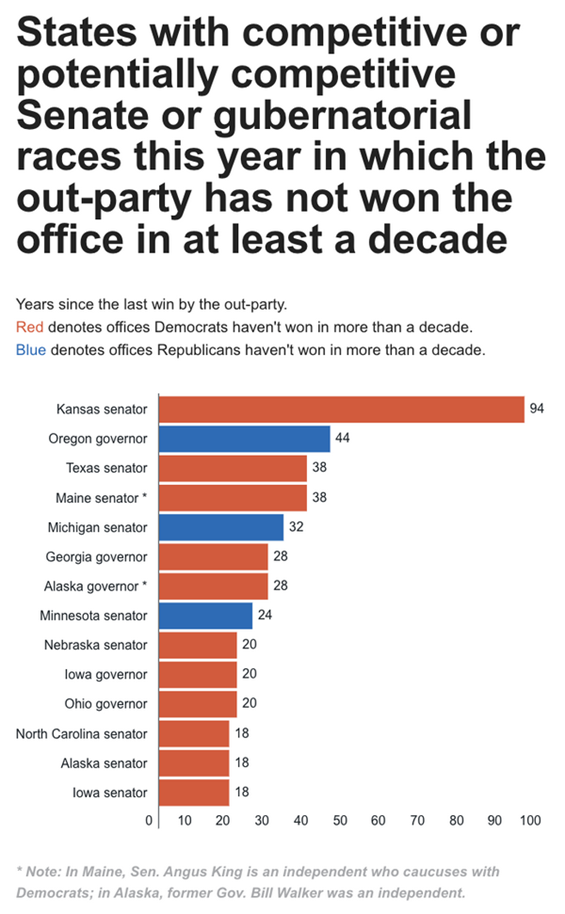
The clearest midterm movement is emerging not in the suburbs but in the agricultural heartland, where tariffs and rising costs are testing a bloc that backed Trump in all but 11 of 444 farming-dependent counties in 2024. Farm bankruptcies hit a six-year high this spring, up about 70 percent by May, and a Farm Futures survey shows the president's support among farmers down 10 points. The fallout is concentrating in states that should be safe: Nebraska, where independent Dan Osborn is Democrats' best chance against Sen. Pete Ricketts, and Iowa, where the governorship and outgoing Sen. Joni Ernst's open seat are viewed as pickup opportunities. Strategists doubt farmers will cross parties en masse with Trump off the ballot, but even modest erosion in deep-red territory reshapes the battlefield. The trajectory bears watching as planting-season costs keep the issue salient into the fall.
3) Immigration Enforcement Is the GOP's All-In Bet and Democrats' New Contrast:
Republicans muscled roughly $70 billion in new ICE and Border Patrol money through Congress on near party-line votes - 52-47 in the Senate and 214-212 in the House, funding the agencies through the rest of Trump's term and ending a 115-day standoff. To clear it on a simple majority, the GOP had to endure a Democratic vote-a-rama built for the midterm record: failed amendments to fund 7 million new homes, redirect enforcement money to housing, and kill the DOJ's $1.8 billion "anti-weaponization" fund. The strain showed inside the conference, where eight Republicans broke to support barring payouts tied to Jan. 6. The episode crystallized two competing frames for November, the GOP betting enforcement still mobilizes its base, Democrats packaging a cost-of-living contrast around housing and a Trump-aligned fund. The question is which message travels further with voters already focused on affordability.
National Sentiment Tracking
Voters Are Sour on the Country, Offering a Midterm Warning
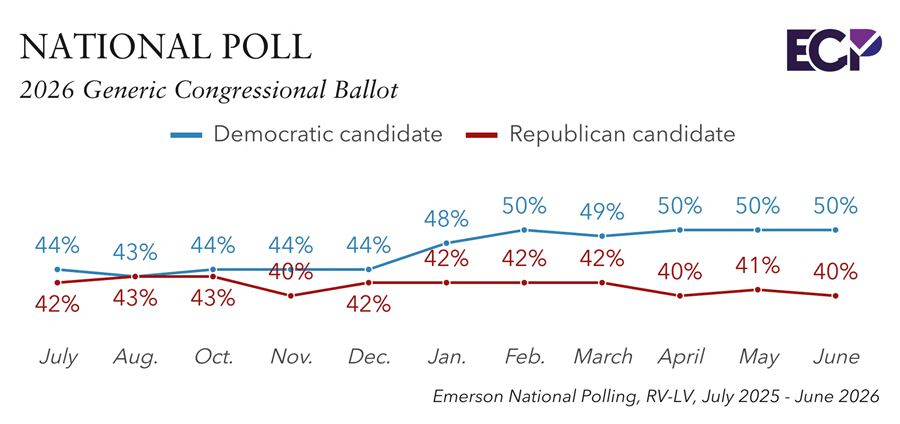
Emerson College Polling’s June 2026 national survey finds Trump at 39% approval and 55% disapproval, while Democrats lead the generic ballot by 10 points, 50% to 40%. This is the kind of baseline that usually gives the opposition room to define the midterms before the administration can reset the environment.
The deeper warning for Republicans is that the public mood is still unsettled rather than turning optimistic. Forty-two percent of voters say they feel optimistic about the country, 41% pessimistic, and 18% uncertain. Independent voters prefer the Democratic candidate by 15 points, 45% to 30%, while Hispanic voters break for the Democrat by 34 points. That suggests the coalition that matters most in a national midterm is drifting away from the president rather than consolidating behind him.
The issue map reinforces the same point. The economy is still the top concern at 38%, and 46% of voters say mid-decade redistricting is bad for the country, which means Republicans are fighting a pocketbook problem and a broader sense that politics is becoming distorted. If that mood holds into November, the midterms are less likely to be a referendum on Democratic strength than a referendum on whether Trump has given voters a reason to feel better. Read More.
A Cautious Public Remains Focused on the Economy
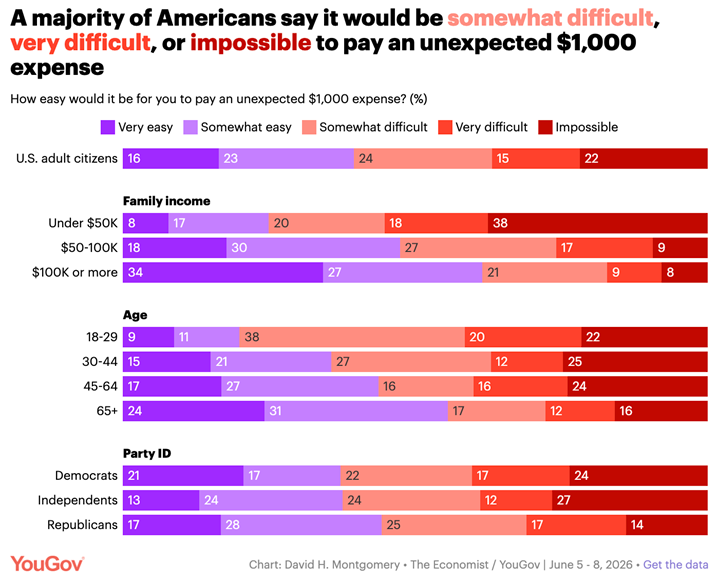
A new Economist/YouGov poll finds a record 63 percent of Americans disapprove of how Trump is handling the economy, a sign that affordability remains the central political drag on his presidency. On Iran, roughly two-thirds of Americans say Trump has been ineffective in negotiations, with expectations of a prolonged and costly conflict feeding broader uncertainty.
Trade and immigration policy remain politically contested. 47 percent of Americans want tariffs on imported goods decreased, while only 10 percent want them increased. 48 percent disapprove of the $70 billion immigration funding bill, versus 38 percent who approve. On top of that, 64 percent say the current moment is a significant turning point in American politics, while 15 percent view it as not particularly significant. Read More.
HOUSE HIGHLIGHTS
Polling At A Glance
House
RCP Average Generic Ballot: 48.3 Dem - 42.5 GOP (D +5.8)
On this day in:
2022: 46.2 GOP - 43.3 Dem (R+3.2)
2018: 46.0 Dem - 38.7 GOP (D+7.3)
Retirements

For context, during the first Trump term, there were 52 retirements from the House.
For the GOP, the Iran Deal May Be Too Late on Gas
A tentative Iran deal has Republicans hopeful that pump prices will ease, but many fear it's too late. Gas has slid from a pre-Memorial Day peak of $4.56 to just above $4, and a Strait of Hormuz reopening, set to run toll-free for 60 days, could speed the decline. Analysts warn drained inventories will floor prices, with a spike above $5 possible if the deal frays.
The war has already split the GOP once; four Republicans broke with Trump on the House war powers vote, and the pump is where that strain reaches voters. Citing the Biden-era lesson that pessimism is sticky, some Republicans fear perceptions are baked in; a May POLITICO poll found over 60 percent say the war made life costlier, including majorities of Trump and Harris voters. Optimists counter that Trump could claim credit and flip the liability into an asset. The swing factor is message discipline.
Read More.
Swalwell Seat Special Serves as November Preview
California voters head to the polls today in the special election to replace former Rep. Eric Swalwell in the heavily Democratic East Bay district. The partisan outcome is not in doubt, making the real story the Democratic contest between state Sen. Aisha Wahab and former Dublin Mayor Melissa Hernandez. The two already secured the top spots in the June primary for the full term, setting up a November rematch. Whoever wins the special gains a valuable incumbency advantage, allowing them to spend the summer building a congressional record and increasing name recognition ahead of the general election. In a race likely decided at the margins between two Democrats, that head start could prove meaningful. Read More.
Redistricting
Redistricting’s Final Scorecard: Republicans Won the Map, but May Still Lose the House
With Alabama and Louisiana finalizing their maps, the mid-decade redistricting fight is effectively over. The numbers are striking in scale: 10 states redrew their maps for 2026, covering nearly 42% of all House seats – an extraordinary amount of change outside a normal post-census cycle.
The bottom line from Sabato's Crystal Ball: Republicans improved the map, but not enough to save themselves if the political environment stays where it is. The median House district shifted about 2 points to the right, and the expected net from redistricting is R+6, with a range of R+5 to R+9. Eight states redrew in Republicans' favor against two for Democrats, with the biggest GOP hauls in Texas (R+3-4), Florida (R+3-4), and the smaller gains in Alabama, Louisiana, Missouri, North Carolina, and Tennessee. California and Utah offset with D+4-5 and D+1 respectively.
The more telling number is competitive seats: the total number of truly competitive districts, those within 4 points either way, declined from 85 to 70. Gerrymandering worked as intended, reducing battlefield exposure for both sides. But it cuts both ways in a wave environment. Crystal Ball still favors Democrats to flip the House, noting that in a bad enough political climate, Democrats can win seats that Trump carried by double digits. The maps made a Republican majority more durable if they hold on.
One race to watch as California finishes counting: Rep. David Valadao in CA-22, whose heavily Latino Central Valley seat was targeted by the Democratic gerrymander, is currently sitting below 50% of the combined Republican vote in the primary – a historically reliable warning sign that he may not survive November. Read More.
SENATE HIGHLIGHTS
Polling At A Glance
Recent Polls
Texas A&M/Siena (TX General): Paxton (R) 46, Talarico (D) 46
Insider Advantage (GA GOP Runoff): Collins 48, Dooley 46
Quantus (ME General): Platner (D) 46, Collins (R-i) 45
Retirements
So far, 11 Senators have announced their retirement from the chamber at the end of the current Congress.

Collins Gains Ground as Democrats Navigate Nominee Controversies
Sen. Susan Collins appears to be regaining ground in Maine's closely watched Senate race, with recent polling showing her within striking distance of Democratic nominee Graham Platner after earlier surveys suggested a wider deficit. Platner emerged from a contentious primary shadowed by scrutiny over past personal conduct allegations and questions about his background, issues Republicans are expected to keep front and center through the fall. While Democrats continue to view Maine as a prime pickup opportunity, Collins' strong personal brand and history of attracting independent voters have kept her firmly in contention.
The broader takeaway is that Maine may be slipping from Democrats' grasp as a straightforward pickup opportunity. Collins has repeatedly outperformed both polling and partisan fundamentals, and the controversy surrounding Platner gives Republicans an opening to shift the race away from national dynamics and toward candidate quality. With Senate control likely hinging on a handful of contests, Maine is increasingly shaping up as one of the GOP's most important defensive battles. Read More.
Last Dan Standing
An Alaska elections official ruled Monday that a second Senate candidate named Daniel J. Sullivan is ineligible for the August primary, finding his entry was a deliberate attempt to confuse voters rather than a good-faith candidacy. The decoy had tried to file as "Dan Sullivan," adopted the same "S" middle initial as incumbent Republican Sen. Dan Sullivan, and ran a lookalike campaign website. The NRSC and state Republicans had pushed for his removal; he has 30 days to appeal.
The ruling clears a ballot-confusion threat in what is shaping up as a top-tier Senate contest, with Democrats eyeing the seat as part of their path to the majority and former Rep. Mary Peltola the expected challenger. A consultant for the decoy candidate has Democratic ties, fueling GOP accusations of a ploy. Still, the seat tilts Republican, Trump carried Alaska by 13 points in 2024, leaving Democrats a steep climb.
Read More.
Trump vs. Kemp, Round Two
The Georgia Senate runoff on June 16 is really a proxy war between Donald Trump and Governor Brian Kemp. Trump endorsed Rep. Mike Collins just days before the runoff, calling him a “true Friend, Fighter, and WARRIOR” with his “Complete and Total Endorsement.” Collins faces Derek Dooley – a political newcomer and former football coach running with Kemp’s full backing. Dooley’s pitch is electability: he wants to win the way Kemp wins, running up crossover margins against an Ossoff campaign sitting on $32.5 million. Collins’ pitch is loyalty: he’s MAGA and has been from the start.
Ossoff is the only Democratic senator running for reelection in a state Trump won in 2024 – meaning if he loses, Democrats have almost no path to a Senate majority. That makes the Republican nominee choice consequential beyond Georgia. If Collins wins, Trump consolidates. If Dooley wins despite the endorsement, Kemp wins the argument – and the general election fight is still ahead.
Read More.
IN THE STATES
Iowa GOP Upset Reshapes Governor's Race
Iowa's open governor's race took an unexpected turn when businessman and farmer Zach Lahn defeated Rep. Randy Feenstra in the Republican primary, despite Feenstra's late endorsement from President Trump. Lahn's victory marked the first major loss for a Trump-backed candidate this cycle and underscored the limits of a last-minute endorsement in a race shaped by grassroots conservative dissatisfaction and agricultural concerns.
Lahn now faces Democratic State Auditor Rob Sand, the state's only Democratic statewide officeholder, in what is expected to be Iowa's most competitive governor's race in years. The result also complicates assumptions about Republican unity heading into 2026, suggesting that outsider candidates can still overcome establishment support in deeply Republican states. With Gov. Kim Reynolds retiring and Democrats viewing Sand as a strong statewide contender, Iowa's governor's race has quickly become one of the more closely watched contests of the cycle. Read More.
California's Slow Count Becomes a Recurring Flashpoint
California's delayed vote count is again fueling election integrity debates after several high-profile races remained uncalled weeks after the June 2 primary. President Trump alleged fraud and claimed the Justice Department was investigating the process, arguing Democrats were benefiting from the extended count. Election officials and analysts, however, point to California's mail voting system, which sends ballots to millions of voters and allows ballots postmarked by Election Day to arrive days later.
The state's lengthy counting process often produces a late "blue shift" as mail ballots are tabulated, a dynamic that has repeatedly drawn scrutiny despite Republicans winning several competitive California House races under the same rules. The issue could take on added significance later this month as the Supreme Court weighs a case involving the legality of counting late-arriving mail ballots, a decision that could reshape election administration beyond California.
Read More.
EMERGING NARRATIVES
Democrats Turn an ICE Bill Into a Midterm Message
To pass $70 billion in ICE and Border Patrol funding on a near party-line vote, Senate Republicans had to grind through a vote-a-rama of Democratic amendments built for the midterm record. Democrats forced votes contrasting the enforcement money with cost-of-living priorities, including failed bids to fund 7 million new homes and to redirect ICE money to housing. The sharpest friction came over the DOJ's $1.8 billion "anti-weaponization" fund, which several Republicans wanted explicitly killed in statute.
The exercise was less about outcomes than about defining the GOP agenda before November. Republican unease was visible: eight Republicans backed a Democratic measure to bar payouts to Jan. 6 rioters, and Sen. Bill Cassidy drew five GOP votes for a related amendment. Democrats now have a packaged contrast, immigration enforcement and a Trump-aligned fund over housing affordability, while Republicans bet enforcement remains a winning issue. Watch which vulnerable members keep breaking.
Read More.
Farmer Discontent Tests a Key Republican Constituency
Economic pressure is mounting across farm country as tariffs, input costs, and weak commodity prices squeeze agricultural producers who overwhelmingly backed President Trump in 2024. Recent surveys show softening support among farmers, while fertilizer affordability concerns remain widespread and farm bankruptcies have climbed to their highest levels in years. The administration has sought to blunt the impact through billions in assistance payments, targeted tariff relief, and high-profile outreach to rural voters.
The political significance lies less in a partisan realignment than in turnout and enthusiasm. Several competitive 2026 races run through agriculture-heavy states, including Senate contests in Nebraska and Iowa. Few strategists expect farmers to abandon Republicans en masse, but prolonged financial strain could erode goodwill among one of the GOP's most reliable constituencies. The key question heading into the midterms is whether economic relief arrives quickly enough to prevent rural frustration from becoming a broader political liability.
Read More.
ON THE HORIZON
Upcoming Elections:
June 16:
CA-14 Special Primary
Oklahoma Primary
Alabama Primary Runoff
Georgia Primary Runoff
June 23:
Maryland Primary
New York Primary
Utah Primary
South Carolina Primary Runoff
June 27:
Louisiana Primary Runoff
June 30:
Colorado Primary