AxIndex, Edition 13
SNAPSHOT
Our Top 3:
1) ) History Says Gas Prices Could Define the Midterm Map:
As Republicans work to defend narrow majorities, gasoline prices are emerging as a key political variable. Prices are up roughly 90 cents per gallon since the war with Iran began in late February and 26% since the start of Trump's second term, even after a recent 60-cent pullback. The historical pattern is clear: the party in power has lost an average of 21 House seats per midterm since 1978, with losses generally smaller when prices fall and larger when they rise. The exposure is uneven, as Brookings data show voters in the average Republican district drive 26% more miles than those in the average Democratic district, making GOP-held seats more sensitive to pain at the pump. The 2022 cycle offers a partial counterpoint, when Democrats limited losses to nine seats despite a 73% spike, aided by the Dobbs ruling.
2) The Socialist Surge Reaches the House and Tests Democratic Leadership:
Mayor Zohran Mamdani's slate swept New York's June 23 House primaries, with democratic socialists Brad Lander, Darializa Avila Chevalier, and Claire Valdez defeating or replacing establishment Democrats, including Hispanic Caucus Chair Adriano Espaillat. The wins build on the movement Mamdani launched with his 2025 mayoral victory and landed hardest on Minority Leader Hakeem Jeffries, who backed the losing incumbents and faced "you're next" chants from DSA members on primary night. The results give Republicans a well-funded socialist foil to tie vulnerable Democrats to, while forcing Democratic leadership to spend more time managing its left flank. The caveat is that these races took place in some of the bluest, most gentrified districts in the country, leaving the movement's appeal outside those strongholds an open question heading into the fall.
3) The Supreme Court Reshapes the Rules of the Game:
In a consequential stretch, the Court handed down two rulings that will shape the 2026 campaign. In NRSC v. FEC, a 6-3 majority struck down limits on coordinated party expenditures, allowing party committees to spend unlimited money directly with candidates, an advantage super PACs cannot match. The day before, in Watson v. RNC, a 5-4 majority, with Justice Barrett writing for the Court, upheld state laws counting late-arriving mail ballots postmarked by Election Day, rejecting an RNC challenge and preserving grace periods in roughly a dozen states. Together, the decisions strengthen party committees as fundraising vehicles while leaving mail-voting rules largely in the hands of state legislatures, where Trump continues to push the stalled SAVE America Act.
National Sentiment Tracking
Voters Are Sour on the Country, Offering a Midterm Warning
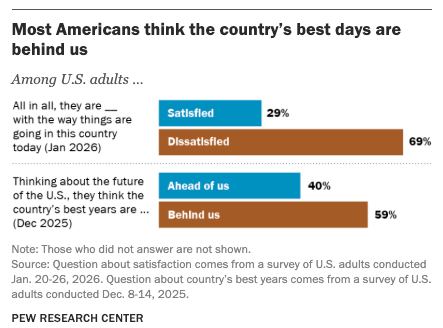
A new Pew Research Center report finds the public approaching America's 250th anniversary in a deeply pessimistic frame, with 69% of adults dissatisfied with the country's direction as of January and 59% saying the nation's best days are behind it. Looking ahead to 2050, two-thirds expect the country to be more politically divided, while majorities anticipate a weaker global standing, a less prosperous economy and a worse-functioning government. There are pockets of optimism, with 68% saying they feel hopeful about the future and 48% optimistic about the country overall, and expectations have ticked up modestly since 2023.
The mood tracks closely with partisanship and power. Republican satisfaction with the country's direction jumped to 54% in January from single digits during the Biden years, while Democratic satisfaction collapsed to 8%, mirroring the swing seen in past administration changes. Younger adults register the most pessimism about 2050, a generational gap worth watching as both parties court a rising electorate heading into the midterms.
Read More.
Latino Voters Emerge as the Swing Bloc Both Parties Are Chasing
At this week's Latino Vote Summit in Washington, strategists from both parties framed Latino voters as decisive in the fall's most competitive races. Equis Research's Carlos Odio called the House map "very Latino" and pointed to Texas, where Hispanics backed Trump 55% in 2024 but have since drifted back toward Democrats. With Latinos comprising roughly one in four 2024 Texas voters, Odio argued the Talarico-Paxton Senate contest could swing the chamber's net seat math. Sen. Alex Padilla flagged fast-growing Latino populations in Georgia, North Carolina, and Louisiana.
The throughline was affordability, with Trump's economic ratings now weaker than at the comparable point in 2018. The open question is whether turnout tracks toward a 2018-style Democratic surge or the muted 2022 environment — a margin that could decide many races. Sen. Ruben Gallego warned Democrats against assuming Latinos are reliably progressive, while both parties eyed a 2028 Rubio bid as a Latino-state wildcard.
Read More.
HOUSE HIGHLIGHTS
Polling At A Glance
House
RCP Average Generic Ballot: 48.4 Dem - 43.1 GOP (D +5.3)
On this day in:
2022: 44.8 GOP - 42.3 Dem (R+2.5)
2018: 46.0 Dem - 40.1 GOP (D+5.9)
Retirements

For context, during the first Trump term, there were 52 retirements from the House.
Teamsters Flip to Bresnahan in a Pivotal Pennsylvania Seat
The Pennsylvania Conference of Teamsters has endorsed Republican Rep. Rob Bresnahan in the 8th District, a striking reversal coming roughly two months after members seemed to back Democrat Paige Cognetti in an April vote. Union President Bill Hamilton credited Bresnahan's role in the bipartisan push to pass the Faster Labor Contracts Act, noting the Teamsters back candidates who support them regardless of party. The endorsement adds to a run of labor support Bresnahan has consolidated from unions that backed the Democrat he unseated in 2024, including the AFGE and the Pennsylvania Laborers' District Council. PA-08, anchored in Scranton, is among the most competitive House races on the map.
The shift fits a broader realignment of organized labor toward Republicans in working-class districts, a trend reflected in 2024 exit polls showing union households moving right. For a freshman in a Trump-trending seat, locking down labor blunts a traditional Democratic advantage and complicates Cognetti's path. The question is whether endorsements translate to rank-and-file votes, or whether the dour national climate for Republicans offsets the gains at the margins.
Read More.
Mamdani's Slate Sweeps New York Primaries, Giving the GOP a Target
Several candidates backed by New York City Mayor Zohran Mamdani won House primaries on Tuesday, including democratic socialists Claire Valdez and Darializa Avila Chevalier, who ousted ten-year incumbent Rep. Adriano Espaillat, alongside the mayor's former rival Brad Lander. The Democratic Socialists of America celebrated the results, with the state party declaring the Espaillat upset a socialist win uptown. President Trump responded on Truth Social that America will never be a communist country, continuing his practice of casting Mamdani and his allies in those terms. The wins extend the movement Mamdani launched with his own 2025 mayoral victory and signal its growing reach into federal primaries.
The dynamic cuts in two directions. The rise of an avowedly socialist bloc within the party gives Republicans a clear opponent to campaign against in the midterms, with the NRCC already moving to tie vulnerable Democrats to the brand. For Democratic leadership, the insurgency complicates message discipline and raises the prospect of intraparty fights in safe-blue seats. The question is how far the model travels beyond deep-blue New York.
Gavel Implications: The wins landed hardest on Minority Leader Hakeem Jeffries, who backed the losing incumbents in each race. DSA members were filmed chanting "you're next" at Jeffries on primary night, and commentators argued neither Jeffries nor Schumer could currently win a primary in their own city. Jeffries downplayed the results as a handful of primaries that would not reshape House Democrats, then congratulated the winners days later. If Democrats win only a narrow House majority in November, the same tensions could surface in a Speaker vote. Read More.
SENATE HIGHLIGHTS
Polling At A Glance
Polling Averages
North Carolina: Cooper +6.8 (Flip)
Maine: Platner +4.0 (Flip)
New Hampshire: Pappas +3.7
Georgia: Ossoff +2.8
Ohio: Brown +1.5 (Flip)
Michigan: Primary 8/4
Alaska: Primary 8/18 --> Tipping Point
Iowa: Not enough data
Texas: Paxton +0.8
Florida: Moody +7.5
Recent Polls
University of Texas (TX General): Paxton (R) 43, Talarico (D) 42
NY Times/Siena (ME General): Platner (D) 49, Collins (R-i) 47
Fabrizio/Anzalone (OH General): Brown (D) 48, Husted (R-i) 45
Susquehanna (MI Dem Primary): El-Sayed 22, Stevens 20, McMorrow 9
Retirements
So far, 11 Senators have announced their retirement from the chamber at the end of the current Congress.

Texas Senate Race Tied as Democrats Eye a Generational Pickup
A new New York Times/Siena poll shows the Texas Senate race deadlocked at 47% each between Republican Attorney General Ken Paxton and Democratic state legislator James Talarico, signaling that the seat will require real investment to hold. An unsettled environment around the economy has tightened a contest that would ordinarily be safely Republican, and the result is a reminder that even the party's strongholds are not running on autopilot this cycle.
The race pits the 63-year-old Paxton against Talarico, a 37-year-old state representative, along demographic lines that will shape the fall fight. The task for Republicans is to consolidate the base and hold independents and crossover voters who remain in play. With Senate control potentially hinging on a narrow set of seats, keeping Texas firmly in the column matters well beyond the state, and the polling argues for treating it as an active race rather than a foregone conclusion.
Read More.
Seeing Double in Alaska... Again
The Alaska Supreme Court ruled Monday that Dan J. Sullivan, a retired Petersburg teacher, must appear on the U.S. Senate ballot alongside the incumbent, Republican Sen. Dan S. Sullivan, affirming a Friday lower-court decision that the state Division of Elections overstepped in disqualifying him. The division had removed the challenger after complaints from the senator, the Alaska GOP and the NRSC that he filed in bad faith to confuse voters by sharing the incumbent's name and party. The justices found ballot design, not removal, was the proper remedy, and left the division to decide how his name would appear before the August 18 primary.
The stakes run beyond the novelty. Alaska is among the handful of seats expected to decide Senate control, and the incumbent's allies have cast the second Sullivan as a spoiler under the state's top-four, ranked-choice system. With ballots set to print imminently, the fight now turns on how clearly the two names can be distinguished, a design choice that could matter in a close race.
Read More.
IN THE STATES
Supreme Court Sides with States on Late-Arriving Mail Ballots, Rejecting RNC Challenge
The Supreme Court ruled Monday that states may count mail ballots that arrive after Election Day if postmarked by it, rejecting an RNC challenge in Watson v. RNC. The 5-4 decision, written by Justice Amy Coney Barrett and joined by Chief Justice John Roberts and the three liberal justices, held that the Mississippi law at issue does not conflict with federal statutes setting Election Day, adding that any change must come from Congress or state legislatures. The ruling preserves grace-period laws in Mississippi and roughly a dozen other states ahead of November, avoiding a late-cycle scramble for election administrators.
President Trump called the decision a tremendous loss and renewed his push for the SAVE America Act, his stalled federal election overhaul, though Senate Majority Leader John Thune has said the votes are not there. The practical effect is continuity: the rules governing mail ballots in affected states will not change before the midterms, leaving the contested questions to the legislative arena.
Read More.
Colorado's Democratic Governor Primary Carries Senate Stakes
Colorado Democrats vote Tuesday in a gubernatorial primary pitting U.S. Sen. Michael Bennet against state Attorney General Phil Weiser, with term-limited Gov. Jared Polis unable to run again. The contest has centered largely on which candidate would take a tougher posture toward the Trump administration. Late polling showed a competitive race, with one survey giving Weiser a 41-34 edge, though Bennet has consolidated broad institutional support. The winner will be favored in November in a state that has not elected a Republican governor since 2002.
The stakes reach beyond the statehouse. If Bennet wins the nomination and the general, he would vacate his Senate seat, letting the new governor appoint a replacement through 2028 and reshuffling a closely divided chamber. For a GOP working to expand the Senate map, the prospect of an appointed Colorado Democrat is a reminder of how downballot outcomes ripple upward.
Read More.
EMERGING NARRATIVES
Supreme Court Strikes Down Party Coordination Limits
The Supreme Court on Tuesday struck down federal caps on coordinated party expenditures, ruling 6-3 along ideological lines that the limits violate the First Amendment. The decision, written by Justice Brett Kavanaugh in National Republican Senatorial Committee v. FEC, overturns a 25-year-old precedent and removes restrictions on how much party committees can spend in concert with their own candidates. The case was brought by the NRSC and Vice President Vance and backed by the Trump Justice Department. With the limits gone, parties can now both raise large sums and coordinate freely with candidates, a combination that super PACs cannot match. Trump called the ruling a win for the First Amendment, while DSCC Chair Kirsten Gillibrand and other Democratic leaders framed it as an opening for donor influence and corruption.
The practical effect is likely to flow to competitive races, where coordinated buys make television advertising cheaper. Party committees become more attractive vehicles for major-donor money heading into the midterms, potentially pulling resources back toward the formal party structures and away from the outside groups that have dominated since Citizens United. Both parties stand to benefit equally under the ruling, though the immediate strategic edge favors whichever committees can mobilize large donors fastest.
Read More.
Gas Prices Loom as a Midterm Risk for Republicans
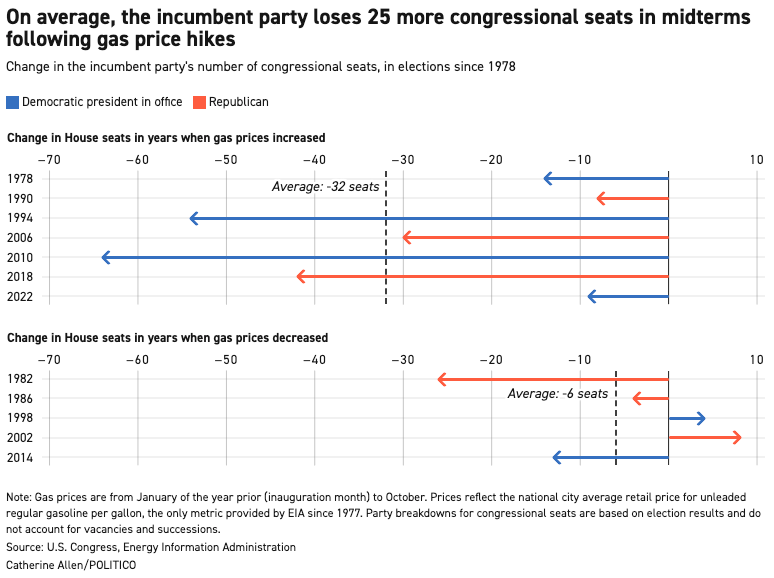
Republican strategists are privately uneasy about gasoline prices heading into November, a concern underscored by President Trump ordering the Justice Department to investigate oil companies he accused of price gouging. Prices are up nearly 90 cents per gallon nationally since the war with Iran began in late February, and 26% since the start of Trump's second term, even after a roughly 60-cent drop over the past month. Analysts warn the increases may linger in voters' minds even as they ease at the pump. History points to the danger: the party in power has lost an average of 21 House seats per midterm since 1978, with losses running smaller when gas prices fall and larger when they climb.
The exposure may fall unevenly. Brookings data show the average constituent of a Republican House member drives 26% more miles than a Democratic member's, leaving GOP-held districts more sensitive to pump prices, and Trump-won states saw sharper increases early in the conflict. The 2022 cycle offers a partial counterpoint, when Democrats limited losses to nine seats despite a 73% gas spike, aided by the Dobbs ruling. As GOP strategist Ron Bonjean put it, the task for Republicans is reminding voters that prices have come down, though a summer roller coaster tied to the Iran peace deal could complicate that message.
Read More.
ON THE HORIZON
Upcoming Elections:
June 30:
Colorado Primary