Polling Error Is the Wild Card Heading Into November
Polling Error Is the Wild Card Heading Into November
With four weeks until Election Day, Democrats are enjoying some of the most favorable polling they have seen in years. The question for anyone planning around November's results is a simple one: are the polls right?
Recent history says that is far from guaranteed. In each of the last three election cycles, polls have missed in the same direction, and that direction has been toward Democrats.
Three cycles, one direction
Nate Silver's Silver Bulletin tracks the average statistical bias in polls taken during the final three weeks of each election cycle. The pattern since 2019 is hard to miss:
• 2019-2020: polls overstated Democrats by 4.7 points across all offices
• 2021-2022: polls overstated Democrats by 0.8 points
• 2023-2024: polls overstated Democrats by 2.9 points
Averaged together, that is a 2.8-point miss in Democrats' favor.
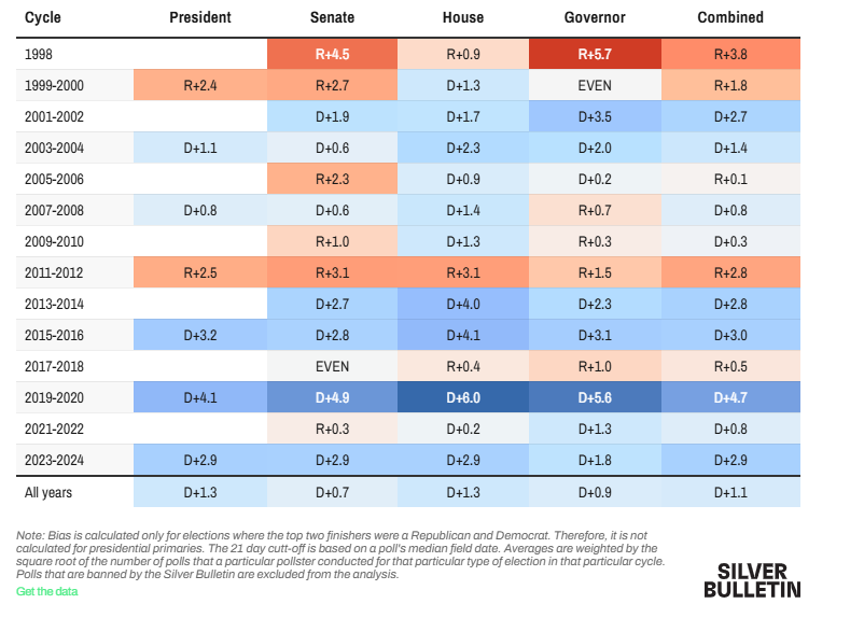
Source: Silver Bulletin
What a repeat would mean
A 2.8-point shift is small enough to fall inside most polls' margin of error, but large enough to change the map. Applied to today's polling averages, an error of that size would flip five U.S. Senate races where Democrats currently lead into Republican wins.
In other words, the difference between a strong Democratic year and a status quo outcome could come down to whether pollsters have fixed what went wrong over the past three election cycles' worth of surveys.
Early warning signs from the field
There is no way to know the direction or size of this year's error until votes are counted. But some pollsters are raising flags.
Pollster Natalie Jackson noted on X that pollsters are having a hard time getting Republican-leaning voters to complete surveys this cycle.
State Navigate saw the same pattern in its own data. In a poll of Iowa State Senate District 35, a seat Trump carried by 21 points, Democrat Mike Zimmer led by 4.6 points in the raw live-call results. Weighting by 2024 presidential vote cut that lead to 2 points. The firm concluded that rural Iowa Republicans are unusually hard to reach, and warned that statewide races there could be closer than current polls show.
Two ways to read it
Low Republican response rates can mean two very different things:
- Republican support is being understated. If the voters who skip surveys still show up to vote, polls will miss them again, as they did in 2020 and 2024.
- Republican-leaning voters are disengaged. If the same voters who ignore pollsters also sit out November, today's polls may be getting it right.
Only the results will tell us which reading is correct. Until then, the smart approach for clients, campaigns and anyone with a stake in the next Congress is to treat current polling leads as provisional and plan for a range of outcomes, not a single forecast.

Bob Salera
Principal of Communications