AxIndex, Edition 5
SNAPSHOT
Our Top 3:
1) Early Primaries Signal Volatility for Incumbents: The first round of 2026 primaries is already revealing a more unstable political environment for incumbents and party establishments. In Texas, where new congressional maps took effect, Rep. Dan Crenshaw was defeated in a GOP primary, while several other races were pushed into runoffs, including contests involving former Rep. Colin Allred and Rep. Julie Johnson and a Houston-area battle between Reps. Al Green and Christian Menefee. The state’s high-profile Senate race is also reflecting the same dynamics, with Attorney General Ken Paxton mounting a serious challenge to Sen. John Cornyn and driving one of the most expensive primaries of the cycle. Together, the results highlight growing ideological pressure within both parties and suggest intraparty battles could play an increasingly significant role in shaping the candidate field before the general election even begins.
2) Energy, AI, and Global Conflict Collide in Economic Messaging: A series of developments are linking energy markets, technology policy, and national security into a single economic narrative heading toward the midterms. The rapid expansion of AI data centers is driving new debates over how the U.S. will generate enough electricity to power the industry, while tensions with Iran and disruptions in the Strait of Hormuz are pushing oil and gasoline prices higher. Together, these issues are reinforcing broader affordability and competitiveness debates as policymakers balance energy policy, tech leadership, and consumer costs.
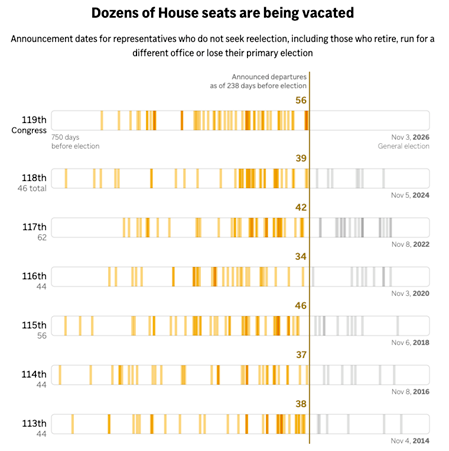
3) Wave of Congressional Retirements Expands the 2026 Battleground: An unusually high number of House members have already announced retirements ahead of the 2026 midterms, putting the next Congress on pace for significant turnover. The growing number of open seats, combined with redistricting changes and primary volatility, could expand the competitive map and force both parties to defend districts that would otherwise remain stable.
National Sentiment Tracking
AXINSIGHTS LATEST ISSUE POLLING
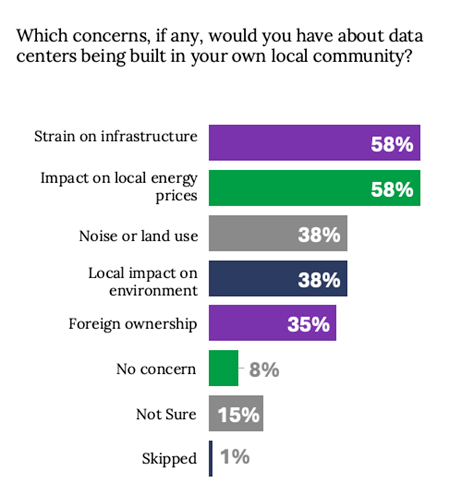
Last week, we shared the attached national polling deck from AxAdvocacy’s latest research partnership with Ipsos.
Ipsos fielded a national survey of 1,025 adults (2/20-22/26) to measure Americans’ views on several key public policy issues dominating today’s debate. This research includes a report on artificial intelligence, data center construction, corporate mergers, domestic manufacturing, and national defense investment.
The findings provide a clear snapshot of where the nation currently stands, highlighting both areas of bipartisan agreement and emerging fault lines that could shape policy conversations in the months ahead during a highly combative election season.
PUBLIC SUPPORT FOR WAR SHOWS SHARP BREAK FROM PAST CONFLICTS
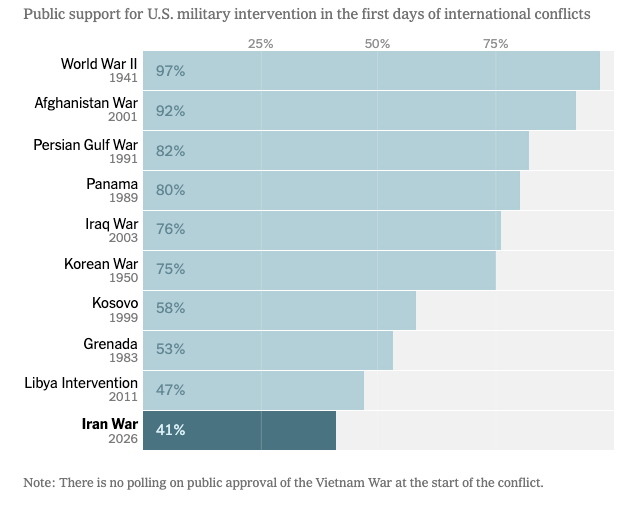
Polling in the days following President Donald Trump’s decision to launch U.S. strikes against Iran shows significantly weaker public backing than at the outset of most previous American conflicts. Surveys indicate that a majority of Americans currently oppose the attacks, though levels of support vary widely, from 27% in a Reuters/Ipsos poll to about 50% in a Fox News poll, suggesting public opinion is still forming as more details emerge.
Even the highest levels of support recorded so far remain well below the early “rally” backing typically seen at the start of major wars such as World War II, the Korean War, or the Iraq War. The muted response highlights a more skeptical public toward new overseas military engagements, potentially shaping the political environment as the conflict unfolds and the 2026 midterm elections approach.
Read More.
HOUSE HIGHLIGHTS
Southern Special Elections Offer Early Clues for 2026 Midterms
Voters in Mississippi and Georgia headed to the polls in closely watched special elections that could provide early signals about voter sentiment heading into the 2026 midterm cycle. In Georgia, a crowded special election is underway to replace former Rep. Marjorie Taylor Greene in the state’s 14th Congressional District, with more than a dozen candidates competing and a runoff likely if no one clears 50%. The race is drawing national attention as a test of former President Donald Trump’s influence within the Republican base.
Meanwhile in Mississippi, primary and special elections for congressional and legislative seats are giving both parties a chance to gauge turnout and enthusiasm in a reliably Republican state. While neither contest is expected to dramatically shift party control, strategists are watching the results closely for signs of generational change within the Democratic coalition and how strongly Republican voters respond to Trump-aligned candidates, potential indicators of broader dynamics that could shape the 2026 midterms.
Read More.
Early Primaries Signal Unsteady Ground for Incumbents
The first round of 2026 primary elections is revealing a volatile political environment for incumbents, with several high-profile races forcing sitting members into runoffs or ending their congressional careers altogether. The dynamics were especially visible in Texas, the first state to redraw congressional maps last year, where shifting districts and ideological divides are reshaping several contests.
In the state’s primaries, Rep. Dan Crenshaw was defeated by state Rep. Steve Toth after facing criticism from the party’s right flank and entering the race without an endorsement from former President Donald Trump. Several other races are headed to runoffs, including a Dallas-area contest between former Rep. Colin Allred and Rep. Julie Johnson, as well as a Houston-area Democratic battle between longtime Rep. Al Green and freshman Rep. Christian Menefee. Outside Texas, North Carolina Rep. Valerie Foushee narrowly defeated progressive challenger Nida Allam after more than $1 million in outside spending, highlighting ideological tensions within the Democratic Party as well. Together, the results suggest both parties may face increasingly competitive primaries that could reshape the political landscape heading into the 2026 midterms.
Read More.
California Rep. Kevin Kiley Leaves GOP to Run as Independent
Rep. Kevin Kiley announced he is leaving the Republican Party and will serve as an independent while seeking reelection in a newly redrawn Sacramento-area congressional district. The move comes after California’s mid-decade redistricting placed Kiley in a more Democratic-leaning seat, prompting him to run without a party label in an effort to broaden his appeal to moderate voters.
Although Kiley will continue caucusing with Republicans to maintain committee assignments, his party switch slightly narrows the GOP’s already thin House majority and underscores how redistricting is reshaping the political landscape ahead of the 2026 midterms. The change leaves the House with a 217–214 Republican majority and one independent, highlighting how even small shifts in party alignment could have outsized implications for House control.
Read More.
Polling At A Glance
Polling:
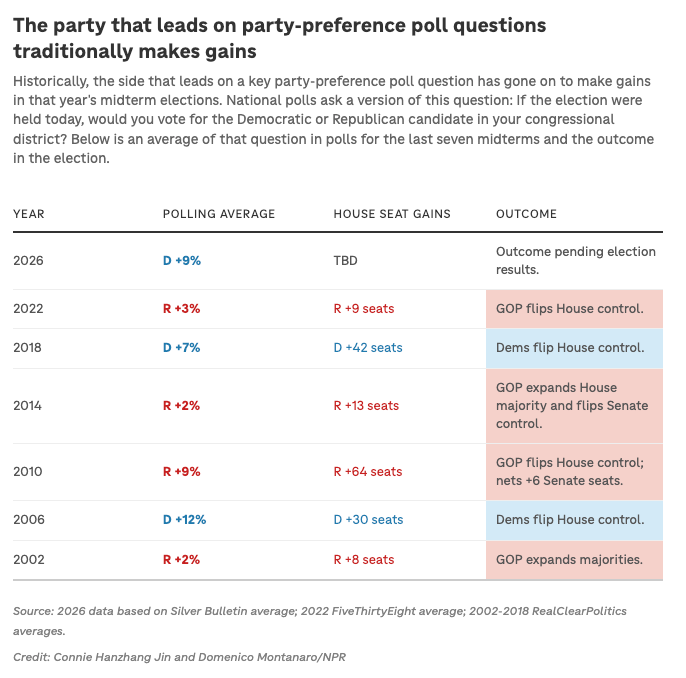
RCP Average Generic Ballot: 47.0 Dem - 42.6 GOP (D +4.4)
On this day in:
2022: 46.1 GOP - 42.8 Dem (R+3.3)
2018: 45.9 Dem - 37.1 GOP (D+8.8)
Retirements
Notable retirements from Congress are beginning to come out as the election year gets underway. The current total sits at 56 incumbent members (21 Democrats / 35 Republicans) of the House who have announced they are not seeking re-election.
For context, during the first Trump term, there were 52 retirements from the House.
Tracking Historic Congressional retirements
An unusually large number of members of Congress have announced plans to retire or seek other offices ahead of the 2026 midterms, putting the 119th Congress on pace for one of the highest levels of turnover in decades. More than 10% of the House has already said they will not seek reelection, with slightly more Republicans than Democrats departing. The exits include long-serving lawmakers and are driven by factors such as redistricting changes, opportunities to run for higher office, and the challenging political environment ahead of the midterms. The wave of retirements is expected to create dozens of open-seat races that could play a major role in determining control of the House.
Read More.
Redistricting
Virginia Dispute Tests Limits of Mid-Cycle Redistricting
Several Republican-led counties in Virginia are challenging a proposed April referendum tied to redistricting, arguing the process used by state lawmakers may violate the state constitution. Local officials claim the measure, part of a broader effort to potentially redraw congressional districts before the 2026 midterms, was improperly advanced during a special legislative session and should be blocked until the courts rule on its legality. The dispute reflects the intensifying national battle over mid-decade redistricting and control of House seats ahead of the next election cycle.
Read More.
SENATE HIGHLIGHTS
Retirements
So far, 10 Senators have announced their retirement from the chamber at the end of the current Congress.
Texas Senate Primary Sets Up High-Stakes GOP Runoff
Texas’ 2026 Senate race is emerging as one of the most closely watched contests of the cycle, with incumbent Sen. John Cornyn facing a major primary challenge from Texas Attorney General Ken Paxton. The Republican contest reflects deep ideological and strategic divisions within the party, as conservative activists push for a more combative candidate while establishment figures argue Cornyn is better positioned to hold the seat in November. On the Democratic side, state Rep. James Talarico defeated Rep. Jasmine Crockett to secure the nomination.
The race is expected to draw significant national attention and outside spending, with $110 million already spent, serving as an early test of how internal GOP dynamics could shape candidate selection in key states. While Texas remains a Republican-leaning state, the intensity of the primary underscores how competitive intraparty battles are becoming an increasingly important factor in shaping the broader 2026 Senate landscape. Read More.
Daines’ Last-Minute Retirement Scrambles Montana Senate Race
Sen. Steve Daines stunned Washington and Montana Republicans by withdrawing from his reelection bid just minutes before the state’s filing deadline, clearing the way for former U.S. Attorney Kurt Alme to enter the race. Alme filed shortly before the deadline and quickly received backing from former President Donald Trump, fueling criticism that the timing effectively blocked other potential GOP challengers from competing for the seat.
The maneuver has drawn backlash from some Republicans and an independent candidate who argue the move limited voter choice by effectively installing a preferred successor. The sudden exit also adds to the unusually high number of Senate retirements this cycle and highlights how late-breaking strategic decisions can reshape candidate fields and influence competitive dynamics ahead of the 2026 midterms.
Read More.
Polling At A Glance
Recent Polls
Emerson (GA General): Ossoff (D-i) 48, Collins (R) 43
Emerson (GA General): Ossoff (D-i) 47, Carter (R) 44
Emerson (GA General): Ossoff (D-i) 49, Dooley (R) 41
Emerson (GA GOP Primary): Collins 30, Carter 16, Dooley 10
Pan Atlantic (ME Dem Primary): Platner 46, Mills 39, Costello 4, LaFlamme 0
Quantus Insights (ME Dem Primary): Platner 43, Mills 38 [Note: Quantus did not read the other 2 candidates as an option]
Pan Atlantic (ME General): Platner (D) 44, Collins (R-i) 40
Quantus Insights (ME General): Platner (D) 49, Collins (R-i) 42
Pan Atlantic (ME General): Collins (R-i) 44, Mills (D) 44
Quantus Insights (ME General): Collins (R-i) 45, Mills (D) 43
IN THE STATES
Citizenship Question Fight Reignites Redistricting Power Debate
The next major front in the redistricting fight may focus on who is counted when states draw their legislative districts. The reemergence of a proposed census citizenship question is reopening a major legal and political fight over how legislative districts should be drawn. Some conservatives argue districts should be based on citizens or eligible voters rather than total population, while critics warn the shift would reduce representation in immigrant-heavy communities. The outcome could reshape future redistricting battles by changing how political representation is calculated nationwide.
Read More.
EMERGING NARRATIVES
Rising Gas Prices Complicate GOP Messaging as Iran Conflict Escalates
Republicans are increasingly grappling with rising gasoline prices tied to tensions with Iran and disruptions in the Strait of Hormuz, a critical shipping lane that handles roughly 20% of the world’s oil supply. Escalating conflict in the region has reduced tanker traffic and driven oil prices higher, pushing gasoline prices upward in the U.S. and creating new economic pressure as the 2026 midterm elections approach.
The situation presents a political challenge for the GOP and the Trump administration, which has emphasized energy independence and lower fuel costs as key economic messages. While the U.S. produces large amounts of domestic oil, global market disruptions, especially at chokepoints like the Strait of Hormuz, can still drive prices higher for American consumers. As energy prices rise and inflation concerns persist, Republicans are balancing national security arguments against Iran with the political risks of higher costs at the pump ahead of the midterms.
Read More.
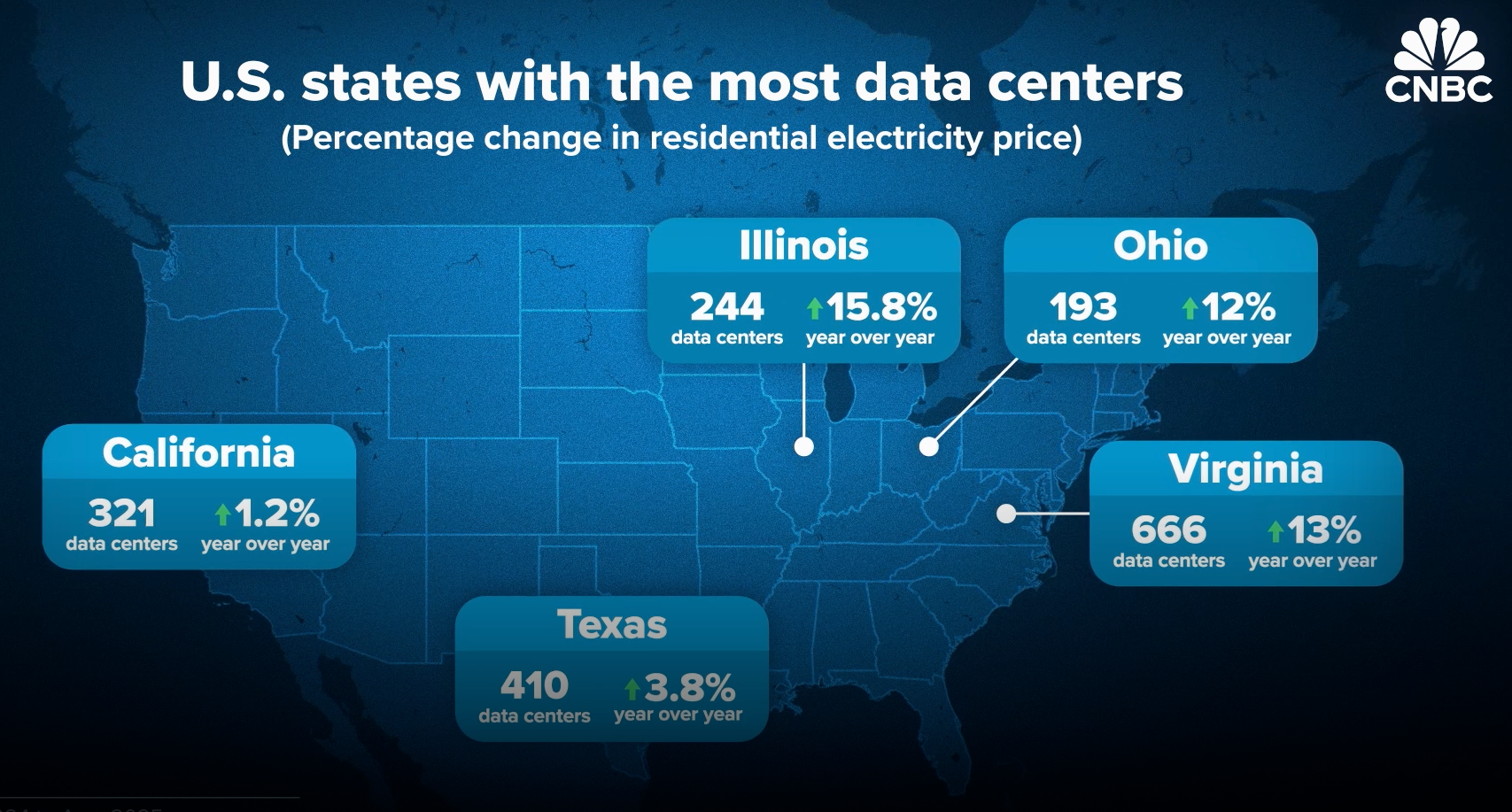
AI Data Center Power Demand Creates New Political Challenge
The rapid expansion of artificial intelligence infrastructure is creating a growing energy challenge for the Trump administration as the 2026 midterms approach. Tech companies are racing to build massive AI data centers across the U.S., but the facilities require enormous amounts of electricity—often comparable to the demand of small cities. Utilities warn that the surge in AI investment could strain the power grid in some regions, forcing policymakers to confront difficult choices about how quickly to expand energy generation and transmission capacity.
The issue is increasingly spilling into national politics as leaders weigh how to meet AI-driven power demand while balancing climate goals and energy policy priorities. Republicans argue the U.S. must expand domestic energy production—including fossil fuels—to remain competitive with China in AI development, while many Democrats emphasize scaling renewables and modernizing the grid. As AI becomes a central economic and national security priority, decisions about how to power the industry are emerging as a new policy and political fault line heading into 2026.
Read More.
Trump Presses House Republicans to Advance SAVE Act
President Donald Trump is urging House Republicans to prioritize the Safeguard American Voter Eligibility Act (SAVE Act), a proposal that would require proof of U.S. citizenship to register to vote in federal elections. Speaking to GOP lawmakers during their annual retreat, Trump warned he would be reluctant to sign other legislation unless Congress advances the bill, elevating it as a central legislative priority for the administration.
The measure has become a key Republican messaging issue on election integrity ahead of the 2026 midterms, with supporters arguing it would strengthen voter eligibility requirements. Democrats and voting rights groups, however, have raised concerns that stricter documentation rules could make voter registration more difficult for some Americans, setting up a likely partisan fight in Congress.
Read More.
ON THE HORIZON
Upcoming Elections:
March 17:
Illinois
March 31:
Arkansas Runoff
April 16:
NJ-11 Special General