AxIndex, Edition 6
SNAPSHOT
Our Top 3:
1) Redistricting Fights Come to Courts and Ballots: Redistricting battles are intensifying across the country, with courts and ballot measures shaping the electoral landscape well before 2026. Missouri’s Supreme Court upheld mid-decade redistricting using existing census data, while Virginia’s high-stakes referendum is drawing tens of millions in outside spending to influence congressional maps.
2) Big Money’s Influence Faces Limits in Key Primaries: While large spends dominate in races and ballot measures, the Illinois primaries delivered mixed results for outside groups, particularly those tied to AIPAC, which spent more than $20 million across multiple races. While some preferred candidates won, others lost despite significant financial backing, highlighting that heavy spending can shape outcomes. The results underscore a key dynamic for 2026: outside money remains powerful, but candidate positioning and local dynamics still matter.
3) Democratic Gains at the State Level Signal Early Momentum: Democrats have flipped 29 Republican-held state legislative seats over the past 14 months, including a recent win in a Florida district covering Mar-a-Lago, marking an early warning sign for Republicans ahead of the midterms. Driven in part by cost-of-living concerns, these gains could have downstream impacts on redistricting, policy, and the candidate pipeline, with both parties increasingly viewing state races as a leading indicator of national political trends heading into 2026.
National Sentiment Tracking
Trump Approval: Polarized Map, Battleground Pressure
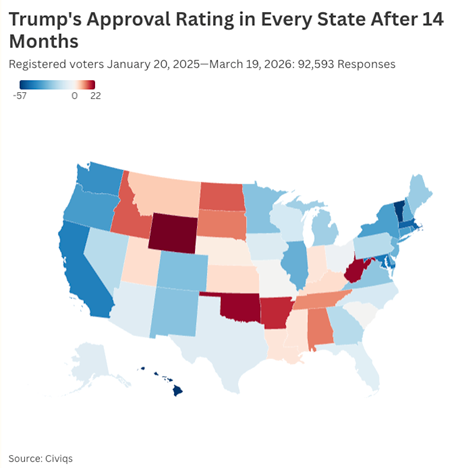
Nearly 14 months into his second term, Donald Trump is holding his base but remains underwater overall. New Civiqs data puts him at 39% approval / 57% disapproval (–18 net), a stable but constrained position heading into a midterm cycle.
The battleground map tells the real story. Arizona (-8) and North Carolina (-10) are still within reach, with Wisconsin (-11) close behind. But the challenge sharpens in the core tipping-point states: Pennsylvania, Nevada, and Georgia (-17), and Michigan (-21), where disapproval is more baked in.
The takeaway: there’s no breakout state right now, but there doesn’t need to be. This is a turnout election environment. Trump’s floor keeps the map competitive, but his ceiling continues to cap upside in the states that will actually decide control. Read More.
Poll Shows American Support Voter ID, but Unsure on Save Act
When it comes to the SAVE Act, a new CBS poll shows voters are aligned on the idea, but not the actual policy. The core of the “SAVE America Act," requiring proof of citizenship to register to vote, draws strong support (66%), roughly two-thirds of Americans.
But that support doesn’t translate to the legislation itself. When asked about the SAVE Act, just 28% support it, 31% oppose, and 41% aren’t sure, a major drop-off once the policy gets specific.
Even among Republicans, support is soft and uneven: 60% support, 6% oppose, 34% unsure. Regardless of politics, only a small share say they know the details, while roughly half don’t know much at all.
Voters broadly support voting ID requirements in principle, but opinions on specific legislation remain unsettled, with awareness of proposed policies low heading into 2026. Read More.
HOUSE HIGHLIGHTS
Polling At A Glance
House
RCP Average Generic Ballot: 47.4 Dem - 42.5 GOP (D +4.9)
On this day in:
2022: 45.0 GOP - 41.8 Dem (R+3.2)
2018: 46.0 Dem - 39.5 GOP (D+6.5)
Recent Polls
The Alabama Poll (AL-01 GOP Primary): Carl 28, Marques 19
St Anslem (NH-02 General): Goodlander (D-i) 48, Tang Williams (R) 36
Cook Ratings
TX-23: Solid R to Likely R
CA-48: Toss-up to Lean D
Retirements
Notable retirements from Congress are beginning to come out as the election year gets underway. The current total sits at 56 incumbent members (21 Democrats / 35 Republicans) of the House who have announced they are not seeking re-election.
For context, during the first Trump term, there were 52 retirements from the House.
Illinois Primaries Show Limits of Big Money Influence
Four Democratic House primaries in Illinois delivered mixed results for outside groups, particularly those tied to AIPAC, which spent more than $20 million to shape the races. While some candidates backed by pro-Israel and tech-aligned spending won, others prevailed despite being outspent, highlighting that heavy financial investment does not guarantee victory.
The results underscore the complex role of outside money in 2026 primaries: large spending can tip close races but can also energize opposition and become a liability. As super PAC involvement expands, these contests suggest that candidate positioning and local dynamics remain critical, even in heavily funded races. Read More.
Barr Senate Run Opens Long-Shot Opportunity for Democrats in Kentucky
Rep. Andy Barr’s decision to run for Senate is creating a rare open-seat opportunity in Kentucky’s 6th District, a seat Republicans have comfortably held for over a decade. While Democrats acknowledge they would have had little chance against Barr, his departure has put the district on their target list, with candidates emphasizing affordability and crossover appeal to compete in the GOP-leaning seat.
Still, the path remains steep. The district has trended more Republican in recent years, and early signs suggest it is not a top-tier battleground, with limited outside spending and skepticism from GOP strategists. Even without an incumbent, the race highlights both the opportunities and limits Democrats face in expanding the House map ahead of the 2026 midterms. Read More.
Redistricting
Missouri Supreme Court Upholds Mid-Decade Redistricting
The Missouri Supreme Court ruled 4–3 that state lawmakers acted within their constitutional authority when they redrew congressional districts in 2025 using the same census data from 2022. The majority found that the state constitution does not explicitly prohibit mid-decade redistricting, allowing the legislature to pass a new map backed by Gov. Mike Kehoe and President Donald Trump.
The decision clears the way for a map that could shift political control, potentially flipping a Democratic-held Kansas City seat to Republicans, but the fight is not over. Opponents are pursuing a referendum to block the map, setting up a continued legal and political battle over redistricting ahead of the 2026 elections. Read More.
Massive Fundraising Gap Emerges in Virginia Redistricting Fight
A federal court rejected Republican efforts to block Utah’s court-ordered congressional map, clearing the way for districts that could give Democrats a viable path to one of the state’s four House seats in 2026. The map consolidates Democratic-leaning Salt Lake County rather than splitting it across multiple districts, and the court declined to intervene so close to the election calendar. The decision underscores how court rulings, even in reliably Republican states, are actively reshaping competitiveness and could influence the fight for House control.
Read More.
SENATE HIGHLIGHTS
Retirements
So far, 10 Senators have announced their retirement from the chamber at the end of the current Congress.
Stratton Wins Illinois Primary, Boosting Pritzker’s Influence
Illinois Lt. Gov. Juliana Stratton is projected to win the Democratic primary to replace retiring Sen. Dick Durbin, defeating Reps. Raja Krishnamoorthi and Robin Kelly, despite being significantly outspent. Stratton’s victory was bolstered by strong backing from Gov. JB Pritzker, who invested millions through an aligned outside group and put his political capital behind her bid.
With Illinois solidly Democratic, Stratton is now the clear favorite in November, making the primary the decisive contest. The result elevates Stratton to the national stage and strengthens Pritzker’s influence within the party as he continues to emerge as a potential 2028 presidential contender. Read More.
Oklahoma Senate Appointment Sets Up Competitive Open Seat
Oklahoma Gov. Kevin Stitt has appointed energy executive Alan Armstrong to temporarily fill the Senate seat vacated by Sen. Markwayne Mullin, who was confirmed to lead the Department of Homeland Security. Stitt highlighted Armstrong’s business background and alignment with President Donald Trump’s energy agenda, but under state law, Armstrong is expected to pledge not to run for a full term, effectively creating an open-seat race later this year.
The appointment is already triggering early political maneuvering. Rep. Kevin Hern launched his bid and has already received endorsements from Leader Thune and Senator Tim Scott. With candidate filing set for April and a primary scheduled for June 16, the seat is poised to become a fast-moving and closely watched contest in the 2026 cycle. Read More.
Polling At A Glance
Recent Polls
PPP (NC General): Cooper (D) 47, Whatley (R) 44
Quantus Insights (TX GOP Runnoff): Paxton 49, Cornyn (i) 41
St. Anslem (NH GOP Primary): Sununu 49, Brown 48
St. Anslem (NH General): Pappas (D) 46, Sununu (R) 43
St. Anslem (NH General): Pappas (D) 47, Brown (R) 38
IN THE STATES
State-Level Gains Signal Early Democratic Momentum
Democrats have flipped 28 Republican-held state legislative seats over the past 14 months, including wins in deep red states like Texas, Arkansas, and Mississippi, an early warning sign for Republicans ahead of the 2026 midterms. Some of these victories have even broken GOP supermajorities, raising concerns about turnout and voter enthusiasm.
Both parties see these races as a preview of the midterm environment, particularly as cost-of-living issues continue to drive voter sentiment. Democrats are expanding their map and investing heavily in state legislatures, where control impacts redistricting, while Republicans are focused on mobilizing low-propensity voters, setting up an increasingly competitive landscape heading into 2026. Read More.
Democrat Flips Florida Seat in Trump’s Backyard
Democrat Emily Gregory won a special election in a Florida state legislative district that includes Mar-a-Lago, flipping a seat Republicans had carried by 19 points in 2024 and defeating a Trump-endorsed candidate. The upset marks one of the most notable Democratic wins in a series of recent special elections, including in traditionally Republican areas.
Democrats are pointing to the result as further evidence of growing momentum ahead of the 2026 midterms, particularly as affordability concerns continue to drive voter sentiment. The victory in a district tied closely to President Donald Trump underscores potential vulnerabilities for Republicans, even in areas that have recently leaned heavily GOP. Read More.
EMERGING NARRATIVES
RNC Financial Advantage Over DNC Continues to Grow
The Republican National Committee significantly widened its fundraising lead over the Democratic National Committee in February, bringing in $18.5 million compared to the DNC’s $10.3 million. Entering March, the RNC reported nearly $109 million in cash on hand, about seven times more than the DNC’s $15.9 million, while Democrats also carry more debt than cash, driven by a $15 million loan taken out last year.
The growing financial gap could have major implications for the 2026 midterms, particularly as the Supreme Court considers raising limits on how much parties can spend in coordination with candidates. If approved, the change would allow the RNC to more directly deploy its cash advantage to support Republican campaigns, further amplifying the imbalance. Read More.
DCCC Launches Targeted Ad Blitz on Rising Gas Prices
House Democrats are launching a digital ad campaign blaming President Donald Trump and Republicans for rising gas prices tied to the Iran conflict, targeting voters in 44 competitive districts. The six-second ads will run on Facebook and Instagram and are geofenced to appear at or near gas stations, directly linking higher prices at the pump to GOP leadership.
The campaign reflects Democrats’ broader effort to center affordability ahead of the 2026 midterms, as gas prices have surged nationwide amid disruptions in global oil markets. While Republicans argue the increases are a short-term consequence of confronting Iran, Democrats are seizing on the issue as a tangible, everyday cost pressure for voters in key battleground districts. Read More.
ON THE HORIZON
Upcoming Elections:
March 31:
Arkansas Runoff
April 16:
NJ-11 Special General