Chris Pack Discusses Ripple Effect of Zohran Mamdani’s NYC Mayoral Primary Win

Chris Pack Discusses Ripple Effect of Zohran Mamdani’s NYC Mayoral Primary Win


AxAdvocacy Principal for Communications Chris Pack discussed the ripple effects of democratic socialist Zohran Mamdani’s upset victory in the New York City mayoral primary with The Hill’s Julia Manchester. Pack noted the win will fuel an ongoing shift to the left within the Democratic Party’s base.


Former NRCC communications director Chris Pack said the mayoral primary results are “a powder keg” that is “waiting to explode for Democrats.” 


“I’ve never seen such measured responses like we have seen from people like Jeffries and Schumer. It represents an ongoing passing of the torch from the old guard of the party to the younger generation that is far more extreme in their views,” Pack said. 


The full story can be viewed below or by clicking HERE


Republicans target vulnerable Democrats over Mamdani: ‘They own him’

The Hill 

By Julia Manchester

June 27, 2025

https://thehill.com/homenews/campaign/5372192-republicans-target-mamdani-new-york/


Republicans are seeking to use Zohran Mamdani’s apparent win in New York City’s Democratic primary to put Democrats on defense in House and Senate races ahead of 2026. 


A number of House Democrats facing competitive reelection bids have already moved to distance themselves from Mamdani, while House Minority Leader Hakeem Jeffries (D) and Senate Minority Leader Chuck Schumer (D) stopped short of endorsing Mamdani following his win on Wednesday. 


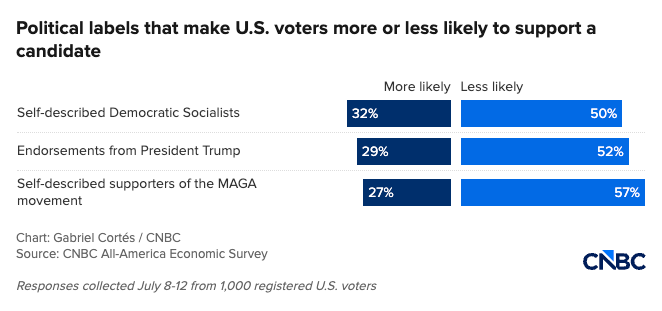
Mamdani’s affiliation with the Democratic Socialists of America, coupled with other far-left-leaning views is giving Republicans fodder to target Democrats in New York and beyond. 


“Every Democrat in America is going to have to answer for these insane positions,” Rep. Elise Stefanik (R-N.Y.) told The Hill. “They own him. This is how radicalized their party has become.” 


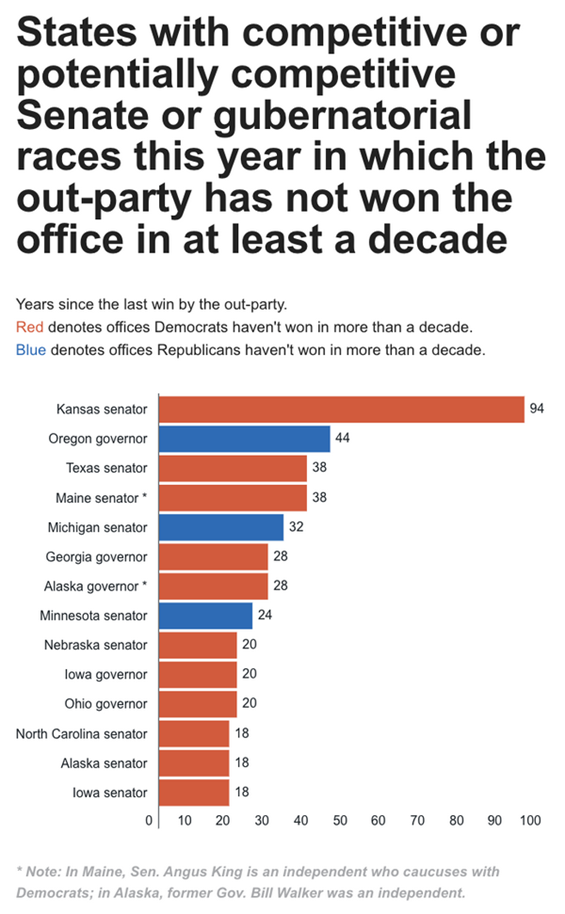
The National Republican Senatorial Committee (NRSC) tied progressives in Minnesota and Michigan to Mamdani in a statement following his presumed win on Wednesday. 


“The grassroots Democrat energy behind socialist Abdul El-Sayed in Michigan and radical Peggy Flanagan in Minnesota is a serious threat to everything Americans elected President Trump and Senate Republicans to protect,” said NRSC communications director Joanna Rodriguez. 

In a separate statement, National Republican Congressional Committee (NRCC) said every “vulnerable House Democrat will own” Mamdani. 


Reps. Laura Gillen (D-N.Y.) and Tom Suozzi (D-N.Y.), who are both facing competitive reelection bids, distanced themselves from Mamdani on Wednesday. Gillen referred to Mamdani as a “socialist” and “too extreme” in a statement, saying he is “the absolute wrong choice for New York.” 


Suozzi noted that the concerns he had about Mamdani prior to the primary “remain.”

The two top Democrats on Capitol Hill, Senate Minority Leader Chuck Schumer (D-N.Y.) and House Minority Leader Hakeem Jeffries (D-N.Y.) offered neutral takes on the race, congratulating Mamdani but stopping short of endorsing him. 


“Every race is different and everyone’s politics are different,” said Antjuan Seawright, an adviser to Jeffries. “We must give everyone breathing room to do what’s necessary in order for us to accomplish our mission in the House.” 


Former NRCC communications director Chris Pack said the mayoral primary results are “a powder keg” that is “waiting to explode for Democrats.” 


“I’ve never seen such measured responses like we have seen from people like Jeffries and Schumer. It represents an ongoing passing of the torch from the old guard of the party to the younger generation that is far more extreme in their views,” Pack said. 


Republicans are also trying to drag Mamdani into some of the region’s marquee governors’ races. 


Potential New York Republican gubernatorial candidates are also looking to cash in on Mamandani’s win. Stefanik and Mike Lawler (R-N.Y.) both sent out fundraising appeals, tying incumbent Gov. Kathy Hochul (R-N.Y.) to the likely Democratic nominee for New York City mayor. 


The Republican Governors Association also sought to tie New Jersey Democratic gubernatorial nominee Rep. Mikie Sherrill (D-N.J.) to Mamdani in a statement on Thursday. 


“It’s not that hard to disavow socialism, and Mikie Sherrill’s official comments saying she shares the goals of Socialist Zohran Mamdani is not only absurd, but it is disqualifying, period full stop,” the group said in a statement. 


Sherrill noted that she has disagreements with Mamdani in a statement, but agreed with him that affordability is a major issue for voters. 


“Voters want leaders who understand their daily struggles and are willing to throw out the old playbook to solve them, and while I have plenty of disagreements with Mr. Mamdani, I share his voters’ goal of making life more affordable,” Sherrill said. “I’m focused on my race and bringing costs down in New Jersey.”


Some Democrats who supported former New York Gov. Andrew Cuomo (D) in the primary argue that the GOP attacks are a natural consequence of Mamdani’s win.


“New York City primary voters have just handed Donald Trump a gift,” said Jon Reinish, a New York-based Democratic strategist. “Zohran Mamdani’s politics only translate and only are a thing in the most liberal districts in a primary.” 


Others note that the Mamdani’s upset win cannot be translated across the midterm map. 

“A Democratic primary for a mayoral race certainly doesn’t define the map or the math,” Seawright said. 


However, Republicans say that New York City’s sheer size and status as an economic giant allows Republicans to paint with a broad brush. 


“This is New York. It’s an emblem of America,” said Republican strategist Matt Beynon. “It is uniquely different.” 


The Democratic Congressional Campaign Committee (DCCC) said that efforts from their counterparts at the NRCC ultimately amounted to a distraction from Trump’s legislative agenda. 

“The NRCC is desperate to change the subject from the big, ugly bill, because they know their plans to strip health care and food assistance from everyday Americans to give tax cuts to the ultra-wealthy will cost them the House majority,” DCCC spokesman Viet Shelton said in a statement to The Hill. 


And it would not be the first time Republicans sought to tie Democrats, particularly in New York, to the city’s mayor. Last year, Republicans worked to tie New York Democrats to New York City Mayor Eric Adams (D) in the wake of his indictment on federal corruption charges. 


A number of New York-area House Democrats won their reelection bids, but Trump improved his performance in New York City and New York State last year. 


“It would be malpractice, frankly, not to highlight what’s going on in New York and saying this is what they want, this is the America they envision, and do you really want this?” Beynon, the GOP strategist, said.

By Bob Salera May 11, 2026
A Spring Congressional Update: What to Watch in the Months Ahead After a busy first four months of the year and with the remaining legislative calendar shrinking, it’s time to take a fresh look at the outlook for the three-month Congressional sprint to August. Appropriations: A Fresh Start — and Early Pressure In our January outlook , Congress was staring down a January 30th funding deadline. After one of the most turbulent funding cycles in recent memory — including a 43-day government shutdown last fall that became the longest in modern history — Congress managed to complete 11 of the 12 FY2026 appropriations bills. Congress recently released funding for the Department of Homeland Security – sans ICE and CBP – but only after swiftly approving a budget resolution to tee up a second reconciliation bill intended to provide multi-year funding for the immigration and border enforcement agencies. Now the clock is already ticking on FY2027 funding. The House is well underway, having reported out five Appropriations bills in the last two weeks of April. The House Appropriations Committee has laid out an ambitious markup schedule to complete its committee work by June. On the other side of the Hill, the Senate has held a flurry of hearings in April to examine the Administration’s budget request, with Administration officials making regular appearances before the Committee as the Senate charts its path for FY2027 funding bills. Whether Congress can complete some or any of these bills before the October 1 deadline, or whether the government once again stumbles into another continuing resolution or shutdown, remains the central fiscal question of the year. Whether it’s Vegas or Kalshi, the safe money is on a continuing resolution at least through the end of the year in order to avoid a messy spending fight a month before the midterm elections. Defense: Boosting the Budget, Expanding Priorities Boosting defense spending remains a top Administration priority, which has taken on increased importance as the military engagement with Iran has dragged on and strained military stockpiles. The Administration's new budget request proposes boosting defense spending to roughly $1.5 trillion — a sharp increase that Congress will have to grapple with as it approaches the NDAA and Appropriations bills this year. Traditionally, Congressional Appropriators tee up the defense funding bill early in the process, but in the House, it is currently scheduled to be the last bill to move through Committee, reflecting uncertainty over how to tackle the Administration’s request. A third reconciliation or a separate bipartisan supplemental funding bill are also options but face significant headwinds in the near term. The FY2027 NDAA is on the (short) list of bills Congress should get done this year with a June 4th mark-up scheduled in the House. The question is whether it becomes a lame duck Christmas tree. Transportation: A Must-Pass Deadline Looms Aside from the annual defense and appropriations work, the biggest legislative item on Congress's plate is the surface transportation reauthorization. The current authorization expires on September 30, 2026. Congress must either pass a new multi-year highway bill or risk leaving states without the long-term funding certainty they need to execute major infrastructure projects. Transportation Secretary Sean Duffy has been vocal about his "America is Building Again" agenda, pushing to streamline permitting and give states more control over environmental reviews. On the Hill, all eyes are on House Transportation and Infrastructure Committee Chairman Sam Graves and Ranking Member Rick Larsen as speculation over a markup date and an impending deal continues to dominate conversations in transportation circles. Optimists (me included) believe that the Graves-Larsen dynamic duo will strike a deal that will bring along a bipartisan coalition and reinvigorate business and labor stakeholders, and that a bill is possible this year. The theory goes that momentum from the House could spur action in the Senate, yet every week that passes makes it more difficult.  Additionally, water infrastructure, aviation safety and additional funding for air traffic control are on the agenda, and Congress is likely to act on these issues before the year concludes. The Bottom Line Congress enters the second half of the fiscal year with a full agenda and real deadlines but as the saying goes, the outlook is as clear as mud. A second and possibly third reconciliation bill shows that Republicans are looking to create additional pathways to advance their remaining priorities. A possible surface transportation bill, defense authorization, and end of year funding will all be big targets as the ‘last trains to leave the station’ after the midterms.
May 5, 2026
SNAPSHOT
By Bob Salera May 5, 2026
AxAdvocacy President Ashlee Rich Stephenson joined SiriusXM POTUS to discuss the midterm elections. "As we look toward the midterms, it’s important to remember there are always ebbs and flows. Right now, economic pressure, especially gas prices, is driving much of the conversation. If costs stay high through key moments like the Fourth of July and Labor Day, that creates a challenging environment for many candidates. At the end of the day, it comes down to a familiar reality, voters will side with whoever they believe is better for their pocketbook." Watch the full interview:
By Bob Salera April 30, 2026
Caught in the Red Tape? How to Use Effective Advocacy to Get Things Moving When a state regulation, policy, or licensing requirement is standing in the way of your business, don’t just get frustrated: get strategic. My dad always said, “You’ve got to know the rule to get around it.” That does not mean breaking the rules. It means understanding exactly what the law or policy says, why it exists, and how to work within the system to find a solution. Regulations can be complicated and changing them is not easy, but knowing the rules is the first step to effective advocacy. Here are five steps to help navigate state government and remove unnecessary barriers. Know the Rule Start by identifying the exact policy, regulation, or law creating the problem. You can do this by: Asking the regulator or government official to cite the exact rule they are enforcing Searching on the agency’s website, where most rules and policies are published Submitting a Freedom of Information request if needed Just as important as identifying the rule is understanding its history. Ask: What problem was this originally designed to solve? Knowing the intent behind the policy often reveals whether it is still relevant or if it has outlived its usefulness. Build Support Reach out to other similar businesses to see if they are experiencing the same issue. Even one or two additional voices can strengthen your position. Real stories, real costs, and real-world examples help decision-makers understand the impact. Stay Focused Once you understand the rule and have identified others with the same issue, develop a clear and simple message. Be able to explain: What the rule is How it is impacting your business Why it is unnecessary or unreasonable in today’s context What outcome would solve the problem Clarity matters. A focused message with a practical solution is far more effective than a long list of complaints. Work with the Agency Start where the issue lives, inside the agency. Speak first with the staff or office handling the matter. If you are not getting traction, identify agency leadership, including division directors, board members, or Governor-appointed agency heads. Request an in-person meeting when possible. Many issues improve significantly when decision-makers hear directly how the policy is affecting real businesses. Contact Your Elected Officials If working through the agency does not resolve the issue, loop in your state representative or senator. It is often best to begin by trying to work directly with the agency first, but keep your legislator informed along the way so they understand the issue if escalation becomes necessary. Elected officials can help connect you to the right people, ask questions on your behalf, and push for broader policy changes when needed. Key Takeaways Most people skip the first step of identifying the rule and miss opportunities to resolve the issues quickly. Many times, policies and laws are misunderstood or misapplied. Progress rarely comes from frustration alone, it comes from clarity, persistence, and collaboration.
April 22, 2026
SNAPSHOT
April 14, 2026
Seasoned Arkansas Policy Leader Mischa Martin Named Arkansas Principal