AxIndex, Edition 14
SNAPSHOT
Our Top 3:
1) Senator Graham’s Death Sends Shockwaves Through Congress:
Longtime South Carolina Sen. Lindsey Graham died Sunday after suffering an aortic rupture, prompting tributes from President Trump, congressional Republicans, and leaders around the world who praised his decades of leadership on national security and foreign policy. Beyond the personal loss, Graham's death creates immediate challenges for Senate Republicans, shrinking their majority to 52-47 and complicating an already crowded July agenda that includes confirming Attorney General nominee Todd Blanche, advancing the annual National Defense Authorization Act (NDAA), and negotiating a $350 billion defense spending package. As Budget Committee chair and one of Trump's closest allies in the Senate, Graham served as a key bridge between the White House and congressional Republicans, leaving uncertainty over who will shepherd those priorities in the weeks ahead. South Carolina Gov. Henry McMaster announced on Monday that Graham’s sister, Darline Graham Nordone, will serve the remaining months of Graham’s current term, which expires in January. A special election will be held next month to pick a new Republican nominee in the general election for Graham’s seat.
2) Long-Held Partisan Turf Is Suddenly in Play:
A set of races this cycle threaten to end partisan winning streaks that have outlasted entire political eras, and Lindsey Graham's sudden death has added South Carolina to that list of unsettled terrain. Texas Democrats, shut out of every statewide office since 1994, see their best opening in over three decades against Ken Paxton after a hotly contested Republican primary. Down-ballot, the same dynamic is playing out in Iowa, where a likely Rob Sand gubernatorial win could be entirely muted if Republicans hold their 67-33 state House supermajority, prompting outside money to flow into obscure legislative races most cycles would ignore. Whether these longstanding structural advantages hold or crack will be one of the clearest signals of how much 2026's national environment is overriding decades of state-level partisan lean.
3) Democratic Dysfunction Threatens a Favorable Cycle:
Even with the national environment tilting their way, Democrats are grappling with turmoil of their own making across several must-win races. In Maine, nominee Graham Platner withdrew after sexual assault allegations he denies, forcing a compressed replacement process ahead of a July 25 convention. In Arizona, the DCCC's $200,000 spend to boost Marlene Galán-Woods over Amish Shah in the 1st District primary is drawing backlash after committee-backed candidates already lost primaries in California and Maine. Layered on top, a wave of DSA- and Working Families Party-backed primary wins, including Melat Kiros's upset of longtime Rep. Diana DeGette in Colorado and a competitive Michigan Senate primary pitting Abdul El-Sayed against establishment-backed Haley Stevens, has some Democrats worried that visible intraparty fights could hand Republicans an opening to nationalize the midterms around division rather than the incumbent president. The common thread is a party whose top-down interventions and internal ideological fights are generating as much friction as momentum, right as it needs a unified footing to capitalize on a favorable cycle.
National Sentiment Tracking
Trump's Deportation Push Tests GOP's Texas Latino Gains
A new survey from the U.S. Hispanic Business Council found that one in five Hispanic business owners in Texas have had an employee deported in the past year, with 70 percent expressing a negative view of workplace immigration raids. The same survey shows Democratic Senate nominee James Talarico holding a 7-point lead over Republican Ken Paxton among Hispanic business owners, an outlier from recent polls that have the race closer to a dead heat. Separately, a New York Times
poll put Talarico's edge among Hispanic voters overall at 32 points, even as a plurality of respondents self-identify as Republican. Trump won Texas Latinos by 10 points in 2024, and Republicans redrew the state's congressional map last year, banking on those gains holding.
The findings point to real exposure in the districts most dependent on continued Hispanic support, since four of the five seats GOP mapmakers targeted to flip are majority-Hispanic. Immigration enforcement, once one of the GOP's strongest issues with Latino voters, is emerging as a liability as high-profile raids generate backlash even from some Republican officials in border districts. The bigger question is whether this softening reflects a durable shift away from the GOP or a temporary reaction that fades by November, with the Paxton-Talarico Senate race serving as the clearest early test.
Read More.
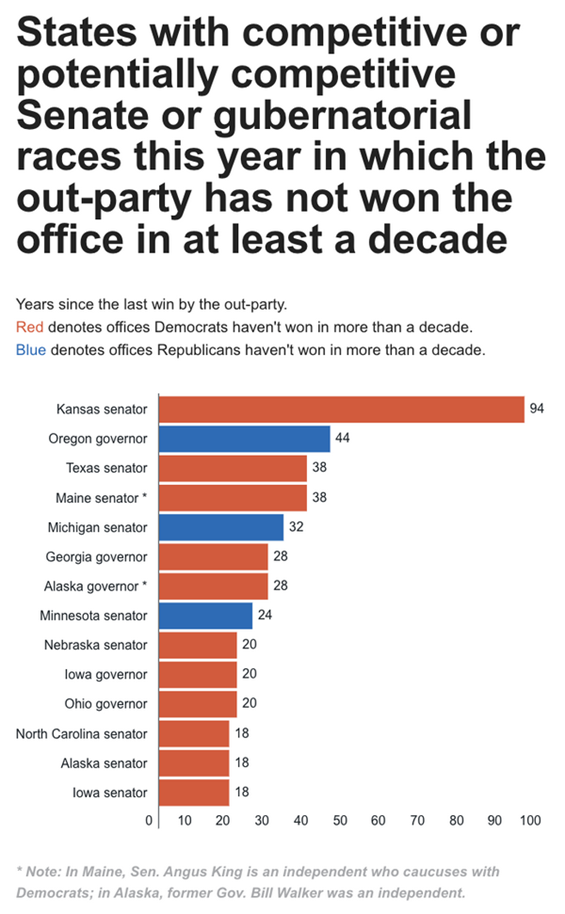
The Streak-Breakers: Decade-Plus Political Droughts On the Line This Fall
Sabato's Crystal Ball identifies several Senate and gubernatorial races this cycle where one party hasn't won the seat in at least a decade, some running considerably longer. Democrats haven't won any statewide office in Texas since 1994, with their Senate drought predating that; they see this year's U.S. Senate race as their best opening in three decades. Maine's Angus King has held the state's other seat as a nominal independent since 2012, but the last actual Democratic nominee to win a Maine Senate race was in 1988. Georgia Democrats broke a decades-long statewide drought last year with two Public Service Commission wins, and Keisha Lance Bottoms now polls ahead in her bid for governor. Alaska hasn't elected a Democratic-affiliated governor since Tony Knowles.
These streaks share a common mechanism: they've persisted mainly because state-level partisan lean outweighed any single cycle's national environment, not because Democrats lacked competitive candidates. A blue midterm changes that calculus but guarantees nothing, since streaks this long usually reflect structural factors — turnout patterns, infrastructure, recruitment — that don't reverse in a single cycle even under favorable conditions. Whether these seats actually flip, and how many do so together, will say more about the durability of 2026's political mood than any single marquee contest.
Read More.
HOUSE HIGHLIGHTS
Polling At A Glance
House
RCP Average Generic Ballot: 48.4 Dem - 43.1 GOP (D +5.3)
On this day in:
2022: 44.8 GOP - 42.3 Dem (R+2.5)
2018: 46.0 Dem - 40.1 GOP (D+5.9)
Retirements

For context, during the first Trump term, there were 52 retirements from the House.
Trump Endorses Seven First-Time House Candidates as GOP Defends Slim Majority
President Trump on Monday endorsed seven Republicans running for the House for the first time, including John Cowan (Ga.-11), Anthony DiLorenzo (N.H.-1), Jeanine Driscoll (N.Y.-4), Jenny Honeycutt (S.C.-1), Barb Regnitz (Ind.-1), Brent Taylor (Tenn.-9), and Steve Toth (Texas-2). Five of the seven have already clinched their party's nomination. Cook Political Report rates three of the districts, Cowan's, Taylor's, and Toth's, as solidly Republican, while Toth is notable as the only endorsee who defeated a sitting member, ousting Rep. Dan Crenshaw in the March primary by roughly 15 points.
Republicans hold a narrow 220-215 edge once the House is at full strength, meaning Democrats need to flip just six seats to retake the majority, a steep climb given the redistricting fights that reshaped maps over the past year. The mix of endorsements reflects Trump's dual strategy of shoring up safe seats, as with Taylor's redrawn Tennessee district, while also testing his brand in tougher terrain, including DiLorenzo and Regnitz's Democratic-leaning districts and Driscoll's head-to-head against freshman Rep. Laura Gillen in New York. Read More.
House Democrats’ Primary Meddling Is Backfiring in Arizona
The DCCC is spending $200,000 to boost Marlene Galán-Woods in Arizona’s 1st District, backing her over former state Rep. Amish Shah in a crowded primary for an open Phoenix-area seat now held by Republican Rep. David Schweikert. That comes after DCCC-backed candidates lost in California and Maine, while the committee says its support is aimed at maximizing Democrats’ chances in a must-win district. The result is a growing argument inside the party over whether Washington should be choosing primary winners at all, especially when the DCCC’s endorsements are starting to look like liabilities. Shah’s camp is framing the race as a test of grassroots support versus “D.C. insiders,” which is exactly the kind of fight the party would prefer to avoid in a swing-seat cycle. Read More.
Progressive Primary Wins Test Democrats' 2026 Coalition
Democratic Socialists of America and allied groups including Justice Democrats and the Working Families Party have notched a string of primary wins this cycle, including Melat Kiros's upset of longtime Rep. Diana DeGette in Colorado and several victories over incumbents in New York City. Nineteen sitting House Democrats and 20 nominated candidates carry backing from one of the three groups, while progressive-aligned Abdul El-Sayed is locked in a competitive Michigan Senate primary against establishment-backed Haley Stevens.
The trend has exposed a real strategic divide over how to run in a favorable midterm environment. Some Democrats worry high-profile progressive primary fights create an impression of disorganization that Republicans can exploit to nationalize otherwise favorable races. Others frame the wins as evidence that voters are rejecting a cautious establishment approach. Whether that energy translates into general-election strength, or instead hands Republicans an opening to make the midterms about intraparty division, remains one of the more consequential open questions of the cycle.
Read More.
SENATE HIGHLIGHTS
Polling At A Glance
Polling Averages
North Carolina: Cooper +6.9 (Flip)
Georgia: Ossoff +5.5
New Hampshire: Pappas +3.3
Ohio: Brown +0.6 (Flip)
Michigan: Primary 8/4
Iowa: Tie
Maine: Awaiting New Dem Nominee --> Tipping Point
Alaska: Primary 8/18
Texas: Paxton +0.6
Florida: Moody +7.5
Recent Polls
Wick (GA General): Ossoff (D-i) 47, Collins 43
Retirements
So far, 11 Senators have announced their retirement from the chamber at the end of the current Congress.

Platner’s Exit Sets Off Maine Democratic Scramble
Democrats' effort to unseat Sen. Susan Collins was thrown into turmoil after nominee Graham Platner withdrew from the race following allegations by a former girlfriend that he sexually assaulted her—claims he has repeatedly denied. His exit came after key Democratic leaders and allies pulled their support, forcing the party into a compressed replacement process ahead of Maine's July 27 ballot deadline. Attention has quickly shifted to a crowded field of potential successors, including former Maine Senate President Troy Jackson, Secretary of State Shenna Bellows, former Maine CDC Director Nirav Shah, former congressional candidate Jordan Wood, and Maine Beer Company co-founder Dan Kleban. Delegates will choose a nominee at a July 25 convention. While Democrats still view Maine as one of their best pickup opportunities, the late upheaval has forced the party to rebuild its campaign on the fly, raising new questions about whether it can quickly unite behind a nominee and keep one of the country's marquee Senate races competitive. Read More.
South Carolina Senate Race Thrown Into Chaos After Graham's Death
Republican Sen. Lindsey Graham, 71, died suddenly on July 11 after 23 years representing South Carolina in the Senate and just weeks after winning his GOP primary with 57 percent of the vote. Under state law, Gov. Henry McMaster will appoint a temporary replacement to serve through early January, while a special GOP primary is set for August 11, with a candidate filing window opening July 21. President Trump told NBC News he has a preferred replacement in mind but declined to name the person, while Rep. Nancy Mace is "strongly considering" a run after losing her gubernatorial primary bid in June, and 2026 primary runner-up Mark Lynch has already launched his campaign with a pledge of $5 million in personal funding. Rep. Joe Wilson and Nikki Haley have both taken themselves out of contention, while Rep. Ralph Norman is weighing a bid.
The seat was rated Solid R by Cook Political Report before Graham's death, and South Carolina hasn't elected a Democrat to the Senate since 1998, so the structural advantage still favors Republicans against Democratic nominee Annie Andrews. Still, the compressed primary timeline injects real uncertainty into what was a settled race, and the vacancy immediately tightens the GOP's working majority, with McConnell's hospitalization already limiting Republicans to 51 voting senators at a moment when the party needs every vote for the upcoming reconciliation package and Todd Blanche's AG confirmation.
Read More.
Senate Leadership Fund Banks Record $238 Million War Chest
John Thune's Senate Leadership Fund had $238 million in cash on hand at the end of June, more than double the $117 million it held at this point in the 2024 cycle and up from $104 million in 2022. SLF and its nonprofit affiliate One Nation raised a combined $140 million in the second quarter, building on $115 million in Q1, with roughly a third of donors giving to the group for the first time. Senate Majority PAC, the main Democratic super PAC aligned with Chuck Schumer, slightly outraised Republicans for the quarter at $147 million but holds just $126 million on hand, with SMP's standalone Q2 haul of $58 million trailing SLF's own $78.2 million.
The disparity in banked cash gives Republicans more room to maneuver as they defend red-state seats in Iowa and Ohio while also going on offense, with SLF and One Nation planning roughly $100 million in spending in New Hampshire, Georgia, and Michigan. Still, nonprofit spending restrictions could complicate that offensive push in states without an incumbent on the ballot, such as Georgia and North Carolina, meaning the cash advantage may not translate evenly across every battleground.
Read More.
IN THE STATES
The Supermajority Problem: Why Iowa's Governor's Mansion Might Not Be Enough
Rob Sand, Iowa's state auditor, is polling well enough to become the state's first Democratic governor in 16 years this November. But a Sand win would come without guardrails if Republicans hold their legislative supermajority, which lets them override any veto — a reality Govs. Laura Kelly of Kansas and Andy Beshear of Kentucky know well. That's pushing Democratic money downballot, into races like Jill Alesch's in suburban Des Moines and Mike Tupper's in Marshalltown, both bets on cracking a 67-33 Iowa House majority sitting at the bare minimum for a supermajority.
It mirrors a national fight: Democrats broke North Carolina's supermajority in 2024 to backstop Gov. Josh Stein, while Republicans work to prevent the same in Nevada and target Democratic chambers in Ohio and Kansas. Iowa Republicans aren't worried, pointing to a state that's "only trended more red." The bigger question is whether a marquee statewide win means much without the votes to match it.
Read More.
Ohio Ad Spending Surges to $749 Million as Senate, Governor Races Tighten
Ohio's projected 2026 political ad spending jumped from an initial $440 million estimate to $749 million, a 70 percent increase that makes it the fourth-most expensive state in the cycle, according to AdImpact's 2026 Political Ad Spending Report. The surge is driven by the competitive Senate race between Sherrod Brown and Jon Husted and a tighter-than-expected governor's race between Democrat Amy Acton and Republican Vivek Ramaswamy, along with heavy outside-group spending.
The revision shows how quickly Ohio has moved from afterthought to marquee battleground, with both statewide races now drawing resources once reserved for traditional toss-up states. Ohio's climb mirrors the national picture, where AdImpact projects a record $11.6 billion in overall midterm ad spending, concentrated in a handful of contests in states like Ohio, Texas, and Maine that could decide control of Congress. Read More.
EMERGING NARRATIVES
Swing-State Republicans Cold-Shoulder Trump's Midterm Convention
Of 28 Republican candidates in competitive races that Politico contacted about attending the RNC's first-ever midterm convention, dubbed "Trumpapalooza" by RNC Chairman Joe Gruters, only two responded. The gathering is set for September 9-10 in Dallas, chosen in part to spotlight the marquee Texas Senate race between Republican Ken Paxton and Democrat James Talarico. Likely Arizona gubernatorial nominee Andy Biggs is among those declining to commit, with his campaign saying travel plans haven't been finalized as it focuses on the July 21 primary.
The muted response signals a split within the party over how closely to embrace Trump ahead of November, particularly in statewide races where his approval rating could be a drag with undecided voters. Former Sen. Jeff Flake noted that candidates like Biggs have little incentive to tie themselves to the president right before early voting begins. Still, RNC officials argue that distancing from Trump would be a mistake, framing him as an enduring turnout asset for the base even if fewer candidates want to share a stage with him this cycle.
Read More.
Trump Plans Prime-Time Election Speech Following EAC Purge
President Trump is planning a Thursday prime-time address built around reexamined FBI files that will argue U.S. election infrastructure has vulnerabilities, including claims of Chinese access to voter data, according to people briefed on the plan. The speech follows last week's firing of all three remaining Election Assistance Commission members, the only federal agency devoted solely to election administration, leaving it without a quorum four months before the midterms. The White House cited the Supreme Court's Trump v. Slaughter ruling as justification for the removals.
The pairing signals a coordinated push to reshape both the narrative and the machinery around 2026 election security, even as courts have repeatedly blocked related mail-ballot and citizenship-verification orders. Democrats call the EAC firings a partisan power grab, while election officials warn the vacancy could stall voting-system certification ahead of November. Whether Thursday's address moves public opinion or simply escalates an already polarized fight over election trust remains the open question.
Read More.
AI Industry Super PACs Emerge as New Political Force
The two largest AI-focused super PACs, Leading the Future and Public First Action, have raised more than $200 million combined and spent at least $44 million backing 40 House and Senate candidates through June, per a CNBC analysis of FEC filings. Leading the Future backed 28 candidates, with 25 winning primaries and one loss; Public First Action backed 11, with all but one winning. Funding includes venture capital firms, AI executives, and a $20 million contribution from Anthropic to Public First Action restricted to public education rather than direct political spending.
Both PACs support some federal AI oversight but split on a key question: Leading the Future favors a single national framework preempting state AI laws, while Public First Action backs preserving state-level regulation. The near-uniform primary success of these AI-aligned candidates marks a new template for industry-specific spending, echoing crypto-backed PACs' 2024 playbook. Whether this yields durable legislative influence, or invites the same backlash crypto spending eventually drew, should become clearer once Congress takes up AI regulation. Read More.
ON THE HORIZON
Upcoming Elections:
July 21:
Arizona Primary
July 28:
South Dakota Primary Runoff
GA-13 Special General
August 4:
Kansas Primary
Michigan Primary
Missouri Primary
Virginia Primary
Washington Primary
August 6:
Tennessee Primary
August 8:
Hawaii Primary
August 11:
Alabama House Primary (CD 1, 2, 6, 7)
Connecticut Primary
Minnesota Primary
Vermont Primary
Wisconsin Primary
August 18:
Alaska Primary
Florida Primary
Wyoming Primary
CA-14 Special General
August 25:
Oklahoma Primary Runoff
September 1:
Massachusetts Primary
September 8:
New Hampshire Primary
September 15:
Delaware Primary