AxIndex, Edition 15
SNAPSHOT
Our Top 3:
1) Less Than 100 Days Out:
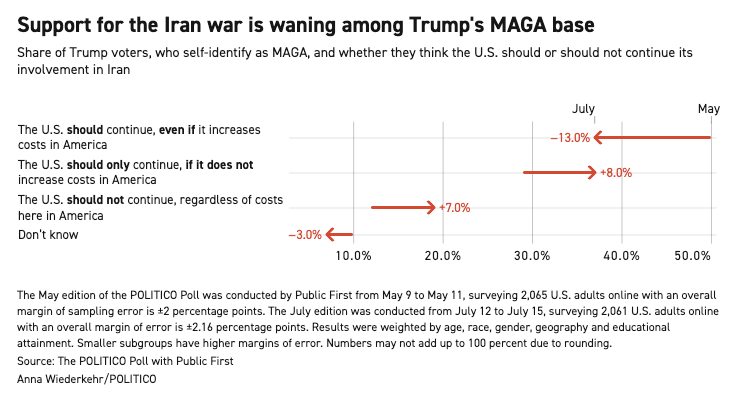
Latest forecasts from Decision Desk HQ give Democrats a 225-210 House edge while projecting Republicans hold a 50-50 Senate with Vice President Vance as tiebreaker. The DCCC marked the 100-day milestone with a digital ad campaign in 25 GOP-held districts hammering affordability, a message reinforced by cracks in the president's own coalition: a POLITICO poll found the share of MAGA voters who see the Iran war as worth its economic costs has fallen 13 points since May, with majorities in both camps now blaming the conflict for higher gas prices, and an Emerson poll put the generic ballot gap at 11 points. Yet money tells a more complicated story. Republican national committees and aligned super PACs, including the $400 million MAGA Inc., still held roughly $657 million cash on hand at the end of June, nearly double Democrats' $334 million, a gap widened further by a Supreme Court ruling loosening party-coordination rules, even as Democratic Senate recruits in Georgia, North Carolina, and Texas dramatically outraise their opponents. The big question heading into the fall is whether Republicans' committee-level cash advantage can offset a softening political environment and a candidate-fundraising deficit in several marquee races.
2) Data Centers Emerge as an Electoral Liability:
What was once a local zoning fight is now showing up in top-of-the-ticket messaging on both sides of the aisle. In Pennsylvania, Democrat Paige Cognetti is running a TV ad against freshman GOP Rep. Rob Bresnahan attacking data center secrecy, tax breaks, and rising electric bills, in one of the cycle's top House targets. New York became the first state to impose a year-long moratorium on large data centers, responding to a Gallup finding that 71% of Americans oppose data centers in their community, a figure that crosses party lines. Even Bresnahan, the Republican incumbent, has introduced his own bill limiting developers' ability to override local zoning denials. The convergence of grid-cost anxiety and community-control messaging suggests data centers are becoming a durable campaign issue rather than a passing NIMBY story, and clients with AI infrastructure exposure should expect this framing to spread to other swing districts with active buildouts.
3) Democrats' Left-Center Fight Moves to New Proving Ground:
Following progressive primary wins earlier this year, the party's next tests come in Michigan (Aug. 4) and Minnesota and Wisconsin (Aug. 11), where progressive candidates like Abdul El-Sayed and Peggy Flanagan face establishment-backed rivals in races that also split sharply over Israel policy. Maine Democrats already navigated a version of this fight, selecting progressive Troy Jackson to replace Graham Platner after his campaign collapsed amid a sexual assault allegation, in what could be one of the most competitive Senate races nationally. Progressive groups view the Midwest primaries as their best remaining chance to prove electability in genuine swing states, while establishment Democrats point to Maine as a cautionary tale about vetting and risk. The outcomes will shape not just November's map but the party's internal leverage heading into the open 2028 presidential primary.
National Sentiment Tracking
MAGA Turns on Iran War
Support for the Iran war is slipping even inside Trump’s MAGA base, where only a little more than a third now say the fighting is worth the economic cost, down 50 percent from May, according to a POLITICO/Public First poll. The drop underscores how the war is colliding with rising gas prices, midterm anxiety, and growing voter fatigue over escalation.
The poll found that 37 percent of self-identified MAGA Trump voters would keep U.S. involvement only if the costs do not rise, while nearly 1 in 5 say the U.S. should end the war regardless of cost. The strain is broader than the core base: only 21 percent of non-MAGA Trump voters still say the war is worth the economic cost.
Republicans warn the backlash could reshape the midterm battlefield, especially as the conflict keeps pushing up prices and forcing Trump to defend the war instead of focusing on his affordability message. Even as the White House argues the costs are temporary and necessary for national security, the polling suggests the president is running into a harder political limit. Read More.
Democratic socialists gain ground in CNBC poll
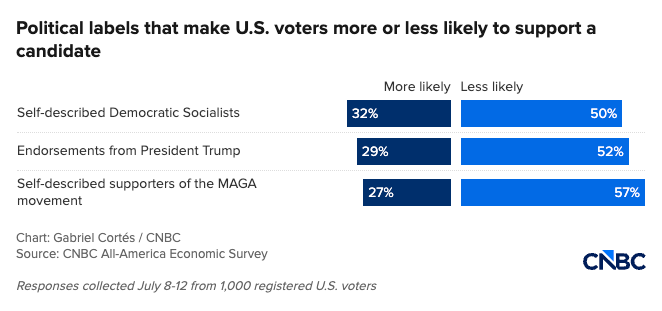
CNBC's All-America Economic Survey (July 8-12, 1,000 registered voters, +/-3.1% margin) found democratic socialist candidates polling better than MAGA-aligned or Trump-endorsed ones. Thirty-two percent of voters said they'd be more likely to back a self-described democratic socialist (50% less likely), versus 29% for a Trump-endorsed candidate (52% less likely) and just 27% for a self-described MAGA supporter (57% less likely). The same poll put Trump's approval at 40%, with Democrats holding a 4-point generic ballot edge, 49% to 45%.
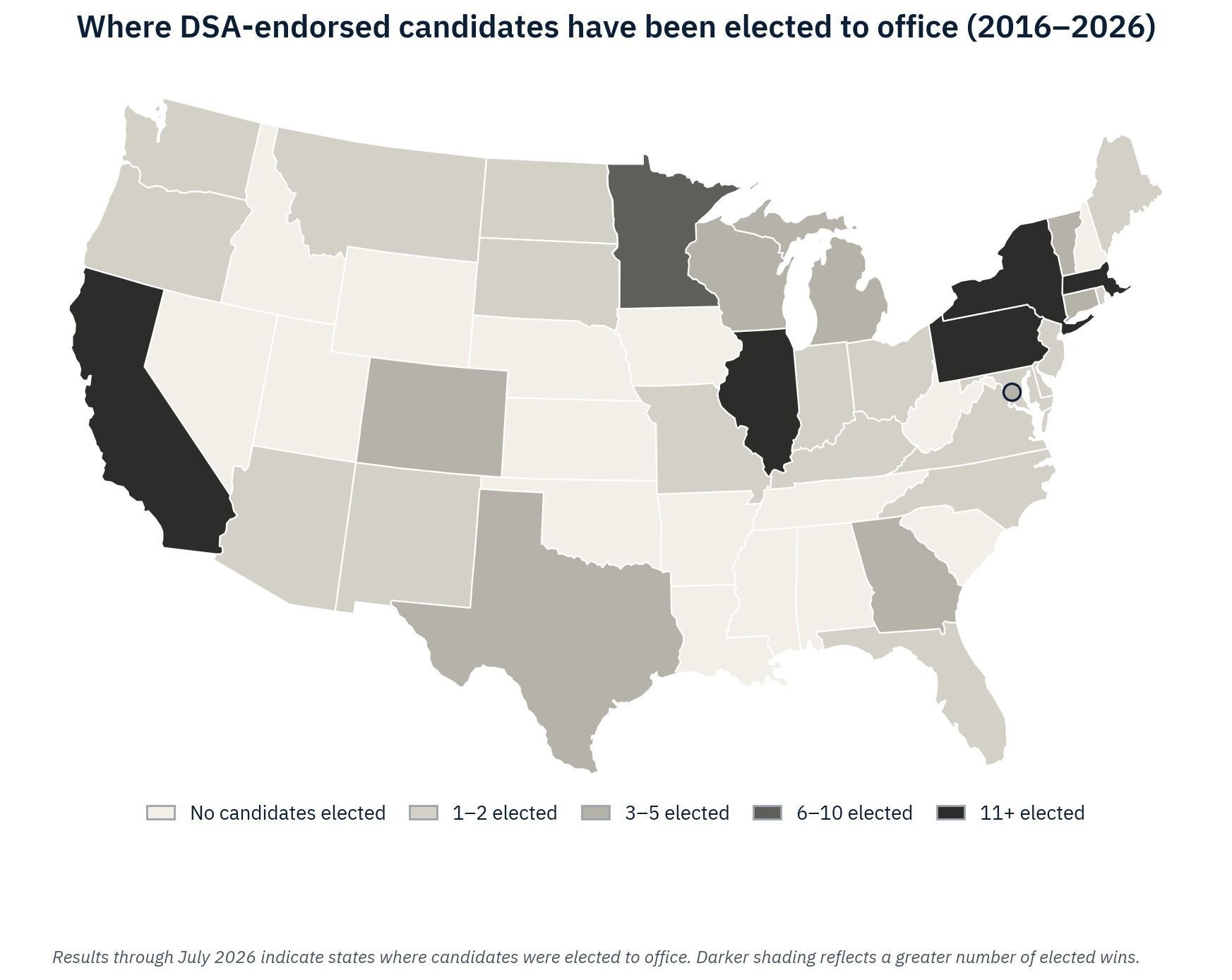
The result lands as democratic socialists keep winning Democratic primaries, a trend Republicans have branded as a communism referendum. Still, all three labels remain underwater overall. The big question is whether that framing keeps working for the GOP when its own brand polls worse, and whether Democrats are right to treat their left flank as a liability. Read More.
HOUSE HIGHLIGHTS
Polling At A Glance
RCP Average Generic Ballot:
48.9 Dem - 43.5 GOP (D +5.4)
On this day in:
2022: 44.9 GOP - 42.4 Dem (R+2.5)
2018: 46.7 Dem - 39.4 GOP (D+7.3)
Retirements

For context, during the first Trump term, there were 52 retirements from the House.
Democrats' Affordability Message Takes Center Stage as Midterm Forecasts Roll In
Decision Desk HQ's latest forecast, released 100 days out, gives Democrats a 225-210 House edge and projects Republicans holding a 50-50 Senate with Vice President Vance as tiebreaker. Republicans face headwinds from the escalating Iran war and rising oil prices, while Democrats contend with an intraparty fight after democratic socialist primary wins fueled GOP attacks that the party has drifted too far left. Marking the same milestone, the DCCC launched a digital ad Sunday in 25 GOP-held House districts hammering grocery and gas prices, urging voters to "remember in November." An Emerson College poll released the same week put Democrats' generic ballot lead at 11 points, wider than DDHQ's estimate.
Democrats' House edge fits the historical pattern of the president's party losing seats at midterm, and the DCCC's ad buy signals the affordability message will anchor the fall campaign. The Senate path remains steeper. Read More.
Pennsylvania Democrat Makes Data Centers a Top-Ticket Campaign Issue
Scranton Mayor Paige Cognetti launched a TV ad attacking AI data centers in her challenge to freshman GOP Rep. Rob Bresnahan, in one of Democrats' top House pickup targets. The ad hits developer secrecy around NDAs, state tax breaks, and rising electric bills, closing with "we are not for sale." The $200,000, two-week ad buy runs as opposition to data center buildouts, long a fixture of local zoning fights, spreads into a top-of-the-ticket contest. Bresnahan, who has drawn visits from both Trump and Vance, has introduced his own bill limiting developers' ability to sue over local zoning denials, though it hasn't moved out of committee.
The race signals data centers are becoming a genuine general-election liability rather than just a NIMBY issue, with a Democrat now running directly at a Republican incumbent on the same grid-cost and community-control arguments that have driven local pushback nationwide. Worth watching for advocacy clients: this kind of messaging could migrate to other swing districts with active data center fights. Read More.
SENATE HIGHLIGHTS
Polling At A Glance
Polling Averages
Georgia: Ossoff +7.6
North Carolina: Cooper +7.3 (Flip)
New Hampshire: Pappas +3.3
Ohio: Brown +0.6 (Flip)
Michigan: Primary 8/4
Iowa: Tie
Maine: Insufficient Data --> Tipping Point
Alaska: Primary 8/18
Texas: Paxton +0.6
Florida: Moody +9.0
Recent Polls
KSTP/SurveyUSA (MN Dem Primary): Flanagan 40, Craig 40
KSTP/SurveyUSA (MN GOP Primary): Tafoya 41, White 10, Weiler 7, Schwarze 5
UNH (ME General): Jackson (D) 49, Collins (R-i) 46
Fabrizio/Anzalone (GA General): Ossoff (D-i) 52, Collins (R) 43
Resonance Media (SC Special GOP Primary): Graham Nordone 21, Norman 17, Evette 10, Fry 7, Lynch 7, Sanford 7, Mace 3
Retirements
So far, 11 Senators have announced their retirement from the chamber at the end of the current Congress.

Democrats Post Strong Fundraising in Marquee Senate Races, but Committee-Level Gap Clouds the Map
Democratic Senate candidates significantly out-raised Republican opponents in several marquee races through Q2: Georgia's Jon Ossoff holds a 20-to-1 cash edge over Rep. Mike Collins, North Carolina's Roy Cooper outraised Michael Whatley $8.2 million to $2.9 million, and Texas's James Talarico ended June with $21.5 million on hand to Ken Paxton's $1.8 million. Republicans lead elsewhere: Maine's Susan Collins sits on $11 million while Democrats scramble for a nominee after Graham Platner's exit, and in Michigan, GOP nominee Mike Rogers has built a cash lead as Democrats burn resources ahead of an Aug. 4 primary.
That candidate-level edge cuts against a committee-level picture favoring Republicans, whose Senate arm held roughly $49 million to Democrats' $39 million in May, an edge the GOP expects to matter more after a Supreme Court ruling loosened party-coordination rules. Democrats need a net gain of four seats for the majority. Read More.
Troy Jackson Named Maine Democrats' New Senate Nominee After Platner Exit
Maine Democrats selected former state Senate President Troy Jackson as their new U.S. Senate nominee at a Bangor convention Saturday, replacing Graham Platner, who withdrew earlier this month after a woman accused him of sexual assault, which he denies. Jackson, a fifth-generation logger and progressive backed by Bernie Sanders, beat out other potential contenders like Secretary of State Shenna Bellows and former state CDC director Nirav Shah, both of whom bowed out to unify the party. He'll face GOP Sen. Susan Collins, who already has more than $11 million cash on hand versus roughly $1 million raised by Jackson since entering the race, and who is moving to brand him as a "Bernie bro" aligned with democratic socialists.
The race remains one of the most closely watched in the country given Collins is the only GOP senator representing a state Trump has never won. Jackson's rural, working-class profile may blunt some of Collins' attacks, but Democrats now face a compressed 101-day sprint to build name recognition and financial parity in a race central to Senate control.
Read More.
Crowded GOP Field Set for South Carolina's Special Senate Primary
At least 10 Republicans filed for South Carolina's Aug. 11 special primary to fill the remainder of the late Sen. Lindsey Graham's term, following his death earlier this month at 71. The field includes Rep. Ralph Norman, backed by Rep. Nancy Mace and other House colleagues; Rep. Russell Fry, leaning on his pro-Trump profile; former Gov. Mark Sanford, attempting another comeback; and Darline Graham, the late senator's sister and interim appointee, who has Trump's endorsement. A runoff follows Aug. 25 if no one clears a majority. Charleston physician Annie Andrews won the Democratic nomination in June.
The compressed timeline has turned an otherwise safe seat into a test of Trump's sway within the state party, since his backing of Darline Graham came before she'd even announced. With no Democrat having won statewide in South Carolina in two decades, the real contest is the GOP primary, and a fractured field raises the odds of a runoff before November.
Read More.
IN THE STATES
New York Becomes First State to Impose Statewide Data Center Moratorium
Gov. Kathy Hochul signed an executive order July 14 imposing a one-year moratorium on new large data centers, defined as those drawing 50 megawatts or more of power, making New York the first state to enact such a ban. The pause blocks new discretionary permits while the state develops a regulatory framework addressing grid capacity, utility rates, and environmental impact; hospitals, universities, and smaller facilities are exempt, and the order pre-empts related state legislation. A Gallup survey found 71% of Americans somewhat or strongly oppose data centers in their communities, with opposition crossing party lines: 75% of Democrats, 63% of Republicans, and 74% of independents.
New York's move lands amid a broader wave of state and local pushback: at least 11 states have introduced similar legislation this session, and Pennsylvania, Minnesota, and other legislatures are weighing their own moratoriums. For an industry racing to build AI infrastructure, the New York order is a signal that public opposition to data centers, once mostly a local zoning fight, is becoming a statewide political liability. Read More.
DNC Panel Sets 2028 Early-State Calendar, Keeps Iowa Off Top Tier
The DNC's Rules and Bylaws Committee voted to select six early-window states for 2028 — South Carolina, Nevada, New Hampshire, New Mexico, Michigan, and Virginia — with South Carolina and Nevada the leading contenders to go first. The decision, which still needs full DNC approval at the August 13-15 summer meeting, continues the party's post-2020 shift away from Iowa and New Hampshire toward states seen as more representative of the party's Black and Latino base. RBC co-chairs Minyon Moore and James Roosevelt Jr. framed the calendar as designed to "battle-test" candidates while keeping the race affordable and open for contenders without early money or name recognition.
With no incumbent or clear frontrunner, the calendar carries outsized weight in shaping which 2028 hopefuls build momentum first; prospective candidates have already been cultivating relationships in South Carolina and Michigan. Progressive voices like Rep. Alexandria Ocasio-Cortez welcomed not "rubber-stamping" the same order each cycle, signaling the process itself has become part of the broader intraparty debate over direction heading into the next presidential primary. Read More.
EMERGING NARRATIVES
Republican Party Committees Hold Nearly 2-to-1 Cash Edge Over Democrats Heading Into Fall
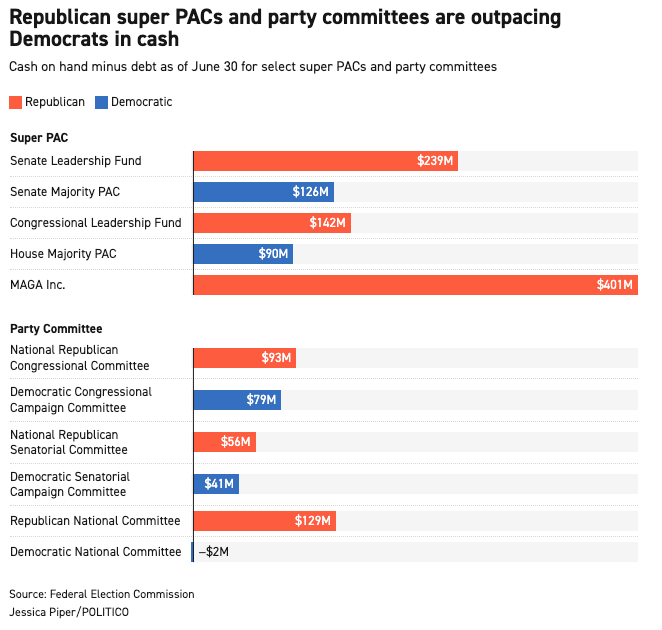
Republican national party committees and their aligned super PACs reported $657 million cash on hand at the end of June, nearly double Democrats' $334 million, according to the latest FEC filings. The gap widens further when factoring in MAGA Inc., the pro-Trump super PAC with roughly $400 million on hand and no Democratic equivalent. Broken down by committee: the RNC held $128.5 million to the DNC's $16.3 million (which also carries $18.5 million in debt), while the NRSC and NRCC outpaced the DSCC and DCCC as well. Republicans expect the gap to matter more after last month's Supreme Court ruling loosened coordination rules between party committees and candidates.
The imbalance sits in tension with individual Senate candidates, where Democrats have generally outraised Republican opponents in top-tier races. Democratic strategists worry the committee-level gap could blunt a favorable environment, while donor apprehension about the DNC's messaging and direction has been cited as a factor in the shortfall.
Read More.
Michigan, Missouri Primaries Set Up Next Test of Democrats' Israel Divide
The Aug. 4 Democratic primaries in Michigan and Missouri will serve as the next major test of the party's fracturing consensus on Israel. In Michigan's Senate race, centrist Rep. Haley Stevens defends the existing US-Israel security relationship against progressive Abdul El-Sayed, who has called Israel a "rogue state" committing genocide; AIPAC has spent nearly $30 million backing Stevens. In Missouri, Israel critic and former Rep. Cori Bush is trying to reclaim the seat she lost two years ago to Rep. Wesley Bell, who takes a more mainstream position. National Gallup polling cited in the piece shows American favorability toward Israel falling from 75% in 2021 to 46% this year.
This year's primaries have split along familiar lines: progressive Israel critics winning safe blue seats, centrists prevailing in swing districts that determine control of Congress. Michigan draws outsized attention because an El-Sayed win would be the first breakthrough for an Israel critic in a genuinely competitive general election, a result that would reverberate well beyond this cycle and into the 2028 presidential primary.
Read More.
Election Officials Wary as Voters Turn to AI Chatbots for Voting Information
Secretaries of state gathered at a recent national conference voiced caution about voters using AI chatbots like ChatGPT and Claude to find voting information, citing risks of outdated, hallucinated, or overly generic answers. West Virginia's Kris Warner noted chatbots can misfire on hyper-local queries, like conflating one state's "Harrison County" with the seven others by that name, and New Hampshire's David Scanlan cited the 2024 AI-generated Biden robocall as a reason his office keeps steering voters back to official sources. AI companies say they're building in safeguards: OpenAI is partnering with the AP and Democracy Works, and Anthropic is rolling out a banner directing election queries to Democracy Works.
Some officials see upside rather than just risk. Ohio's office built an internal chatbot, Eva, to help election workers navigate procedures, though it still requires human verification and struggles with future election dates. Maine, by contrast, says the technology remains too unproven on cybersecurity grounds to trust with election administration. The split illustrates a broader challenge: AI adoption in the civic information space is outpacing officials' confidence in its reliability. Read More.
ON THE HORIZON
Upcoming Elections:
July 28:
South Dakota Primary Runoff
GA-13 Special General
August 4:
Kansas Primary
Michigan Primary
Missouri Primary
Virginia Primary
Washington Primary
August 6:
Tennessee Primary
August 8:
Hawaii Primary
August 11:
Alabama House Primary (CD 1, 2, 6, 7)
Connecticut Primary
Minnesota Primary
Vermont Primary
Wisconsin Primary
August 18:
Alaska Primary
Florida Primary
Wyoming Primary
CA-14 Special General
August 25:
Oklahoma Primary Runoff
September 1:
Massachusetts Primary
September 8:
New Hampshire Primary
September 15:
Delaware Primary