AxIndex, Edition 16
SNAPSHOT
Our Top 3:
1) Economic Anxiety Deepens Heading into the Midterms:
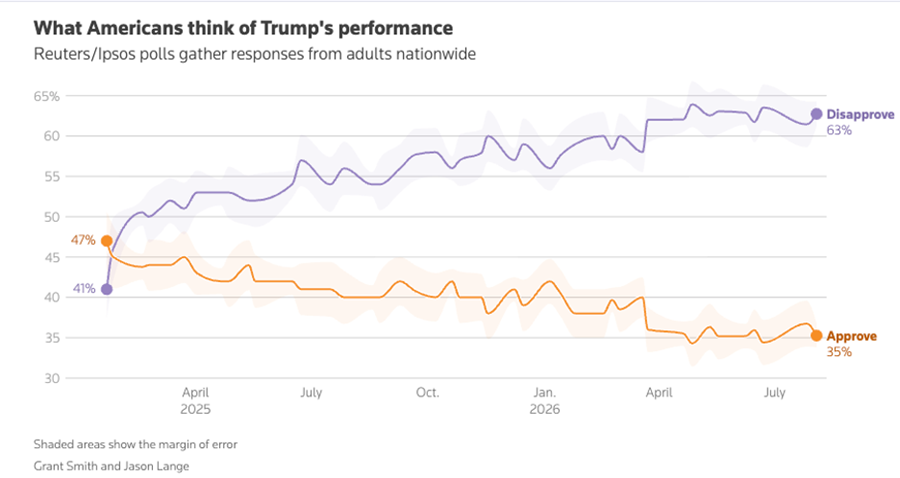
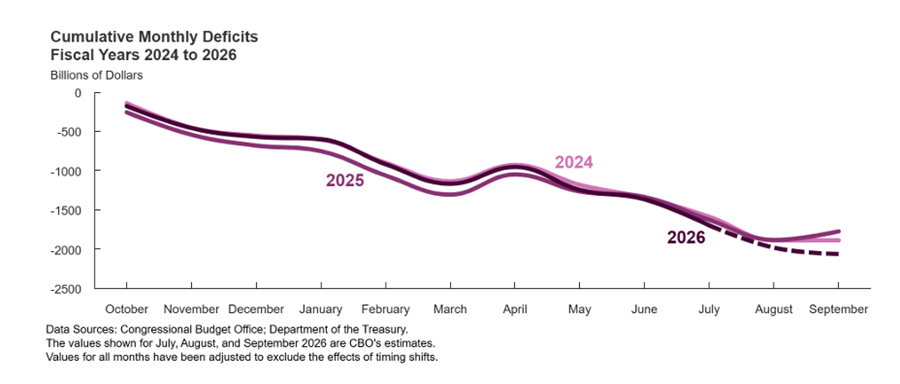
The economic backdrop heading into the midterms carries real headwinds, though the underlying picture is more mixed than the topline numbers suggest. Second-quarter GDP grew at a 1.5% annualized rate, down from 2.1% in the first quarter, and July's jobs report showed employers cutting 23,000 jobs with May and June payrolls revised down by a combined 103,000; consumer spending and business investment, by contrast, have held up comparatively well. Weaker hiring, softer labor-force participation, and gas prices around $4.10 a gallon are still shaping voter sentiment, a dynamic reinforced by CBO's latest deficit projection of $2.1 trillion for fiscal 2026, as tariff revenue comes in below expectations following the Supreme Court's ruling striking down the administration's IEEPA tariffs. Amid these reports, Trump's approval has slipped to 35%, and a Reuters/Ipsos poll found Democrats narrowly edging ahead on economic trust, though within a range incumbent parties have typically closed in the final stretch. The bigger strategic question is whether Republicans can pair a still-resilient consumer economy with a unified affordability narrative before Democrats lock in a cost-of-living message of their own.
2) Progressive Democrats Keep Momentum, but Wisconsin Will Test Its Limits:
Abdul El-Sayed's narrow Michigan Senate primary victory gave the Democratic left its most consequential statewide win yet, making him the first progressive to capture a statewide nomination in a state Trump carried in 2024. The result followed other progressive gains, including Donovan McKinney’s defeat of Rep. Shri Thanedar in Michigan, but the same night also delivered a reminder that the trend is not universal: former Rep. Cori Bush lost her Missouri rematch against Rep. Wesley Bell. The Aug. 11 Wisconsin gubernatorial primary is the next major test. Democratic socialist state Rep. Francesca Hong leads the four-way field, running on a cost-of-living-focused populist message, while Milwaukee County Executive David Crowley, backed by outgoing Gov. Tony Evers, has become the establishment’s chief vehicle for stopping her. Crowley and Evers warn that Hong could put a critical swing-state governorship at risk against Republican frontrunner Tom Tiffany; Hong argues that her coalition can bring new voters into the electorate.
3) Both Parties Maneuver to Rewrite the Rules of Engagement:
With competitive seats increasingly scarce, both parties are turning to structural fights that could shape elections well beyond November. Maryland Gov. Wes Moore signed legislation placing a constitutional amendment before voters that would clear the way for Democrats to redraw congressional lines and eliminate Republicans' last House seat, mirroring GOP-led mid-decade redistricting elsewhere. A parallel fight is playing out over ballot initiatives, with as many as nine states weighing measures to raise the bar for citizen initiatives, mostly in Republican legislatures reacting to progressive wins on abortion rights and minimum wage. Uncertain they can win the next fight on the merits, both parties are working just as hard to control the terms on which it's fought.
National Sentiment Tracking
Democrats Edge GOP on Economy
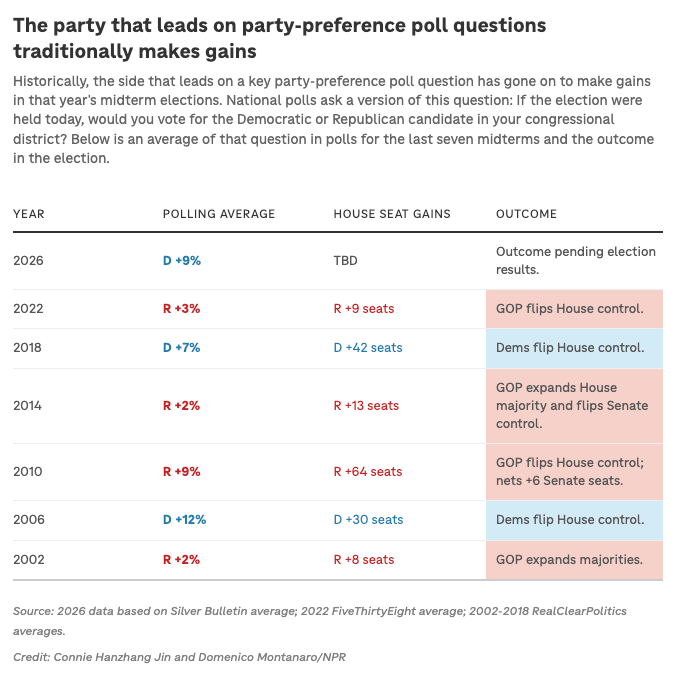
For the first time in nearly a decade, voters narrowly favor Democrats over Republicans to manage the economy, 37% to 36%, according to a Reuters/Ipsos poll conducted July 29 through August 3. The shift comes as the GOP’s longtime advantage on economic stewardship has steadily eroded amid the Iran war’s effect on household costs. Trump’s approval rating also fell to 35%, down from 37% in July and just one point above the lowest level of his second term. The poll found Democrats leading Republicans 42% to 37% on the generic congressional ballot, with independents favoring Democrats by 12 points. Read More.
AI Anxiety Rises, Especially Among Younger Americans
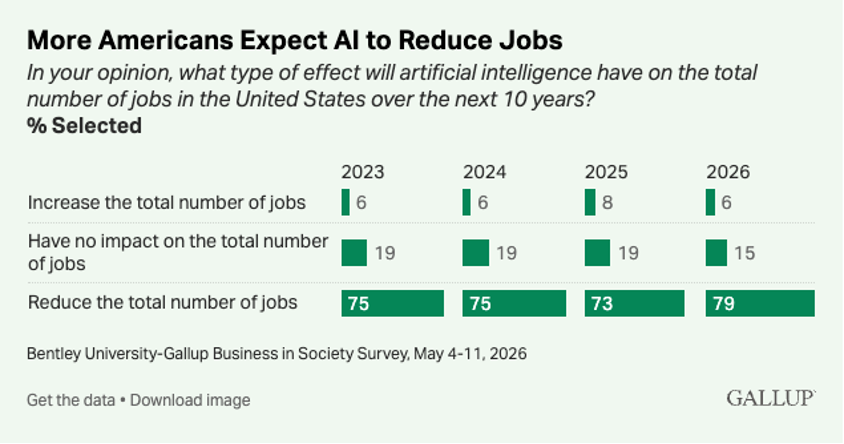
Americans are becoming more skeptical of artificial intelligence after two years of improving attitudes, with 39% now saying AI does more harm than good, up from 31% in 2025. The shift is particularly pronounced among young adults: 47% of Americans ages 18-29 say AI does more harm than good, up 11 points from last year, while trust among the same group in businesses to use AI responsibly fell from 30% to 20%.
Concerns about employment are also growing, with 79% of Americans expecting AI to reduce the number of U.S. jobs over the next decade, including 75% of young adults, up 13 points from 2025. Overall, just 27% of Americans say they trust businesses at least somewhat to use AI responsibly, down from 31% last year. The findings suggest that as AI becomes more familiar, public concern is increasingly shifting from uncertainty about the technology to skepticism about its economic and social consequences.
Read More.
HOUSE HIGHLIGHTS
Polling At A Glance
RCP Average Generic Ballot:
48.6 Dem - 41.6 GOP (D +7.0)
On this day in:
2022: 44.6 GOP - 44.5 Dem (R+0.1)
2018: 46.1 Dem - 40.1 GOP (D+6.0)
Retirements

For context, during the first Trump term, there were 52 retirements from the House.
Trump-Backed Candidates Stumble in Tennessee and Michigan Primaries
Two Republican primaries last week produced unusual setbacks for President Trump's preferred House candidates. In Tennessee's redrawn 5th District, former state Agriculture Commissioner Charlie Hatcher defeated GOP Rep. Andy Ogles despite Trump's endorsement and a late campaign intervention — with Ogles also facing roughly $2 million in outside spending and opposition from Gov. Bill Lee (Read More). In Michigan's 8th District, Thomas Smith won the GOP nomination with just over 50% of the vote despite having suspended his campaign in July, defeating Trump-endorsed Amir Hassan in a fractured, low-information contest. Smith now advances to face Democratic Rep. Kristen McDonald Rivet in one of the few districts nationally that backed Trump for president while electing a Democrat to Congress (Read More). While the results don't signal a broader collapse of Trump's primary influence, they underscore real limits to his endorsement power when he himself is not on the ballot.
House Democrats Expand Battlefield into Trump Territory
The DCCC added 12 Republican-held districts to its “Districts in Play” list, bringing the total to 58 seats as the party looks to capitalize on a favorable national environment and reclaim the House. New targets include seats held by NRCC Chair Richard Hudson in North Carolina, House Financial Services Chair French Hill in Arkansas, and Colorado Reps. Lauren Boebert and Jeff Hurd – districts Trump carried and several incumbents won by double digits in 2024.
The move is more a signal of Democratic confidence than proof that each new district is competitive. Republicans control the House by only a narrow margin and can lose no more than two seats to retain the majority; recent polling and cost-of-living dissatisfaction have encouraged Democrats to test a broader affordability message. The NRCC, which has 36 Democratic targets of its own, argues the DCCC is attempting to distract from Democratic divisions after progressive primary wins.
Read More.
Virginia Democrats Pick Establishment Candidates in Two Key House Districts
Last Tuesday, Virginia voters wrapped up a primary season delayed to August by a failed Democratic redistricting push, setting up the fall's key House races. Both DCCC- and Gov. Abigail Spanberger-backed Democrat Elaine Luria, a former congresswoman, prevailed over three opponents in the 2nd District, setting up a rematch with GOP Rep. Jen Kiggans, who unseated her in 2022. Henrico Commonwealth's Attorney Shannon Taylor defeated a seven-way field that included progressive candidate Salaam Bhatti to win the 1st District nomination and will face Rep. Rob Wittman. Democrats are hoping to flip at least two Virginia seats as they work to reclaim the House, with the 5th District also emerging as a target after former Rep. Tom Perriello won the Democratic nod to challenge Trump-aligned incumbent John McGuire, who turned back a primary challenge of his own with 85% of the vote. Read More.
SENATE HIGHLIGHTS
Polling At A Glance
Polling Averages
North Carolina: Cooper +7.6 (Flip)
Georgia: Ossoff +7.6
New Hampshire: Pappas +3.3
Maine: Jackson +2.3 (Flip)
Texas: Talarico +1.6 (Flip)
Ohio: Brown +0.6 (Flip)
Alaska: Peltola +0.4 (Flip) --> Tipping Point
Michigan: Rogers +0.3 (Flip)
Iowa: Hinson +0.7
Florida: Moody +9.0
Recent Polls
TSU/YouGov (TX General): Talarico (D) 47, Paxton (R) 45
Texas A&M/Siena (TX General): Talarico (D) 47, Paxton (R) 43
Emerson (IA General): Hinson (R) 48, Turek (D) 45
KSTP/SurveyUSA (MN Dem Primary): Craig 42, Flanagan 40
KSTP/SurveyUSA (MN GOP Primary): Tafoya 48, White 13, Schwarze 5, Weiler 3
Quantus (SC GOP Special Primary): Graham Nordone 33, Norman 20, Fry 20, Sanford 17, Lynch 8
Change Research (NC General): Cooper (D) 50, Whatley (R) 41
Carolina Forward (NC General): Cooper (D) 50, Whatley (R) 43
Retirements
So far, 11 Senators have announced their retirement from the chamber at the end of the current Congress.

Michigan Delivers a Progressive Win – but Not the Landslide the Left Expected
Abdul El-Sayed’s Democratic Senate primary victory is the progressive movement’s biggest statewide breakthrough of the cycle, but its narrowness leaves Democrats with significant work before November. The former public health official defeated Rep. Haley Stevens by just under one percentage point after an expensive race that split the party over ideology and Israel. The margin was far below pre-election polling, which had suggested a decisive El-Sayed victory.
El-Sayed ran up margins in liberal college towns and high-education areas but struggled in metro Detroit and with important Black and Jewish constituencies. Republican Mike Rogers is already targeting those voters, seeking to portray El-Sayed as outside the Democratic mainstream; early polling gives Rogers a narrow edge. Michigan is a crucial open-seat defense in Democrats’ Senate path, so El-Sayed must now consolidate Stevens supporters and shift from a base-focused primary message to a broader affordability argument.
Read More.
South Carolina Republicans Vote Today to Replace Lindsey Graham
South Carolina Republicans head to the polls today in a special primary to fill the remainder of the late Sen. Lindsey Graham's term, following his sudden death last month. More than 10 candidates are competing, led by Sen. Darline Graham, the late senator's younger sister, appointed to the seat days after his death, and Rep. Ralph Norman, with Rep. Russell Fry, former Gov. Mark Sanford, and businessman Mark Lynch trailing in polling. President Trump has given Darline Graham his "complete and total endorsement," urging her to run to honor her brother's legacy, though some South Carolina Republicans have privately grumbled about the arrangement, given Trump's mixed recent track record in the state's primaries. The winner will face Democrat Annie Andrews in November. If no candidate clears a majority today, the race proceeds to a runoff.
Read More.
IN THE STATES
Wisconsin Democratic Primary Tests Anti-Establishment Wave
Wisconsin Democrats head to the polls today to pick a nominee to face Republican Rep. Tom Tiffany, who ran unopposed in the GOP primary and voted against certifying the 2020 election results. The Democratic field narrowed to four: state Rep. Francesca Hong, a democratic socialist and Marquette poll frontrunner; Milwaukee County Executive David Crowley, backed by outgoing Gov. Tony Evers on an electability message; state Sen. Kelda Roys; and former state administration secretary Joel Brennan. Sara Rodriguez exited after campaign finance irregularities, and Mandela Barnes dropped out July 31.
The race is the latest test of progressive momentum following Abdul El-Sayed's Michigan Senate primary win, though Midwest contests have leaned more on electability concerns than the party's coastal wins. Also on the ballot: Wisconsin's 3rd Congressional District primary, where DCCC-endorsed Rebecca Cooke faces Emily Berge in a race Democrats see as a key pickup opportunity against Republican Rep. Derrick Van Orden. Read More.
Maryland Democrats Push Ahead With Redistricting Plan That Could Eliminate the GOP’s Last House Seat
Maryland is moving forward with a plan that could give Democrats control of all eight of the state’s congressional districts, as Gov. Wes Moore signed legislation placing a constitutional amendment on the November ballot. The amendment would clarify that Maryland’s constitutional requirements for compactness and respect for political and geographic boundaries apply only to state legislative districts, potentially clearing the way for lawmakers to redraw congressional lines ahead of the 2028 elections.
Democrats already hold seven of Maryland’s eight House seats, with Republican Rep. Andy Harris representing the state’s only GOP-held district, and an earlier map proposed by Moore’s redistricting commission would have made Harris’ district substantially more Democratic. Republicans have accused Moore and legislative Democrats of using redistricting to erase the state’s lone Republican voice in Congress, while Democrats argue the move is a response to Republican-led mid-decade redistricting efforts elsewhere and the changing legal landscape surrounding congressional maps. The amendment does not alter the 2026 congressional map; if voters approve it in November, however, Maryland Democrats would have a clearer path to pursuing a new map for the 2028 cycle.
Read More.
GOP-Led States See a Wave of Fights Over Ballot Initiative Rules
This year's midterms feature a wave of measures, in as many as nine states, that would rewrite the rules governing how citizen ballot initiatives qualify and pass, rather than deciding policy outright. Most originate in Republican-led legislatures seeking to raise the bar for future initiatives, a reaction to progressive wins on issues like abortion rights and minimum wage in red states. Missouri voters rejected one such measure by more than 80% this week; North Dakota, South Dakota, and Utah will ask voters in November to raise the threshold for constitutional amendments to 60%, while Idaho seeks to bar initiatives on drug legalization. Meanwhile, progressive advocates in states like Arkansas, Montana, and Nebraska are pushing counter-measures to protect the initiative process from legislative interference, marking a new phase of advocates playing offense rather than just defense. Read More.
EMERGING NARRATIVES
Widening Deficit Undercuts a GOP Fiscal Argument
CBO's latest monthly review pushed its fiscal 2026 deficit projection to $2.1 trillion, $200 billion above February's estimate, as the government's tariff windfall evaporates faster than expected following the Supreme Court's ruling striking down Trump's IEEPA tariffs. The administration's pivot to replacement tariffs under Sections 122 and 301 of the Trade Act hasn't fully closed the gap: by July, refunds tied to the ruling ($36 billion) outpaced gross collections ($26 billion). Committee for a Responsible Federal Budget's Maya MacGuineas called the borrowing pace, $1.8 trillion so far this fiscal year, outside a recession, "not normal." The report is notable heading into the midterms because tariffs had been pitched by the administration as a meaningful offset to the cost of last year's tax-and-spending law; the Supreme Court's ruling has scrambled that math, and the durability of replacement tariff revenue remains uncertain heading into fiscal 2027.
Read More.
ON THE HORIZON
Upcoming Elections:
August 11:
Alabama House Primary (CD 1, 2, 6, 7)
Connecticut Primary
Minnesota Primary
Vermont Primary
Wisconsin Primary
South Carolina Special GOP Senate Primary
August 18:
Alaska Primary
Florida Primary
Wyoming Primary
CA-14 Special General
August 25:
Oklahoma Primary Runoff
South Carolina Special GOP Senate Primary Runoff (if necessary)
September 1:
Massachusetts Primary
September 8:
New Hampshire Primary
September 15:
Delaware Primary