AxIndex, Edition 20
SNAPSHOT
Our Top 3:
1) Money Is Republicans' Answer to a Tough Environment: The national mood is clearly working against Republicans, with Trump's approval at 37 percent, Democrats up about nine points on the generic ballot and Cook projecting a Democratic House gain of five to 15 seats. The GOP's counterweight is cash. Republicans lead Democrats in Senate battleground ad spending by nearly $190 million, their first edge at this point in a cycle since at least 2020, and Trump's $415 million war chest is only now entering the fight. The advantage shows up race by race: three megadonors have powered Tom Tiffany to a more than 2-to-1 fundraising lead in Wisconsin, and Republicans have outspent Democrats $39 million to $23 million in New Hampshire. Spending will not reverse a national environment, but in races decided by a point or two, a sustained money advantage can determine which seats survive it.
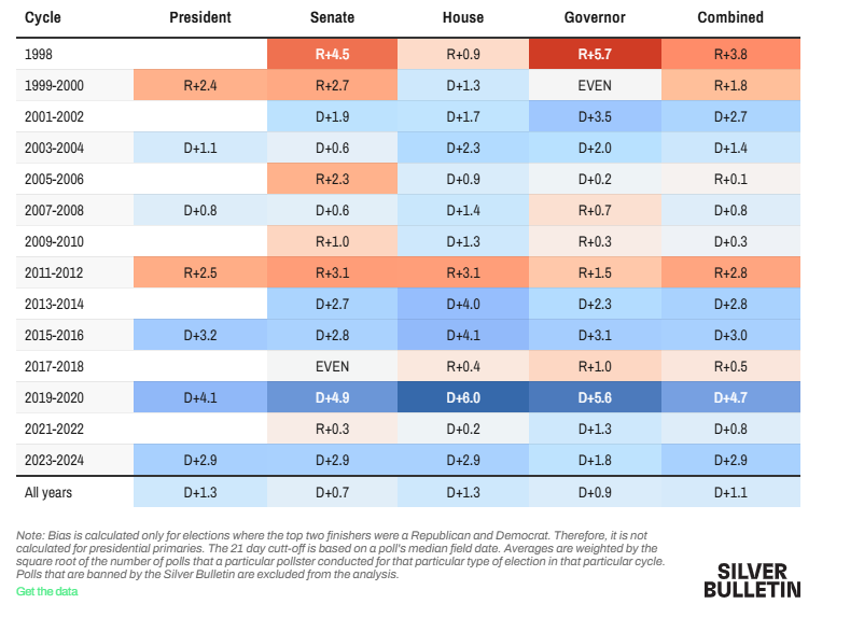
2) The Polls May Behave Better in a Midterm, but Close Races Are Still Coin Flips: Pollsters underestimated Republicans in each of the last three presidential elections, by about 3 points in 2016, 4.7 in 2020 and 2.9 in 2024, even as overall accuracy in 2024 hit a record high. Midterms have been kinder, with little Democratic bias in 2022 and a slight Republican tilt in 2018, suggesting the problem may be Trump on the ballot rather than the industry itself. That gives Democrats some reason to trust their current advantage. But leads under 3 points have historically picked the winner only about 56 percent of the time, and that describes much of this year's battleground, from Kansas to Wisconsin's governor's race. Narrow deficits this fall are toss-ups, not verdicts.
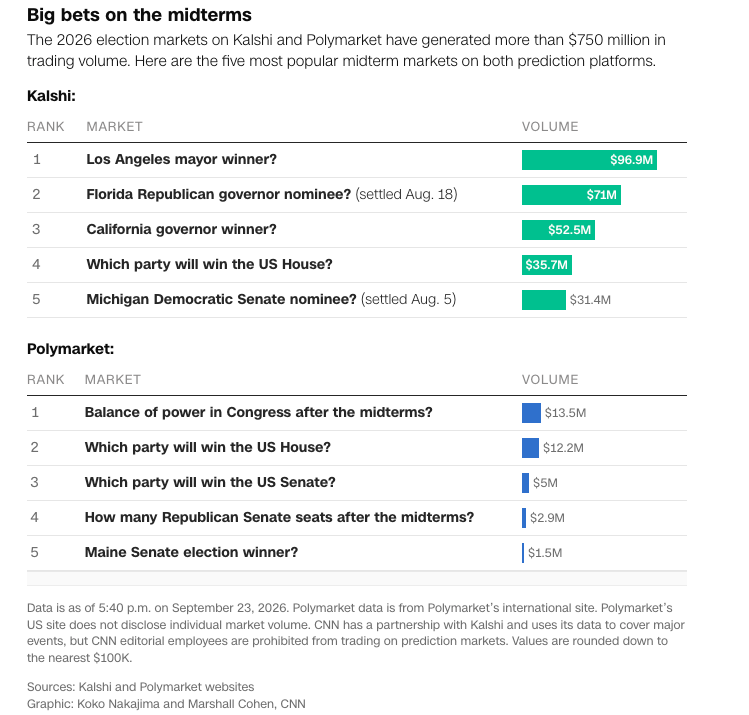
3) Prediction Markets Are Writing the Narrative Before Voters Do: More than $750 million has been traded on 2026 races on Kalshi and Polymarket, and campaigns, donors and candidates now track the odds in real time. Markets give Democrats commanding odds for the House and an edge in the Senate, pricing that feeds the story of an inevitable wave. Yet many battleground House markets have drawn under $100,000 in trades, and this year's favorites have stumbled, including a Wisconsin primary frontrunner priced near 95 percent who lost. Election officials also worry that market-driven "projections" could fuel doubts about legitimate results. Odds reflect sentiment, not ballots, and a thinly traded price is a weak foundation for declaring any race over.
National Sentiment Tracking
One Month Out, the Midterm Map Tilts Toward Democrats
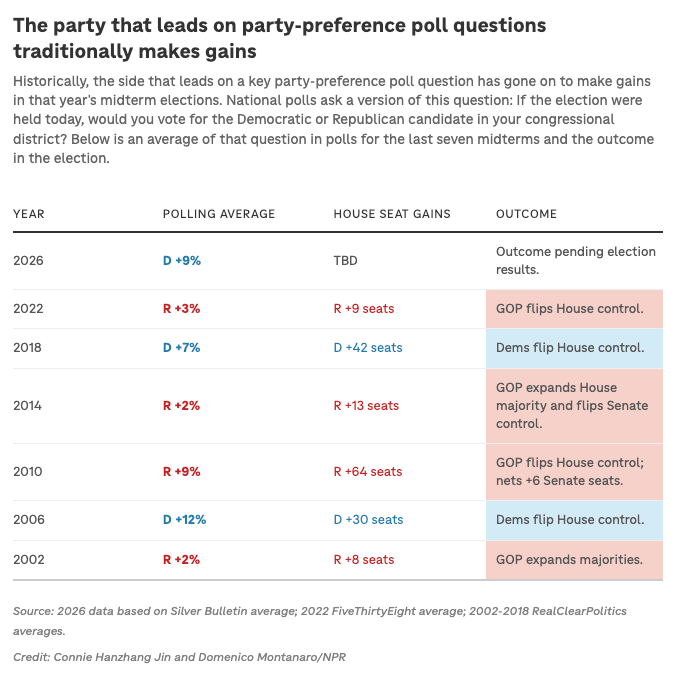
With less than a month until Election Day, the national environment continues to favor Democrats. President Trump's approval sits at 37 percent in the polling average, tied for the lowest pre-midterm mark in 50 years, and Democrats hold a nine-point edge on the generic ballot. The Cook Political Report projects a Democratic House gain of five to 15 seats, while six Senate races have shifted toward Democrats since June, putting the chamber within reach. A CBS poll also shows an enthusiasm edge, with 84 percent of Democrats saying they will definitely vote compared to 77 percent of Republicans.
Still, Republicans retain structural advantages that could limit losses. Mid-decade redistricting has shored up GOP seats, most competitive districts were carried by Trump in 2024, Republicans hold a spending edge in Senate battlegrounds, and the Democratic Party remains unpopular. The White House is betting that making the election about Trump will turn out conservatives the way his own campaigns have. The big question is whether that base mobilization can offset a national mood driven by rising costs. Read More.
What 2024 Polling Says About Reading 2026
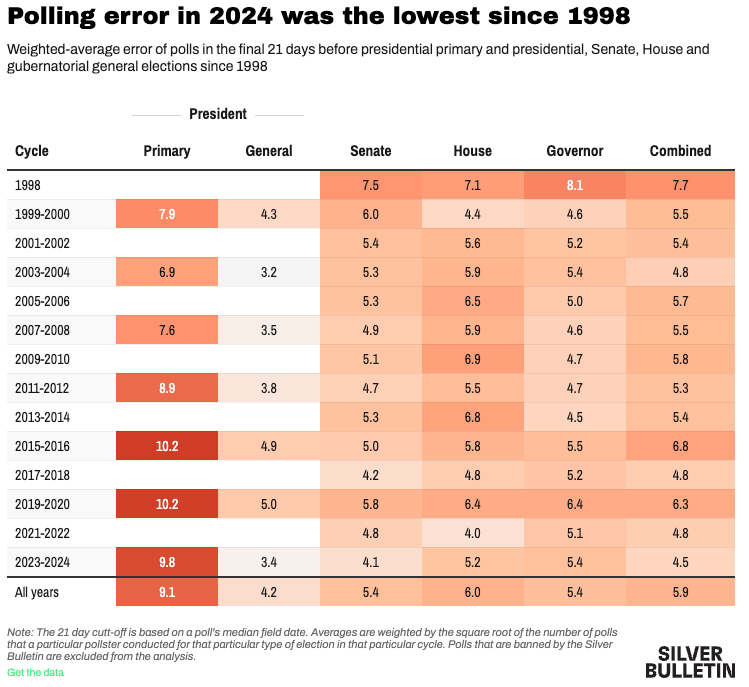
A Silver Bulletin review of 2024 polling offers a useful lens for this fall's numbers. By accuracy, polls had a strong cycle: average error was 4.5 points, the lowest in the outlet's database dating to 1998, with Senate polls the most accurate on record. The weakness was direction. Polls overstated Democrats by roughly 3 points across presidential, Senate and House races, the third straight presidential cycle of Democratic-leaning bias after misses of 3 points in 2016 and 4.7 in 2020.
For 2026, the record cuts both ways. Midterm polling held up better when Trump was off the ballot, with much smaller Democratic bias in 2022 and a slight Republican tilt in 2018, which suggests today's Democratic generic ballot lead could be closer to the mark. Still, the analysis finds that polls showing leads under 3 points pick the right winner only 56 percent of the time, only modestly better than chance. In the tightest Senate and House battlegrounds, a narrow polling deficit should not be read as a settled outcome for either party. Read More.
HOUSE HIGHLIGHTS
Polling At A Glance
RCP Average Generic Ballot:
51.2 Dem - 42.7 GOP (D +8.5)
On this day in:
2022: 45.9 GOP - 45.2 Dem (R+0.7)
2018: 48.5 Dem - 41.3 GOP (D+7.2)
Recent Polls
NY Times/Siena (AK-AL First Round): Begich (R-i) 47, Hill (I) 35, Hafner (D) 8, McDermott (L) 5
NY Times/Siena (AK-AL): Begich (R-i) 53, Hill (I) 47
PIX 11/Emerson (NY-17): Conley (D) 48, Lawler (R-i) 46
Co/efficient (SC-01): Honeycutt (R) 46, Lacore (D) 40, Reeside (L) 4
Washington Post/GMU (VA-01): Taylor (D) 50, Wittman (R-i) 46
Washington Post/GMU (VA-05): McGuire (R-i) 51, Perriello (D) 45
Co/efficient (VA-06): Cline (R-i) 59, Macy (D) 29
OPB/DHM Research (WA-03): Braun (R) 48, Gluesenkamp Perez (D-i) 47
Crypto Money Plays Both Sides of the House Map
Fairshake, the crypto industry's dominant super PAC network, is turning its war chest toward November's House battles, backing 32 incumbents: 19 Republicans and 13 Democrats. Six of them, split evenly by party, will receive $1 million each in initial support, with spending on the rest undisclosed. Every candidate on the list voted for the CLARITY Act, the market-structure bill that cleared the House in 2025 but has stalled in the Senate. The network entered September with roughly $120 million in cash and claims wins in 53 of the 57 races it has engaged this cycle.
The slate reads as insurance as much as advocacy. With Democrats favored to take the House, protecting pro-crypto members in both parties keeps the industry's coalition intact whoever controls the gavel next year. Its sharpest partisan move remains in Ohio, where Fairshake is spending about $30 million to keep crypto critic Sherrod Brown out of the Senate. For Republicans, that makes Fairshake one of the cycle's most valuable outside allies in a must-win race.
Read More.
Lawler Bets on Ratepayer Message as Data Center Backlash Builds
Development has emerged as a defining issue in New York's 17th District, one of eight Republican-held seats Kamala Harris carried in 2024. Rep. Mike Lawler has positioned himself as a check on data center costs, sponsoring the Ratepayer Protection Act, which passed the House last month before stalling in the Senate and would push states to make data centers cover infrastructure upgrades. Democrat Cait Conley blames Lawler for Rockland County's growth as a data center hub and backs Gov. Kathy Hochul's one-year moratorium.
Lawler enters the fight with home-turf strength. He carried Rockland by 18 points in 2024, holds endorsements from seven building trades unions whose members benefit from new construction, and notes that the county's data center industry predates his tenure, with many facilities serving financial services rather than AI. Still, local frustration is real, fueled by tax breaks such as $77 million for a JPMorgan Chase facility projecting a single permanent job. The big question is whether Lawler's ratepayer message can keep anger aimed at local officials rather than at him.
Read More.
DCCC Stretches the Map Into Trump Country
House Democrats have added eight more Republican-held districts to their target list, bringing the DCCC's Districts in Play program to 66 seats, nearly double where it stood at the end of the 2024 cycle. The new additions include seats in Kansas, Michigan and Virginia that Trump carried by roughly 20 points, along with a redrawn Houston-area district in Texas. With Republicans holding a 220-215 majority, Democrats need a net gain of just three seats to win control.
The expansion is as much about strategy as opportunity. Inside Elections rates every new target Solid Republican except the Texas seat, which it rates Likely Republican, and Republicans dismiss the list as wishful thinking. But a wider map forces the NRCC and allied groups to spread resources across districts they would rather not defend, at a moment when Republicans are already spending to shore up Senate seats in Kansas and elsewhere. Most of these seats should hold, but every dollar spent protecting them is a dollar not spent in true battlegrounds. Read More.
SENATE HIGHLIGHTS
Polling At A Glance
Polling Averages
North Carolina: Cooper +9.0 (Flip)
Georgia: Ossoff +8.0
New Hampshire: Pappas +6.4
Michigan: El-Sayed +3.5
Ohio: Brown +3.1 (Flip)
Texas: Talarico +2.8 (Flip)
Alaska: Peltola +1.8 (Flip)
Minnesota: Flanagan +1.6--> Tipping Point
Iowa: Turek +0.7 (Flip)
Maine: Jackson +0.1 (Flip)
Kansas: Marshall +1.0
South Carolina: Graham Nordone +2.4
Florida: Moody +6.6
Recent Polls
Rasmussen (AK-First Round): Dan S. Sullivan (R-i) 39, Peltola (D) 39, Daniel J. Sullivan (R) 7, Heikes (R) 6
Fabrizio/Anzalone (AK): Peltola (D) 53, Sullivan (R-i) 47
Co/efficient (AK): Sullivan (R-i) 49, Peltola (D) 46
St. Pete Polls (FL): Moody (R-i) 45, Nixon (D) 45
Rasmussen (GA): Ossoff (D-i) 51, Collins (R) 42
Quantus (GA): Ossoff (D-i) 49, Collins (R) 45
Cygnal (IA): Hinson (R) 43, Turek (D) 43
Co/efficient (IA): Hinson (R) 48, Turek (D) 43
Trafalgar (IA): Hinson (R) 44, Turek (D) 42
Emerson (KS): Hamilton (D) 45, Marshall (R-i) 43
Quantus (ME): Collins (R-i) 47, Jackson (D) 46
Emerson (MI): El-Sayed (D) 48, Rogers (R) 46
Washington Post (MI): El-Sayed (D) 48, Rogers (R) 45
InsiderAdvantage (MI): El-Sayed (D) 47, Rogers (R) 45
Co/efficient (MN): Flanagan (D) 43, Tafoya (R) 42
KSTP/Survey USA (MN): Flanagan (D) 42, Tafoya (R) 42
Quantus (MT): Alme (R) 44, Bodnar (I) 24, Bankhead (D) 23
Carolina Journal/Harper (NC): Cooper (D) 49, Whatley (R) 34
InsiderAdvantage (NC): Cooper (D) 48, Whatley (R) 43
Co/efficient (NH): Pappas (D) 46, Sununu (R) 46
InsiderAdvantage (NH): Pappas (D) 48, Sununu (R) 40
Bowling Green/YouGov (OH): Brown (D) 48, Husted (R-i) 45
Trafalgar (OH): Brown (D) 45, Husted (R-i) 42
Rasmussen (SC): Graham Nordone (R-i) 48, Andrews (D) 43
Telemundo/Mason-Dixon (TX): Talarico (D) 46, Paxton (R) 43
Emerson (TX): Talarico (D) 47, Paxton (R) 46
Texas A&M/Siena (TX): Talarico (D) 49, Paxton (R) 43
Trafalgar (TX): Talarico (D) 46, Paxton (R) 45
Trump's War Chest Hits the Battlefield
Trump's political operation is finally tapping a war chest that stood at $415 million in late August. MAGA Inc. has put $25 million behind Ken Paxton in Texas, while the affiliated No Going Back PAC has spent nearly $23 million in Ohio, $17.5 million in Michigan and roughly $10 million in North Carolina. The same group has also gone on offense in Democratic-held House seats, including more than $7 million in Florida's 25th District.
The money cements a structural advantage Republicans have not had in recent cycles: AdImpact reports the GOP leads Senate battleground spending by nearly $190 million, its first edge at this stage since at least 2020. Still, some of the dollars are landing in districts that should be safe, such as Texas's redrawn 9th, which some Republicans read as a sign of a shifting map. As one GOP operative put it, a bad November would trace to voters' frustration over costs, not a shortage of resources. Money can buy airtime; it cannot reset the economic mood.
Read More.
Republicans Shore Up Marshall as Kansas Joins the Senate Map
Kansas has emerged as an unexpected Senate battleground, with Republican Sen. Roger Marshall facing a competitive challenge from Democrat Adam Hamilton, a first-time candidate and pastor of the nation's largest United Methodist church. Recent polling is mixed: Emerson College showed Hamilton ahead 45 to 43 percent, while a co/efficient survey had Marshall up 49 to 44 percent. The Senate Leadership Fund responded last week with a multimillion-dollar ad campaign for Marshall, pausing further spending in North Carolina to do it.
Still, Republicans hold the stronger hand. Marshall retains a sizable cash advantage and has reserved roughly four times as much advertising as Hamilton, and Kansas has not sent a Democrat to the Senate since 1932. Marshall won his first race by more than 11 points in 2020, and NRSC Chair Tim Scott says he expects Marshall to win, though by a narrower margin than he would like. Hamilton's crossover appeal in deep-red communities now faces its stiffest test as late Republican money floods the state.
Read More.
Sununu Tests Whether Independence Sells in New Hampshire
John E. Sununu is running for Senate as the Republican who can say no to Trump, and the GOP is spending like its majority depends on him. The former senator, seeking the seat held by retiring Democrat Jeanne Shaheen, trails Rep. Chris Pappas narrowly, but Republicans have outspent Democrats $39 million to $23 million this year and hold the edge in fall reservations. Democrats, who need a net gain of four seats, cannot afford to lose a seat they have long counted as theirs.
Sununu's pitch is distance with an endorsement attached. He says he has never met Trump, calls the president's $5,000 payment pledge economically senseless and faults the Iran war for lacking a plan to reopen the Strait of Hormuz, all while carrying Trump's backing. He even stands by most of a 2024 op-ed labeling Trump a loser. Democrats paint him as a lobbyist and future rubber stamp. If New Hampshire swing voters buy the independent brand, Sununu could turn a blue seat into the GOP's firewall.
Read More.
IN THE STATES
Missouri GOP Plays Catch-Up on Map and Initiative Measures
With absentee voting already underway, the Missouri Republican Party is only now assembling campaigns on two measures it spent months trying to keep off the ballot. The State Committee voted to back Proposition A, a referendum on the 2025 congressional map designed to elect seven Republicans, and to oppose Amendment 6, which would require 80 percent legislative approval to send changes to voter-passed initiatives back to the ballot. The groundwork is thin: the pro-map committee has bought no airtime and raised under $20,000 since June 30, while union-backed Yes on Amendment 6 has raised $2.7 million and is already on the air.
The larger concern for Republicans is turnout. With only the auditor's race on the statewide ballot, the measures will likely drive who shows up, and the August electorate that rejected two GOP-backed measures skewed unusually Democratic and independent. Republicans hold two-thirds supermajorities in both chambers, and party leaders believe Democrats see Amendment 6 as a tool to chip away at them. Defending those majorities may matter more to the GOP than winning either measure. Read More.
Billionaire Backing Gives Tiffany a Cash Edge in Wisconsin
Republican Rep. Tom Tiffany raised more than $26 million in his bid for Wisconsin governor between mid-August and mid-September, with more than $24 million via transfers from the state Republican Party. Most of that money traces to three donors: Richard and Elizabeth Uihlein, who each gave $11 million to the party, and ABC Supply co-founder Diane Hendricks. The infusion helped Tiffany outraise Democrat David Crowley by more than 2-to-1, and the state GOP has raised three times what it brought in during the 2022 governor's race.
The cash positions Tiffany to dominate the airwaves in the final weeks of the first open governor's race in 16 years. A Marquette Law School poll shows a statistical tie, with Crowley at 46 percent and Tiffany at 45 percent. Crowley has made the billionaire support a central attack line, though Democrats relied on the same party-transfer rules to outraise Republicans in past cycles. In a state where the last two governor's races were decided by 1.1 and 3.4 points, Tiffany's financial edge could prove decisive. Read More.
EMERGING NARRATIVES
Swing-Seat Democrats Play Defense on Socialism Label
Democrats in competitive races are increasingly declaring themselves proud capitalists as Republicans cast the party as bent on socialism. Sixty Democratic candidates, including 10 sitting members of Congress, have signed a pledge from Promise to America, a group moderate Democrats formed in June after a string of DSA primary wins, declaring "we are capitalist, not socialist." Strategist Doug Schoen called it the first time in his 50 years in politics that Democrats have had to affirm support for capitalism.
The GOP message appears to be landing. In Arizona, an NRCC mailer tied moderate Amish Shah to a 2019 event co-hosted by a DSA chapter, forcing the DCCC to run an ad defending him. In South Florida, Rep. Maria Elvira Salazar is framing her race as a choice against "a socialist," a label her opponent concedes many Cuban Americans hear as "communist." Still, Democrats lead the generic ballot 43 to 35 percent in the latest Reuters/Ipsos poll. Republicans are hoping the label can move enough swing voters to narrow that gap.
Read More.
Prediction Markets Become a Midterm Wildcard
Election betting has grown into a force campaigns can no longer ignore, with more than $750 million traded on 2026 races across Kalshi and Polymarket, according to a CNN analysis. Operatives say candidates and donors now track their odds closely, sometimes hourly, and some campaigns have had to talk donors out of reacting to market swings. The platforms also carry risk: Kalshi has fined several candidates for betting on their own races, and Los Angeles officials had to counter rigging claims that cited the markets after the mayoral primary.
The record so far argues for caution in reading the odds. Many battleground House markets have drawn less than $100,000 in trades, and heavy favorites have stumbled, including a Wisconsin Democratic primary frontrunner priced near 95 percent who lost to David Crowley. With Kalshi's election-night "projections" based on trader odds rather than official results, officials fear the markets could seed doubts about legitimate outcomes in close races. For candidates trailing in the markets, thin trading and volatile prices leave plenty of room for an upset.
Read More.
ON THE HORIZON
Upcoming Elections:
November 3:
General Elections