AxIndex, Edition 19
SNAPSHOT
Our Top 3:
1) Diesel Is the Cycle's Defining Headwind: Fuel costs have become the single biggest variable in the closing stretch of the midterms. Diesel is averaging a record $6.51 a gallon, up from $3.70 a year ago, and gasoline sits at $4.48. The latest NBC News poll shows the toll: President Trump's approval has slipped to 41%, and 55% of voters now say his policies have hurt the economy, up from 48% in March. The pressure is sharpest in rural, red states where diesel powers farms and freight. That has pulled GOP resources into Kansas, Nebraska, and Iowa, races Sen. John Kennedy said "ought to be fat-guy layups." Republicans are responding with proposals to pause diesel exports and suspend the gas tax, led by Sen. Chuck Grassley and embraced by candidates from Iowa to Michigan. Still, Democrats' 50-45 generic ballot edge trails their 2018 pace, suggesting voter frustration has not yet hardened into a wave. The big question is whether relief proposals give Republicans enough cover before prices dictate the outcome.
2) The Split on AI - Global Race, Homefront Backlash: President Trump is framing artificial intelligence as a race the United States cannot afford to slow, even as voter unease builds at home. This week he hosts Chinese leader Xi Jinping in Washington for their third meeting since his return, with AI competition at the center of an escalating economic rivalry. Ahead of the talks, officials from both countries discussed a communication channel for AI concerns. That global contest underpins Trump's rejection of guardrails. He dismissed calls from Anthropic, OpenAI, and Elon Musk to slow development, calling existential fears a hoax and insisting the industry would move prudently but not stop. The administration has shown some flexibility, developing a new framework to review AI models for cybersecurity risks. Still, lawmakers in both parties are pushing for guardrails, and data center backlash is giving Democrats openings in the rural Midwest. The result is a competitiveness message that plays well on the world stage and a cost-and-safety debate that plays out in local races. The big question is whether Republicans can own the China argument before AI becomes a kitchen-table liability.
3) Missouri's Map Fight Heads to the Supreme Court: The cycle's most consequential redistricting battle is going down to the wire. A federal appeals panel ruled Monday that Missouri must use the 2025 congressional map in November, holding that switching districts after the August primary would violate the Constitution. Reverting to the older map would place nearly a quarter of the state's registered voters in different districts than they voted in during the primary. The ruling conflicts with a Missouri Supreme Court decision and is stayed until Sept. 28, putting the next move squarely with the justices, who already let the state ruling stand once. If the 2025 map holds, Republicans could win seven of Missouri's eight seats by flipping Rep. Emanuel Cleaver's Kansas City district. In a razor-thin House majority, a single mid-decade seat could prove decisive.
National Sentiment Tracking
NBC Poll: Trump Approval Slips, but Democrats' Midterm Edge Trails 2018 Pace
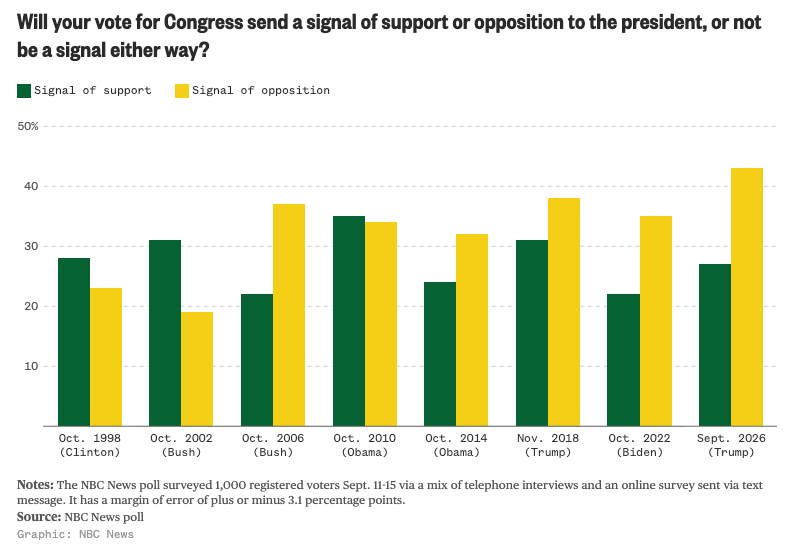
A new NBC News poll finds 41% of registered voters approve of President Trump's job performance and 56% disapprove, his lowest mark in the survey during his second term. Fifty-five percent say his policies have hurt the economy, up from 48% in March, and inflation and cost of living (28%) top the list of issues. Democrats lead the congressional preference question 50% to 45%. More voters say their vote will signal opposition to the president (43%) than support (27%).
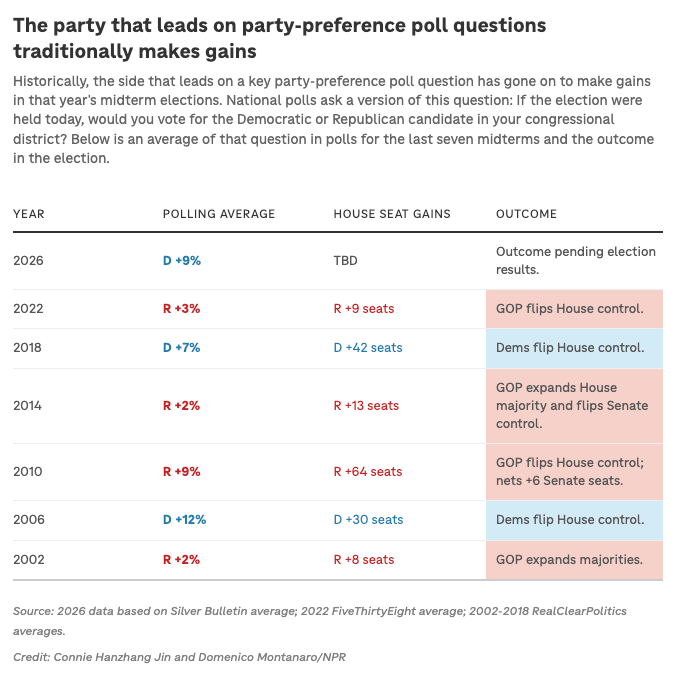
Still, the generic ballot tells a more measured story, with Democrats' five-point edge short of their pace at this point in 2018. The poll also shows voter priorities on immigration shifting toward a path to citizenship over border security, a change from 2024. In addition, Democrats are moving toward in-person voting amid Trump's attacks on mail ballots. With less than 50 days to go, the big question is whether GOP candidates can keep races local before the midterm becomes a straight referendum on the White House. Read More.
HOUSE HIGHLIGHTS
Polling At A Glance
RCP Average Generic Ballot:
50.4 Dem - 42.3 GOP (D +8.1)
On this day in:
2022: 45.3 Dem - 44.0 GOP (D+1.3)
2018: 48.8 Dem - 40.8 GOP (D+8.0)
Recent Polls:
Fabrizio/Anzalone (AK-AL): Begich (R-i) 57, Hill (I) 43
Golden's Crossover Endorsement Hands Lawler a Bipartisan Credential in NY-17
Outgoing Rep. Jared Golden (D-Maine) endorsed Rep. Mike Lawler (R-N.Y.) for re-election in a Sept. 21 op-ed, praising him as a lawmaker who treats the job as work rather than a stage. Golden urged voters everywhere to keep members who pass laws with the other party. Lawler, first elected in 2022, called the endorsement an honor and cited the pair's shared focus on finding common ground. He faces Democrat Cait Conley, a combat veteran and former National Security Council counterterrorism director, who rallied with Pete Buttigieg last week.
The endorsement gives Lawler a rare cross-party validator in a swing Hudson Valley seat. Golden built his brand holding a Trump-won Maine district as a centrist Democrat, which makes him a credible messenger for Lawler's pitch of independence. The contrast with Conley's national-figure support sharpens the race's framing: a local problem-solver versus a nationalized contest. The big question is whether crossover endorsements still move voters in a cycle increasingly shaped by the national environment and presidential approval.
Read More.
SENATE HIGHLIGHTS
Polling At A Glance
Polling Averages
North Carolina: Cooper +8.3 (Flip)
Georgia: Ossoff +7.5
New Hampshire: Pappas +4.8
Ohio: Brown +4.8 (Flip)
Texas: Talarico +2.6 (Flip)
Michigan: El-Sayed +2.1
Minnesota: Flanagan +1.8
Maine: Jackson +1.8 (Flip)--> Tipping Point
Alaska: Peltola +1.7 (Flip)
Iowa: Hinson +1.3
Kansas: Marshall +1.5
South Carolina: Graham Nordone +3.5
Florida: Moody +5.0
Recent Polls
Rasmussen (AK-First Round): Dan S. Sullivan (R-i) 39, Peltola (D) 39, Daniel J. Sullivan (R) 7, Heikes (R) 6
Fabrizio/Anzalone (AK): Peltola (D) 53, Sullivan (R-i) 47
Co/efficient (AK): Sullivan (R-i) 49, Peltola (D) 46
St. Pete Polls (FL): Moody (R-i) 45, Nixon (D) 45
Rasmussen (GA): Ossoff (D-i) 51, Collins (R) 42
Quantus (GA): Ossoff (D-i) 49, Collins (R) 45
Cygnal (IA): Hinson (R) 43, Turek (D) 43
Co/efficient (IA): Hinson (R) 48, Turek (D) 43
Trafalgar (IA): Hinson (R) 44, Turek (D) 42
Emerson (KS): Hamilton (D) 45, Marshall (R-i) 43
Quantus (ME): Collins (R-i) 47, Jackson (D) 46
Emerson (MI): El-Sayed (D) 48, Rogers (R) 46
Washington Post (MI): El-Sayed (D) 48, Rogers (R) 45
InsiderAdvantage (MI): El-Sayed (D) 47, Rogers (R) 45
Co/efficient (MN): Flanagan (D) 43, Tafoya (R) 42
KSTP/Survey USA (MN): Flanagan (D) 42, Tafoya (R) 42
Quantus (MT): Alme (R) 44, Bodnar (I) 24, Bankhead (D) 23
Carolina Journal/Harper (NC): Cooper (D) 49, Whatley (R) 34
InsiderAdvantage (NC): Cooper (D) 48, Whatley (R) 43
Co/efficient (NH): Pappas (D) 46, Sununu (R) 46
InsiderAdvantage (NH): Pappas (D) 48, Sununu (R) 40
Bowling Green/YouGov (OH): Brown (D) 48, Husted (R-i) 45
Trafalgar (OH): Brown (D) 45, Husted (R-i) 42
Rasmussen (SC): Graham Nordone (R-i) 48, Andrews (D) 43
Telemundo/Mason-Dixon (TX): Talarico (D) 46, Paxton (R) 43
Emerson (TX): Talarico (D) 47, Paxton (R) 46
Texas A&M/Siena (TX): Talarico (D) 49, Paxton (R) 43
Trafalgar (TX): Talarico (D) 46, Paxton (R) 45
GOP Bets Its Cash Advantage Can Outrun $4.48 Gas
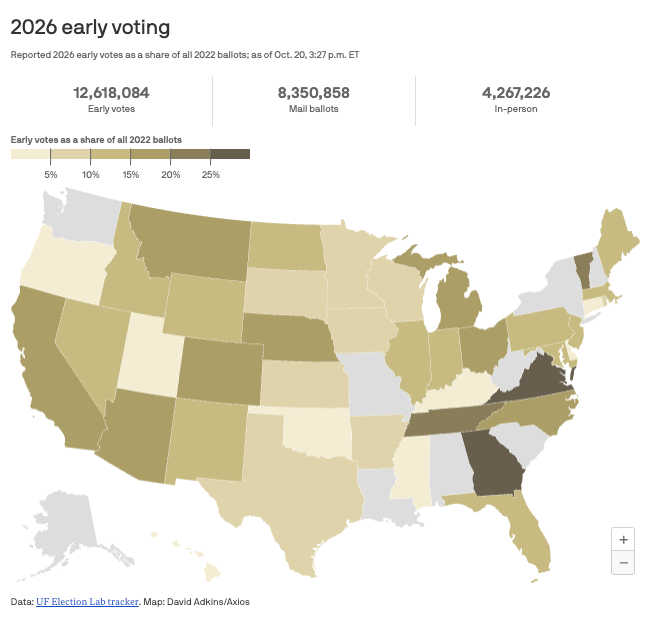
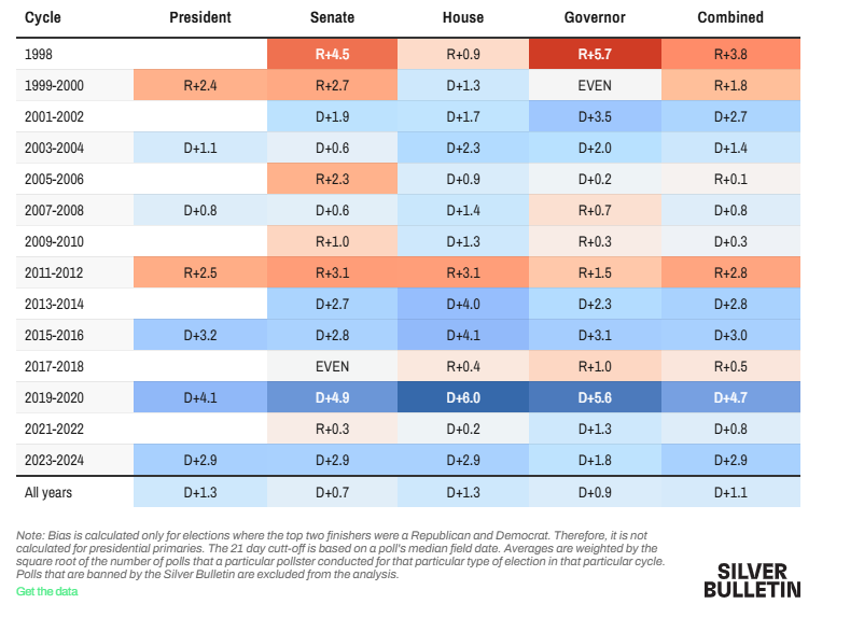
With early and mail voting underway in nearly half the country, Republicans' midterm outlook hinges on whether a massive cash infusion from GOP groups can offset gas prices averaging $4.48 a gallon. Strategists say they will know by early October whether the spending has halted Democratic gains, and Rep. Mike Lawler noted that "Republicans always outperform their polling." Operatives are already reallocating Senate dollars, eyeing cutbacks in Georgia and North Carolina to boost pickup bids in Michigan and New Hampshire.
Iowa is the decisive test, and its Republicans are adapting fast. Senate nominee Ashley Hinson and Michigan's Mike Rogers both called Monday for ending the Iran war, and Hinson is airing an ad touting her work with Democrats. Most of the state's delegation backed Sen. Chuck Grassley's call to halt diesel exports as prices hit $6.57. Reps. Zach Nunn and Mariannette Miller-Meeks also voted for the first time to limit Trump's war powers. The big question is whether local independence and a cash advantage can take hold in time to matter.
Read More.
Talarico's Pivot to the Middle Hands Republicans a Credibility Attack
Democratic Senate nominee James Talarico is moderating on key wedge issues as he runs within striking distance of Ken Paxton in Texas. After opposing trans athlete restrictions in the Legislature, he now says he opposes trans athletes in girls' sports when safety or fairness is at stake. He also backs a national ban on gender surgeries for minors. On energy, the author of a 2021 bill to cut Texas emissions to half of 1990 levels by 2030 now champions an all-of-the-above approach that protects oil and gas jobs.
Republicans are framing the shifts as election-year repositioning. National GOP groups launched a multimillion-dollar ad campaign this month, and allies circulated video of a minister at Talarico's church predicting he would revert once elected. The pivot also carries base risk, with Equality Texas publicly voicing disappointment. Still, Talarico's populist economic message gives him an opening few Texas Democrats have had since the 1990s. The big question is whether voters see pragmatism or reinvention.
Read More.
IN THE STATES
Appeals Court Backs Missouri's Primary Map, Putting 7-1 Plan Back in Play
A federal appeals panel ruled Monday that Missouri must keep the House districts it used in the August primary, holding that switching maps between the primary and general election would violate the U.S. Constitution. Reverting to the 2022 lines would put nearly a quarter of the state's registered voters in different districts in November than in the primary. The 8th Circuit ordered a permanent injunction, stayed until Sept. 28 for Supreme Court review, and held that a conflicting Missouri Supreme Court ruling must yield to federal constitutional requirements.
The decision strengthens the GOP's hand heading into a final round at the Supreme Court. The panel found the 2025 map had been the status quo for nearly the entire cycle, undercutting arguments that federal intervention came too late. If the map holds, Republicans could win seven of eight seats by flipping the Kansas City district held by Democratic Rep. Emanuel Cleaver. Still, the justices already let the state ruling stand once, and People Not Politicians plans an emergency appeal. Read More.
Data Center Backlash Becomes a Midwest Flashpoint, and Republicans Move to Defuse It
Local resistance to data centers is reshaping rural Midwest politics. In Defiance, Ohio, a city of 17,000 where no project has even been announced, residents gathered signatures for a Nov. 3 ballot measure banning all but the smallest data centers. City officials also imposed a six-month moratorium on approvals. Democratic Rep. Marcy Kaptur faces one of the toughest races of her four-decade career in a redrawn district that includes Defiance. She is running TV ads accusing Republican Derek Merrin of supporting unpopular tax incentives.
Republicans are moving to take the issue off the table. Gov. Mike DeWine has suspended new applications for data center tax exemptions pending legislative reforms. GOP gubernatorial candidate Vivek Ramaswamy released an "Ohioans First" plan that would eliminate local property-tax abatements for the facilities. Still, lawmakers adjourned for summer without acting, leaving an opening Democrats are eager to use in a region where they have struggled under Trump. The big question is whether a localized fight can overcome the region's rural partisan lean. Read More.
EMERGING NARRATIVES
Trump Bets on AI Growth as Voter Unease Builds
President Trump is doubling down on his opposition to AI guardrails, putting him at odds with a growing number of lawmakers in both parties. In a series of posts, he dismissed a push by Anthropic and OpenAI to slow work on cutting-edge systems, calling existential fears about AI a hoax. He later told Nvidia CEO Jensen Huang, in a call aired live at a tech conference, that the industry would proceed prudently but would not be stopped. The comments followed calls by Anthropic's Dario Amodei, OpenAI's Sam Altman, and Elon Musk to slow the pace of AI development.
The White House frames its approach around competitiveness as the AI race with China intensifies. It has also shown some flexibility, developing a new framework to review AI models for cybersecurity risks. Senior officials also met with Anthropic's top Washington executive to discuss safety. Still, some Republicans in tight races have signaled openness to regulation, and data center backlash is already giving Democrats openings in the rural Midwest. The big question is whether AI becomes a local liability for GOP candidates.
Read More.
The 2026 Map Is Flush With Crypto
Crypto companies have contributed $206 million to the 2026 cycle, the largest of three tech-related sectors driving record corporate political spending, according to a Public Citizen analysis of FEC records. Total corporate contributions have reached $646 million, already 40% above the entire 2024 cycle and more than triple the 2022 midterms. Fairshake, the industry's main super PAC, held nearly $113 million in cash at the end of July. Its network has backed nearly 50 candidates in both parties who won nominations.
The money is now being aimed squarely at the Senate. Fairshake has prepared at least $30 million to oppose former Sen. Sherrod Brown in Ohio's special election against Republican Sen. Jon Husted, which would be its largest outlay of the cycle. The push follows the Senate's failure on Sept. 15 to advance the CLARITY Act, which stalled at 50-49, short of the 60 votes needed. Ohio was also Fairshake's top target in 2024, when it spent more than $40 million to help Bernie Moreno defeat Brown. The big question is whether a repeat investment can carry Husted through a far tougher national environment.
Read More.
Trump's $5,000 Dividend Tests GOP Fiscal Discipline
President Trump's promise of a $5,000 "Trump dividend" for every adult if Republicans hold Congress is drawing a cautious reception from his own party. He first pitched it at the GOP's midterm convention in Dallas and repeated it on the trail in North Carolina. The plan would cost more than $1 trillion, with the national debt now above $40 trillion. Sen. John Kennedy said he would not support borrowing $1.2 trillion for the checks, and Sen. Ted Budd said he would need details. Sen. Susan Collins said the payments should not appear tied to election results.
The hesitancy reflects a party balancing loyalty to Trump with the fiscal message many members have campaigned on. Sen. Roger Marshall, facing a surprisingly competitive race in Kansas, first touted the idea but later said he would weigh the details before deciding. The Tax Foundation estimates the checks would consume nearly all projected tariff revenue over a decade. The big question is whether the pledge energizes voters or pulls vulnerable Republicans off the cost-of-living message they need to own.
Read More.
ON THE HORIZON
Upcoming Elections:
November 3:
General Elections