AxIndex, Edition 21
SNAPSHOT
Our Top 3:
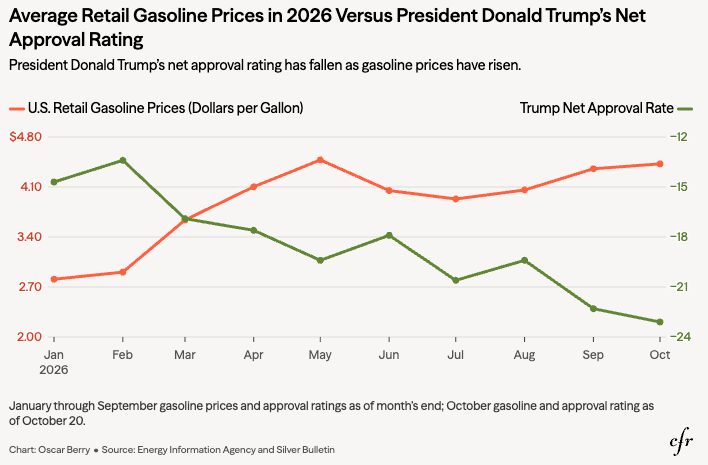
1) Nightmare on Main Street: The Fundamentals Have Turned Against the GOP: Two weeks out, nearly every traditional midterm indicator points in Democrats’ direction. Trump’s approval has fallen to 33 percent in the latest Washington Post-ABC News-Ipsos poll, his lowest across either term, and Democrats lead the generic ballot by 8 to 9 points, comparable to their 2018 position. Affordability is driving much of the shift: gas has climbed from $2.98 before the Iran war to $4.28, and voters now trust Democrats over Republicans on the economy, 40 to 33 percent. The Senate is firmly in play as well, with forecasters putting Democratic odds of control between 56 and 75 percent and Cook listing seven toss-ups, six of them in states Trump carried. The result is an environment that has Republicans defending far more ground than they planned for.
2) Red Seats Get Spooked: The Battlefield Moves Deep Into Trump Country: The clearest sign of the cycle’s direction is where both parties are spending. Republicans have shifted into a defensive posture, with the Senate Leadership Fund moving money out of North Carolina and into Kansas and South Carolina, and the Congressional Leadership Fund pulling support for Reps. Mariannette Miller-Meeks and Tom Kean Jr. to consolidate behind 16 GOP-held seats. Democrats are moving the other way, as the DCCC adds airtime in Arizona’s 2nd and South Carolina’s 1st, districts Trump carried by 15 and 13 points, and is now active in 49 races, two-thirds of them Republican-held. Inside the party, frustration is surfacing, with one House Republican telling CNN that Trump is dragging the party down. When a majority party is defending seats it once considered safe, the fight for control is being waged on its own turf.
3) Monster Money and Phantom Footage: The 2025-26 cycle has already topped $10 billion in ad spending and reservations, surpassing final totals for both 2020 and 2022, with AdImpact projecting $11.6 billion by Election Day. Ohio leads the Senate map at $422.6 million, and Elon Musk has become the cycle’s dominant donor, giving $276 million since July, including $158 million to the Senate Leadership Fund. A growing share of that money is buying scenes that never happened: the Wesleyan Media Project counts $137 million spent on 220 AI-generated ads through October 11, mostly from Republicans, including deepfakes targeting Jon Ossoff, James Talarico, and Josh Shapiro. No federal law governs AI in political advertising, and only four states restrict deepfakes outright. With saturation spending and synthetic content converging in races likely to be decided by a point or two, the closing weeks will test how much voters trust what they see on screen.
National Sentiment Tracking
By the Numbers: Fundamentals Point Toward a Democratic House
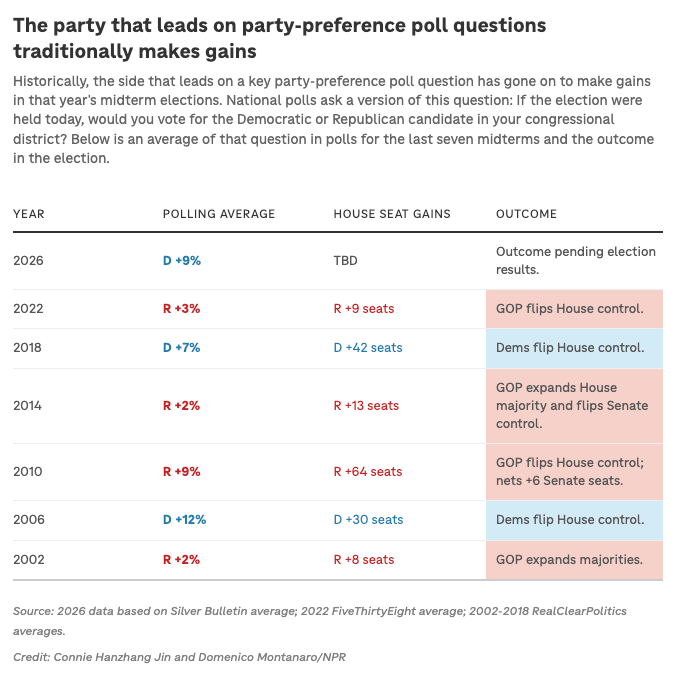
Nearly every traditional midterm indicator now favors Democrats, who need a net gain of just three House seats to flip the chamber. They lead the generic ballot by 9 points in Nate Silver’s average, matching their 2018 position, when they gained 41 seats. Trump’s net favorability has sunk to negative 23.1, and the president’s party has lost an average of 31 House seats across the last five midterms. The affordability picture compounds the damage: gas has risen from $2.98 before the Iran war to $4.28, and diesel from $3.72 to $6.32.
Redistricting is the GOP’s firewall. Mid-decade maps shifted a net nine seats toward Republicans on paper, with 15 gained across seven states against six lost in California and Utah. But aggressive maps carry their own risk. Spreading Republican voters thinner to capture more seats can backfire in a wave, turning engineered gains into competitive races. If the environment holds, the cycle’s defining test will be whether those new lines bend or break. Read More.
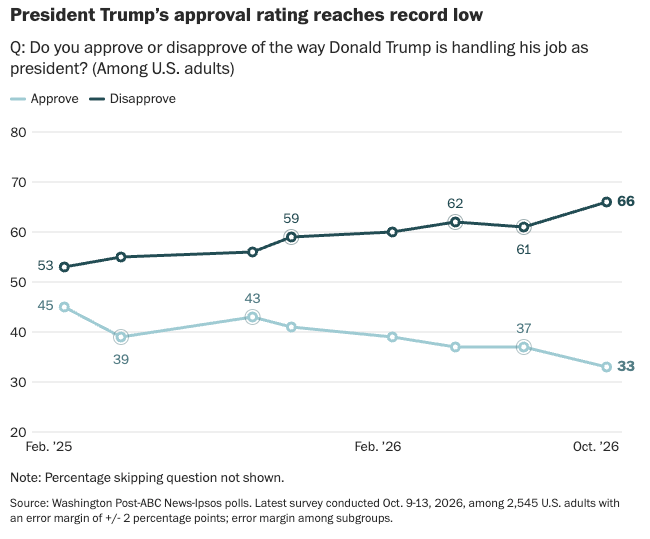
Trump Approval Hits Record Low as Democrats Widen Congressional Ballot Lead
President Trump’s approval has fallen to 33 percent in a Washington Post-ABC News-Ipsos poll of 2,545 adults conducted October 9 to 13, his lowest mark across either term, with 66 percent disapproving and 52 percent disapproving strongly. Among independents, approval sits at just 22 percent. Democrats lead the congressional ballot 52 to 44 percent among likely voters and 50 to 42 percent among registered voters, up from a 3-point edge in July. Roughly 7 in 10 Americans say the country is on the wrong track and that gas is unaffordable.
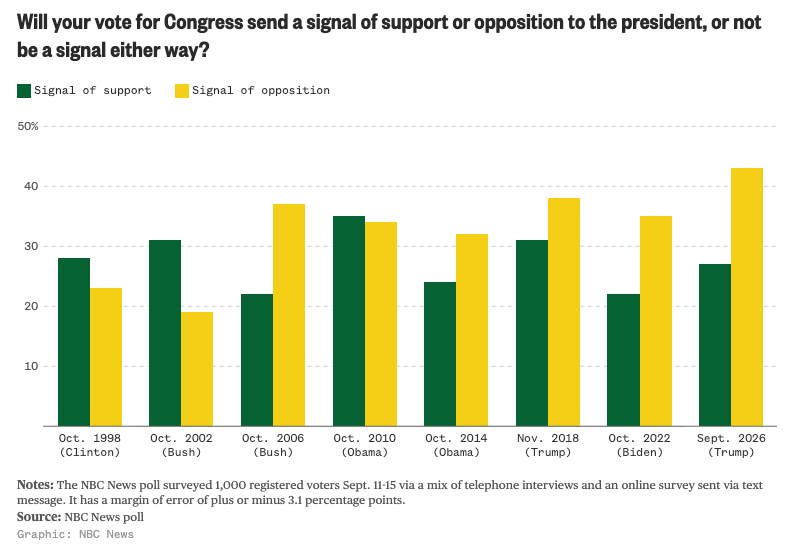
The economic findings may matter most for Republicans. Voters now trust Democrats over Republicans on the economy 40 to 33 percent, eroding what has long been a core GOP advantage. Still, more than 9 in 10 likely voters who approve of Trump plan to back Republicans, leaving the party’s path dependent on base turnout in a cycle increasingly shaping up as a referendum on the president. Read More.
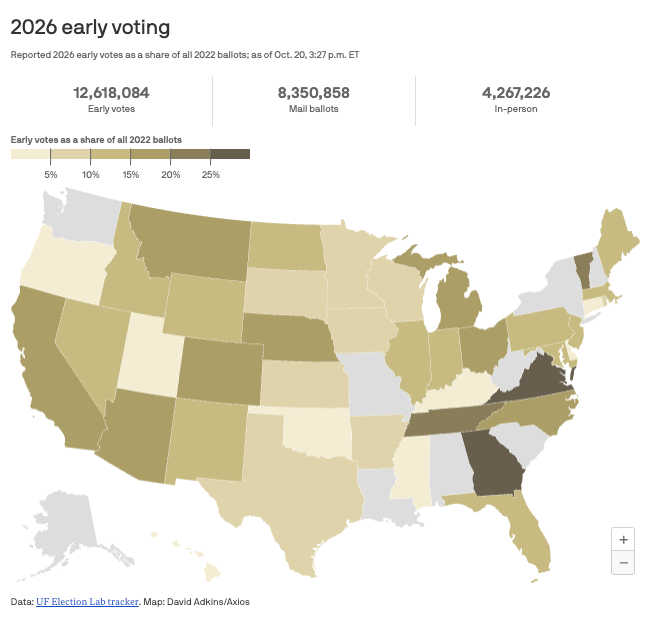
Early Voting Surges Past 12.6 Million Ahead of Midterms
More than 12.6 million Americans have already voted, according to the University of Florida Election Lab, with heavy early activity in several states hosting competitive Senate races. Georgia leads the country, with over 1 million ballots cast, equal to 25.9 percent of its total 2022 turnout, followed by Virginia at 770,916 ballots, or 25.5 percent. In North Carolina, early voting was running 37 percent ahead of the same point in 2022 as of October 18, with registered Democrats casting more than twice as many ballots as Republicans. Dallas County also set a first-day record Monday with 76,079 in-person votes, topping its 2020 mark.
The numbers point to an engaged electorate, though they offer limited predictive value. Early voters tend to be more politically active than the broader electorate, and states differ widely in their voting schedules and reporting timelines. Democrats are working to convert dissatisfaction with the administration and the economy into turnout, while Republicans are counting on Election Day mobilization of their base. Read More.
HOUSE HIGHLIGHTS
Polling At A Glance
RCP Average Generic Ballot:
50.7 Dem - 42.4 GOP (D +8.3)
On this day in:
2022: 47.9 GOP - 44.8 Dem (R+3.1)
2018: 48.7 Dem - 41.1 GOP (D+7.6)
Recent Polls
ABC6/Survey USA (MN-01): Johnson (D) 46, Finstad (R-i) 44
Susquehanna (PA-10): Stelson (D) 49, Perry (R-i) 46
Christopher Newport Univ. (VA-02): Luria (D) 46, Kiggans (R-i)
Cook Ratings
Recent Changes:
FL-16 (Open - Buchanan): Solid R --> Likely R
FL-25 (Moskowitz): Tossup --> Lean D
KS-02 (Schmidt): Solid R --> Likely R
MN-01 (Finstad): Likely R --> Lean R
MT-01 (Open - Zinke): Lean R --> Tossup
NE-01 (Flood): Solid R --> Likely R
NY-21 (Open - Stefanik): Likely R --> Lean R
OH-01 (Landsman): Lean D --> Likely D
OH-10 (Turner): Likely R --> Lean R
OH-15 (Carey): Likely R --> Lean R
SC-01 (Open - Mace): Likely R --> Lean R
Two Weeks Out, the House Fight Moves Into Unfamiliar Territory
Democrats need a net gain of just three seats to flip the House, and The Washington Post’s updated battleground guide shows the field tilting their way. Cook Political Report now has competitive races in districts Trump won by double digits, driven by his approval in the 30s, high prices and the Iran war.
The details are more mixed than the topline. Much of the GOP’s exposure comes from open seats, with an unusual number of Republicans retiring or seeking higher office, and from candidate-specific troubles like Rep. Max Miller’s ethics investigation in Ohio and a late nominee swap in North Carolina. Long-entrenched incumbents such as Ohio’s Mike Turner face real races for the first time in years.
Republicans hold openings of their own. Mid-decade redistricting put Democrats like Marcy Kaptur, Henry Cuellar and Don Davis in tougher seats, and South Texas will test whether Latino voters who moved right in 2024 stay there. Notably, many Democrats defending Trump-won districts are running as moderates or on tougher immigration stances.
The upshot: Democrats are favored, but the majority still runs through a few dozen close, highly local contests. Read More.
DCCC Pushes Deeper Into Trump Country as GOP Retrenches
The Democratic Congressional Campaign Committee is adding TV reservations in three Republican-held districts Trump carried comfortably in 2024, part of a $16 million coordinated ad push this week. In Arizona’s 2nd, a Trump +15 seat, Rep. Eli Crane faces former Navajo Nation President Jonathan Nez. In South Carolina’s open 1st, a Trump +13 district, retired Navy Vice Admiral Nancy Lacore takes on Republican Jenny Honeycutt. In Ohio’s 10th, Rep. Mike Turner faces nurse and veteran Kristina Knickerbocker in a seat Trump won by nearly 8. The DCCC is now active in 49 districts, two-thirds of them Republican-held.
The moves mirror a battlefield tilting toward Democrats. Last week, the Congressional Leadership Fund pulled spending for Reps. Mariannette Miller-Meeks and Tom Kean Jr., dropped efforts against two Trump-district Democrats, and consolidated resources into 16 GOP seats. With Republicans playing defense and Democrats reaching into double-digit Trump territory, the House majority may hinge on how far into red terrain the environment extends.
Read More.
SENATE HIGHLIGHTS
Polling At A Glance
Polling Averages
Rhode Island (SB): Reed +31.8
Massachusetts (RCP): Markey +25.3
New Mexico (RCP): Lujan +16.5
North Carolina (RCP): Cooper +9.6 (Flip)
Georgia (RCP): Ossoff +8.6
New Hampshire (RCP): Pappas +6.5
Ohio (RCP): Brown +3.3 (Flip)
Minnesota (RCP): Flanagan +2.8
Michigan (RCP): El-Sayed +2.6
Alaska (RCP): Peltola +2.5 (Flip)
Texas (RCP): Talarico +2.2 (Flip)--> Tipping Point
Maine (RCP): Jackson +1.6 (Flip)
Iowa (RCP): Turek +0.6 (Flip)
Nebraska (SB): Ricketts +0.1
Kansas (RCP): Marshall +0.3
South Carolina (RCP): Graham Nordone +2.7
Mississippi (SB): Hyde-Smith +5.0
Florida (RCP): Moody +7.0
South Dakota (SB): Rounds +7.4
Arkansas (SB): Cotton +7.5
Montana (RCP): Alme +14.0
Idaho (SB): Risch +19.5
Key: RCP=RealClearPolitics; SB=Silver Bulletin
Recent Polls
Talk Business/Hendrix College (AR): Cotton (R-i) 50, Shoffner (D) 41, Wadlin (L) 5
Stetson University (FL): Moody (R-i) 52, Nixon (D) 41
Quantus (GA): Ossoff (D-i) 52, Collins (R) 45
YouGov (IA): Turek (D) 48, Hinson (R) 46
Marist (IA): Turek (D) 48, Hinson (R) 45
Trafalgar (IA): Hinson (R) 46, Turek (D) 44
Insider Advantage (KS): Marshall (R-i) 48, Hamilton (D) 47
WCVB/Amherst (MA): Markey (D-i) 56, Deaton (R) 29
Suffolk (ME): Jackson (D) 49, Collins (R) 47
Insider Advantage (ME): Jackson (D) 49, Collins (R-i) 47
Rasmussen (MI): El-Sayed (D) 46, Rogers (R) 44
KSTP/Survey USA (MN): Flanagan (D) 45, Tafoya (R) 42
Trafalgar (MN): Flanagan (D) 48, Tafoya (R) 45
Carolina Forward/Change Research (NC): Cooper (D) 50, Whatley (R) 40
WRAL/SurveyUSA (NC): Cooper (D) 54, Whatley (R) 40
Bowling Green/YouGov (OH): Brown (D) 48, Husted (R-i)
WPRI/Emerson (RI): Reed (D-i) 59, McKay (R) 25
Trafalgar (SC): Graham Nordone (R-i) 49, Andrews (D) 46
ReconMR/Siena (TX): Talarico (D) 48, Paxton (R) 44
Quantus (TX): Paxton (R) 47, Talarico (D) 47
Marist (TX): Talarico (D) 47, Paxton (R) 45
University of Texas (TX): Talarico (D) 50, Paxton (R) 47
InsiderAdvantage (TX): Paxton (R) 49, Talarico (D) 48
CBS News (TX): Talarico (D) 51, Paxton (R) 49
University of Houston (TX): Talarico (D) 48, Paxton (R) 46
Cook Ratings
Recent Changes:
AK (Open - R): Tossup --> Lean D
NE (Pillen - R): Solid R --> Likely R
OK (Open - R): Solid R --> Likely R
VT (Scott - R): Solid R --> Likely R
Senate Majority Increasingly in Play as Forecasts Shift Toward Democrats
With two weeks until Election Day, race ratings, forecasting models, and prediction markets show Democrats in their strongest position of the cycle to flip the Senate. Democrats need a net gain of four seats to take control of the 53-47 chamber. Cook now rates North Carolina, where Roy Cooper has consistently led Michael Whatley, as Likely D, and lists seven toss-ups: Alaska, Iowa, Kansas, Maine, Michigan, Ohio, and Texas. Nate Silver’s model puts Democratic odds at 75 percent, Decision Desk HQ at 56 percent, and Kalshi at 63 percent, up from 44 percent in March.
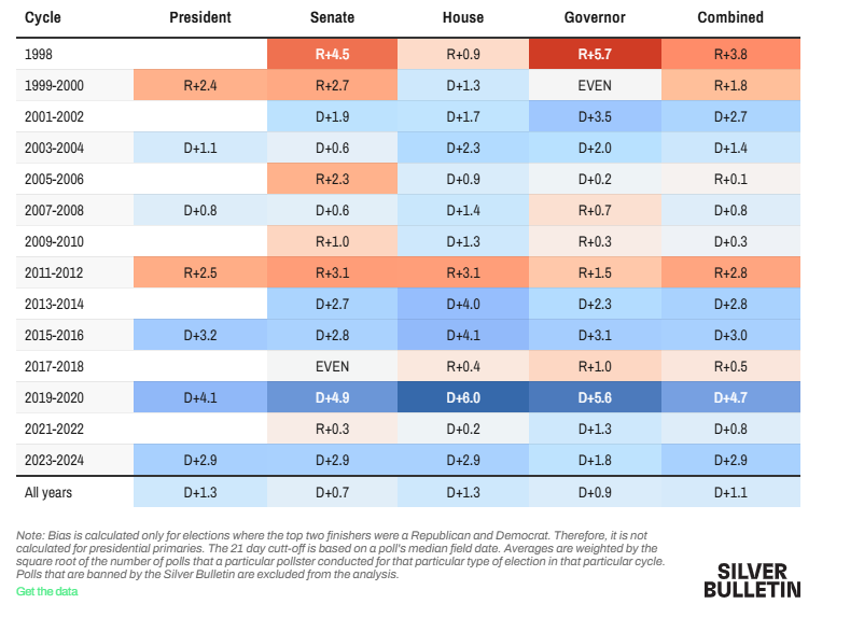
Still, nearly every competitive race sits inside the margin of error, and the polling record gives Republicans reason for confidence. Surveys understated GOP performance by roughly 5 to 6 points in Ohio and Michigan in 2024, and both Collins and Sullivan beat their 2020 polls by wide margins. With Democrats defending an open seat in Michigan and the Senate Leadership Fund committing millions in Ohio and Kansas, control may come down to whether Republican turnout holds. Read More.
Texas Republicans Hold Down-Ballot Edge as Senate Race Tightens
Republicans lead seven of eight statewide races in a University of Houston Hobby School survey of 2,000 likely Texas voters, released as early voting opened Monday. Governor Greg Abbott leads Gina Hinojosa 49 to 46 percent, and Lt. Governor Dan Patrick and attorney general nominee Mayes Middleton each hold 47 to 42 percent advantages. The lone exception is the Senate race, where Democrat James Talarico edges Ken Paxton 48 to 46 percent, within the poll’s margin of error. A separate InsiderAdvantage survey shows Paxton ahead 49 to 48 percent.
The results point to a Senate contest driven more by Paxton’s individual vulnerabilities than by any structural shift in Texas. Hobby School’s Mark Jones credits strong Republican identification, a financial edge, and low name recognition for most Democratic challengers with keeping the GOP ahead down the ballot. Polls have also understated Republicans in the state: Trump led his 2024 polling average by 7.4 points and won by nearly 14. Democrats have not won a Texas Senate race since 1988.
Read More.
IN THE STATES
DOJ Sues California Over Ballots From 20,000 Alleged Noncitizens
The Justice Department filed suit in federal court in Los Angeles on October 15, asking a judge to bar California from counting mail ballots from more than 20,000 voters the administration says are likely noncitizens until their status is verified. The Department of Homeland Security built the list by checking voter rolls against federal databases, and DOJ delivered it to Los Angeles County officials on a thumb drive two days earlier. The department says it is not seeking a purge, only to set those ballots aside, and is relying on the Supremacy Clause.
The case escalates a broader federal push on noncitizen voting that includes suits against 30 states and D.C. over voter data and warnings of criminal prosecution for election officials. Secretary of State Shirley Weber called the demand unprecedented and the timeline impossible, and election law experts note it could collide with federal limits on systematic roll changes within 90 days of an election. A ruling could set the template for post-election ballot challenges elsewhere. Read More.
Voters Weigh 145 Ballot Measures, With Election Rules and Abortion at the Center
Voters in 39 states will decide 145 statewide ballot measures on November 3, below the even-year average of 163 since 2000, according to Ballotpedia. Election policy leads the docket with 34 measures, including voter ID proposals in California and Nevada, a citizenship voting requirement in Alaska, and higher thresholds for constitutional amendments in North and South Dakota. Redistricting is also on the ballot, with Missouri voters deciding whether to keep the state’s new congressional map. Idaho, Nevada, and Virginia will vote on abortion rights, while Missouri weighs repealing its 2024 abortion rights amendment.
Several measures could affect turnout in competitive states, particularly the abortion questions in Nevada and Virginia and California’s proposed one-time 5 percent tax on billionaires, which faces two competing opposition initiatives. The Missouri referendum offers the first direct voter test of mid-decade redistricting this cycle. Data centers are also emerging as a local flashpoint, with 41 local measures on development this fall. Read More.
EMERGING NARRATIVES
Musk Becomes the Cycle’s Dominant Donor With $276 Million GOP Push
Elon Musk has given more than $276 million to Republican groups and his own super PAC since July, according to figures his team provided to The New York Times, lifting his 2025-26 total to roughly $366 million, above his 2024 giving. His $158 million to the Senate Leadership Fund exceeded what its Democratic counterpart raised last quarter and arrived just before the group launched a $149 million pro-Paxton ad campaign in Texas. America PAC, which received $76 million, has deployed nearly 3,000 paid canvassers across seven Senate battlegrounds and about three dozen House races, with Texas drawing more than a third of its disclosed spending.
The operation targets low-propensity conservatives rather than swing voters, leaning on culture-war and anti-socialism messaging, a harder sell without Trump on the ballot. Musk has also taken a far more hands-off role than in 2024. Still, his money has helped give Republicans a clear financial edge, and America PAC’s confirmed plans for 2028 point to a lasting presence on the right.
Read More.
AI Ads Go Mainstream, and the Rules Haven’t Caught Up
Generative AI has become a standard campaign tool this cycle. The Wesleyan Media Project counts 220 AI-generated ads with $137 million in spending through Oct. 11, most of it Republican, and Axios found them across top Senate and governor’s races.
Axios
The uses vary widely. At one end is clear satire, like a Blakeman campaign ad showing the Tooth Fairy unable to afford her job in Kathy Hochul’s New York. At the other are realistic fabrications, such as a Paxton ad depicting James Talarico defacing a Bible and Senate Leadership Fund spots of Jon Ossoff getting beauty treatments, which don’t disclose AI use. Some sit in between: a Michigan ad targeting Abdul El-Sayed includes AI disclosures, and its sponsor says it’s grounded in his public statements.
The AI attack-ad nightmare is coming true
+3
That range is what makes regulation hard. Four states ban certain deepfake uses, 27 require some disclosure, and there’s no federal law specifically covering AI political ads. For now, whether voters are told what they’re watching depends largely on which state they live in.
Read More.
ON THE HORIZON
Upcoming Elections:
November 3:
General Elections