AxIndex, Edition 18
SNAPSHOT
Our Top 3:
1) Both Parties Are Fighting Themselves as Much as Each Other: Intra-party friction is surfacing on both sides at once, House Democratic leadership scrambling to respond to centrist defections on a procedural vote, progressive-versus-establishment primaries reshaping New Hampshire's Senate race and Wisconsin's governor's race, and Republicans banking on Trump's personal brand to drive turnout in a race he isn't on the ballot for. These aren't isolated dustups; they reflect real uncertainty over which wing of each party controls its coalition heading into 2027, layered on top of the external headwinds each party is already navigating.
2) The Ground Is Shifting Beneath Both Parties, Not Just the Democrats: Republicans' once-comfortable Senate position has narrowed, with Trump's approval at 32% amid tariff and economic pressure, and Democrats now see live opportunities in Texas, Iowa, Alaska, Ohio and North Carolina as total spending climbs past $3.4 billion. The erosion is showing up in unlikely places: Sen. Mike Rounds of South Dakota said farmers "feel just like the administration pulled the rug right off from underneath" them over Trump's beef imports, adding "politics is local." The question isn't whether the environment has soured — it clearly has — but whether that discontent survives contact with partisan lean once voters are actually in the booth.
3) Trump Puts His Full Weight Behind the Midterms, Betting His Coalition Delivers: Republicans open an unprecedented midterm convention in Dallas this week, built around a president determined to make Election Day a referendum on his record. Trump conceived the event and controls its programming, headlining both nights alongside rising stars like Paxton and Rogers to harness his continued pull with the base at a moment when enthusiasm matters most. The party is still building out its financial firepower, with MAGA Inc.'s first major buy, $10 million in Texas, landing this month, and more of its nearly $400 million war chest expected to follow as races tighten. The real test is turnout, and Republicans are counting on Trump's singular ability to energize supporters, paired with a deep bench of next-generation talent, to carry momentum past November.
National Sentiment Tracking
Record-High 89% of Americans See Government Corruption as Widespread
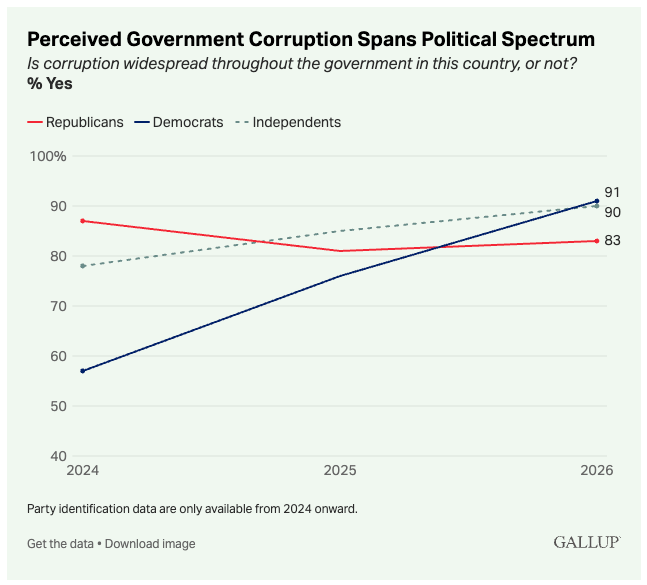
A new Gallup poll finds 89% of U.S. adults now say government corruption is widespread, a 10-point jump from 2025 and the highest reading in Gallup's 20-year trend, up from a 72%-79% range that held from 2010 through 2025. The rise is driven mainly by Democrats, whose perception of corruption climbed from 57% in Biden's final year to 91% today, while independents rose to 90% and Republicans have held steady in the low-to-mid 80s. The U.S. figure now exceeds the Organisation for Economic Co-operation and Development median of 59% by 30 points and ranks among the highest worldwide.
The convergence across party lines is notable: Republican views have stayed relatively fixed regardless of which party holds power, while Democratic and independent perceptions have moved sharply since 2024, suggesting their views are more closely tied to control of the administration. With corruption perceptions now nearly bipartisan in their severity, the finding underscores an anti-establishment mood that both parties' campaigns may look to tap into heading into November, whether through anti-corruption messaging or broader "drain the swamp" framing. Read More.
HOUSE HIGHLIGHTS
Polling At A Glance
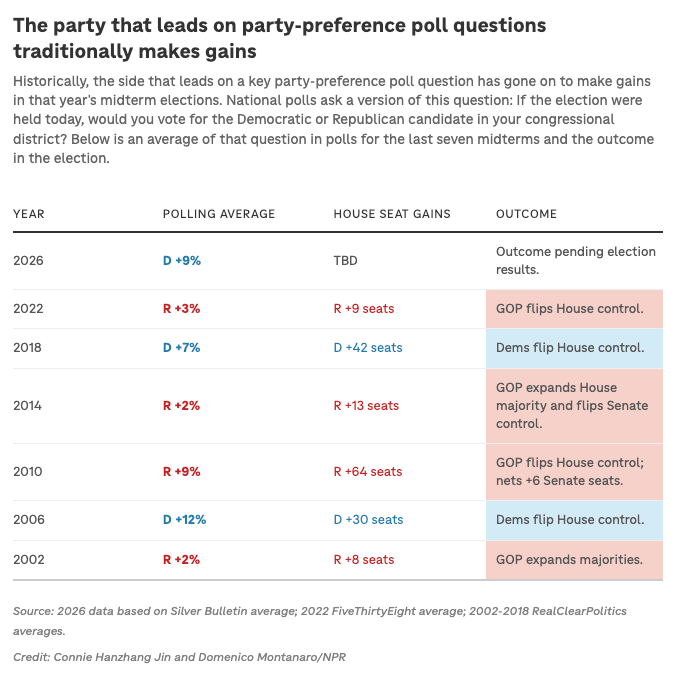
RCP Average Generic Ballot:
48.1 Dem - 42.3 GOP (D +5.8)
On this day in:
2022: 44.4 GOP - 44.8 Dem (D+0.4)
2018: 47.3 Dem - 39.5 GOP (D+7.8)
Retirements

For context, during the first Trump term, there were 52 retirements from the House.
NRCC Adds Five Candidates to Battleground Recruitment Program
The NRCC added five candidates in Florida and North Carolina to its MAGA Majority battleground recruitment program, all backed by President Trump. Dan Green, Mike Beltran and Scott Singer will challenge Democratic Reps. Darren Soto, Kathy Castor and Jared Moskowitz respectively in Florida, while Casey Askar and Jennifer Balkcom are running for open seats in Florida's 22nd and North Carolina's 11th districts. NRCC Chair Richard Hudson said the recruits "have what it takes to win" and help Republicans "keep America on the path to prosperity."
The addition continues a steady recruitment push even as Republicans face a challenging environment nationally, with Trump's approval slipping and the ongoing Iran war and affordability concerns weighing on the party in recent polling. The expanded slate signals Republicans see opportunity to go on offense in Florida specifically, even as they play defense elsewhere, underscoring how uneven this cycle's battlefield has become district by district.
Read More.
SENATE HIGHLIGHTS
Polling At A Glance
Polling Averages
North Carolina: Cooper +8.0 (Flip)
Georgia: Ossoff +7.5
Minnesota: Flanagan +5.5
Ohio: Brown +2.6 (Flip)
Texas: Talarico +2.4 (Flip)
Michigan: El-Sayed +2.3
Maine: Jackson +2.3 (Flip)
New Hampshire: Pappas +2.0 --> Tipping Point
Alaska: Peltola +2.0 (Flip)
Iowa: Hinson +1.8
Florida: Moody +9.5
Recent Polls
Michigan State/YouGov (MI General): El-Sayed (D) 50, Rogers (R) 45
Albuquerque Journal (NM General): Lujan (D-i) 53, Marker (R) 28
TPPF (TX General): Paxton (R) 50, Talarico (D) 50
Emerson (IA General): Hinson (R) 50, Turek (D) 45
Beacon Center (TN General): Hagerty (R-i) 58, Bradshaw (D) 33
Retirements
So far, 11 Senators have announced their retirement from the chamber at the end of the current Congress.

Trump's Cavalry Arrives as Paxton Gets $10 Million Air Cover in Texas
President Trump's MAGA Inc. made its first general-election ad buy of the cycle, committing $10 million to Texas — half boosting Paxton's tax-cut message, half hitting Talarico on property taxes. It adds to a wall of outside support for Paxton, including Elon Musk's America PAC and $18.9 million already spent by Lone Star Liberty PAC, even as Talarico has outspent Republicans $41.7 million to $24.3 million overall. Thune has pushed Trump to go further, calling Texas a must-win, and Trump says he has close to $1 billion available for the midterms.
The late but decisive entrance of Trump's operation signals Republicans see Paxton's position, anchored by Trump's continued loyalty and a tax-cut message, as strong enough to defend at scale, not a race slipping away. With GOP money now converging from multiple directions, the financial gap fueling early toss-up chatter is starting to narrow.
Read More.
Senate Map Widens as Economic Discontent Scrambles Both Parties' Paths
Republicans' once-comfortable Senate position has narrowed, with Trump's approval at 32% amid tariff and economic pressure. Democrats now see live opportunities in Texas, Iowa, Alaska, Ohio and North Carolina beyond their original target of Michigan, Georgia and New Hampshire, while Michigan and Maine have grown tougher after contentious primaries. Total spending is projected to exceed $3.4 billion, and Thune himself has said he "worries" about losing the majority. Notably, the strain is reaching into reliably red territory: Sen. Mike Rounds of South Dakota said farmers and ranchers "feel just like the administration pulled the rug right off from underneath" them over Trump's move to import beef, adding that "politics is local."
The expanding map cuts both ways. Democrats gain a real shot in traditionally elusive Texas, but must still net four seats overall, including two in states Trump carried by double digits — a high bar Republicans are counting on. Rounds's comments suggest even farm country isn't immune to the economic frustration reshaping the broader battlefield. With Trump planning heavy late-cycle travel, both parties see the final stretch as the decisive variable.
Read More.
New Hampshire Primary Sets Up Marquee Open-Seat Senate Race
New Hampshire voters head to the polls Tuesday in one of the cycle's last major primaries, with Rep. Chris Pappas favored to fend off democratic socialist challenger Karishma Manzur for the Democratic nomination; recent UNH polling has shown Manzur narrowing Pappas's lead to 13 points. On the Republican side, Trump-endorsed former Sen. John Sununu holds a wide lead over fellow former Sen. Scott Brown, with GOP leadership including Sens. Tim Scott and John Barrasso backing Sununu. The seat opened when longtime Sen. Jeanne Shaheen announced her retirement.
The race is shaping up as a test of both parties' internal dynamics: Manzur's late surge reflects the same progressive energy that has toppled establishment Democrats elsewhere this cycle, while Sununu's likely nomination — despite past criticism of Trump — shows the president's continued sway even over previously skeptical GOP figures. Both matchups head into a general election rated among the most competitive in the country, with Pappas leading both potential Republican opponents in early general-election polling.
Read More.
IN THE STATES
Missouri, Maryland High Courts Deliver Democrats a Pair of Redistricting Wins
Missouri's Supreme Court blocked use of the state's new GOP-drawn congressional map for November, reinstating the 2022 lines and preserving Democratic Rep. Emanuel Cleaver's more favorable 5th District rather than one Trump would have carried by 18 points. Separately, Maryland's high court allowed a ballot referendum to proceed that would let Democrats redraw the state's map ahead of 2028, potentially targeting the state's lone GOP-held seat, though justices ordered the amendment language rewritten as misleading. Missouri Republicans, who had primaried candidates under the now-blocked map, say they'll appeal to the U.S. Supreme Court.
The rulings arrive amid a broader mid-decade redistricting wave that Republicans launched to shore up their narrow House majority following a Supreme Court decision weakening Section 2 of the Voting Rights Act. Democrats are watching closely whether the justices apply the same standard they used blocking Virginia's Democratic-drawn map in May, calling it a test of the Court's consistency. With control of the House still contested, these late map fights could meaningfully affect which seats are competitive in November. Read More.
2026 Governors' Map Extends Deep Into Both Parties' Territory
Democrats are defending governorships in five states Trump carried in 2024, Arizona, Kansas, Wisconsin, Michigan and Pennsylvania, while only two Republican-held seats sit in states Harris won, with just New Hampshire seen as competitive. Analysts see 12 state trifectas in play, with Democrats eyeing Minnesota, Nevada and Pennsylvania and Republicans eyeing Kansas, Arizona, Michigan and Wisconsin. Even traditionally safe territory has moved: Cook and Sabato downgraded Texas Gov. Greg Abbott's reelection from "solid" to "likely" Republican in August, and Florida Republican Byron Donalds faces a vigorous challenge from party-switcher David Jolly amid backlash over home insurance rates and data centers. In Georgia, Keisha Lance Bottoms holds a narrow polling lead that could flip the GOP trifecta and make her the first Black woman elected governor of any state.
Local dynamics are cutting in unpredictable directions within that national picture. Iowa's Rob Sand leads in a red-trending state by running on anti-corruption messaging and local water-quality concerns rather than partisanship, while Wisconsin Democrats scrambled to avoid nominating a democratic socialist before settling on Crowley, who now leads narrowly. Ohio and Nevada remain functionally tied despite lopsided GOP fundraising advantages, and Alaska's ranked-choice system leaves Republicans favored but exposed after late ballot chaos. With Democrats defending far more hostile terrain than Republicans, the governors' map offers one of the clearest tests of whether a national wave, if one materializes, extends beyond Congress into the states. Read More.
EMERGING NARRATIVES
House Democratic Unity Cracks Over Procedural Vote, Exposing Leadership Strains
Two House Democrats, Jared Golden of Maine and Marie Gluesenkamp Perez of Washington, broke with their party Tuesday to help Republicans pass a procedural rule, ending a long-standing precedent of unified Democratic opposition to such votes. The rule cleared the floor for several GOP bills, including an anti-socialism resolution Democrats broadly opposed over its election-restriction provisions, and Golden and Perez said their real target was securing a vote on a lobstering-regulation bill. Leadership, caught off guard, called it a "significant breach of trust" requiring "a serious response," though by Wednesday no discipline had been decided, and the matter was referred to a rules committee with no formal punishment authority.
The episode exposed friction between Minority Leader Hakeem Jeffries and Whip Katherine Clark over who missed the defection coming, and revived anxiety that a Democratic majority next year could face the same fractious-caucus dynamics that have hampered Speaker Mike Johnson's Republicans. Eight Democrats in total crossed over, drawing sharp criticism from both centrist colleagues worried about caucus discipline and progressive figures who see the defections as validating concerns about the party's "big tent" coalition. With Gluesenkamp Perez facing a competitive reelection and showing little concern about consequences, the fight signals unresolved tension over how much leverage swing-district members will hold if Democrats retake the majority.
Read More.
The Trump Show: Republicans Bet on Star Power to Energize the Midterms
Republicans open an unprecedented midterm convention in Dallas this week, built around a president determined to make Election Day a referendum on his record. Trump conceived the event and controls its programming, headlining both nights alongside rising stars like Paxton and Rogers — a deliberate strategy to harness his continued pull with the base at a moment when enthusiasm matters most. Choosing Dallas also signals confidence: Republicans haven't lost statewide in Texas since 1994, and putting the spotlight there doubles as a statement of intent to defend the state decisively.
The party is still building out its financial firepower, with MAGA Inc.'s first major buy — $10 million in Texas — landing this month and more of its nearly $400 million war chest expected to follow as the race tightens. Trump's message has centered on tangible wins: border security, tax cuts on tips and overtime, and efforts to lower drug prices, giving Republicans concrete deliverables to campaign on.
The real test is turnout. Trump has shown he can energize supporters like no one else in the party, and Republicans are counting on that star power, paired with a packed roster of next-generation talent taking the stage, to carry enthusiasm past November. Read More.
ON THE HORIZON
Upcoming Elections:
September 8:
New Hampshire Primary
September 9:
Rhode Island Primary
September 15:
Delaware Primary