AxIndex, Edition 10


SNAPSHOT


Our Top 3:


1) Redistricting Tilts Right as Democrats Pivot to 2028:
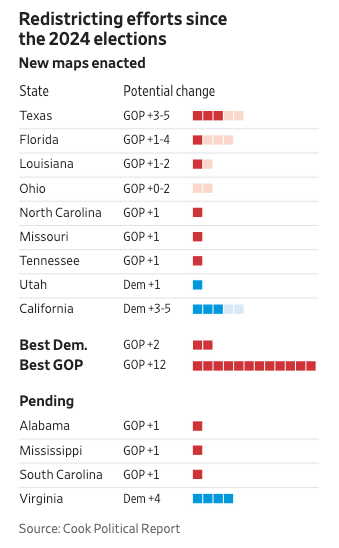
Two court rulings reshaped the map in recent weeks: the Virginia Supreme Court struck down a voter-approved Democratic plan, and the U.S. Supreme Court vacated a Mississippi ruling protecting Black voting strength. Republicans now project gains of up to 15 seats across the South and Midwest, against six potential Democratic gains in California and Utah. House Democrats are responding by targeting New York, Colorado, Oregon, and Washington for 2028 redraws. With control of the House likely to hinge on a handful of seats, even small map shifts could prove decisive.


2) Cassidy Becomes the Highest-Profile Casualty of Trump's Retribution Tour:

Sen. Bill Cassidy finished third in Louisiana's GOP Senate primary with 25 percent, behind Trump-backed Rep. Julia Letlow (45 percent) and former Trump official John Fleming (28 percent), who advanced to a June 27 runoff. Cassidy spent $21 million defending his seat but could not overcome Trump's targeting over his 2021 impeachment vote. Only Sens. Collins and Murkowski remain among Senate Republicans who voted to convict. Attention now shifts to Tuesday's Kentucky primary, where Rep. Thomas Massie faces a Trump-recruited challenger in the most expensive House primary ever at $32 million. The big question is whether Trump-aligned primary winners carry the same edge in competitive generals.


3) Polling Shows Trump Endorsements Cut Both Ways:

New POLITICO Poll modeling finds Trump's endorsement remains the most powerful force in GOP primaries but a likely liability in battleground generals. His backing made 2024 Trump voters 22 percent more likely to support a candidate, but pushed 2024 Harris voters 55 percent less likely to support a candidate, a net negative overall. Pro-crypto and pro-AI-deregulation endorsements proved similarly toxic to voters of both parties. The findings echo 2018 research showing Trump's nods can drag down GOP nominees in swing seats. As Trump stays active in primaries from Louisiana to Texas, the dynamic could shape how nominees position themselves for November.


National Sentiment Tracking


Trump's China Trip Yields Few Wins as Approval Hits Second-Term Low

President Trump returned from a two-day visit to Beijing without securing concrete commitments on the Strait of Hormuz, where a 79-day-old conflict with Iran continues to drive up gas prices and squeeze the U.S. economy. A new NYT-Siena poll released Monday found 64 percent of Americans, including 73 percent of independents, view the Iran war as a mistake, while Trump's overall approval rating fell to 37 percent, a second-term low. With 76 percent rating the economy fair or poor and Speaker Mike Johnson openly expressing concern about Trump's refusal to leverage Xi for relief at the pump, the trip did little to ease the political headwinds confronting the GOP heading into November. Trump's reluctance to engage in traditional horse-trading and his vague characterization of the visit's "deliverables" underscore the difficulty of converting foreign policy into domestic political relief. Read More.

Democrats Open Double-Digit Generic Ballot Lead in NYT-Siena Poll

A new New York Times-Siena survey shows Democrats leading the generic congressional ballot 50 percent to 39 percent, with 11 percent unsure, an 11-point margin and one of the cleanest Democratic advantages of the cycle. The poll surveyed 1,507 registered voters from May 11–15, with 90 percent saying they plan to vote in the midterms.


The advantage comes despite Republicans holding a cash-on-hand edge of $78.2 million to $69.9 million as of February, signaling that the political environment, not financial firepower, is the dominant force. With six months to go, generic ballot leads of this size have historically been a strong indicator of how a president's party will perform in the midterms.
Read More.

GOP Loses Its Traditional Economic Advantage as Affordability Anger Mounts

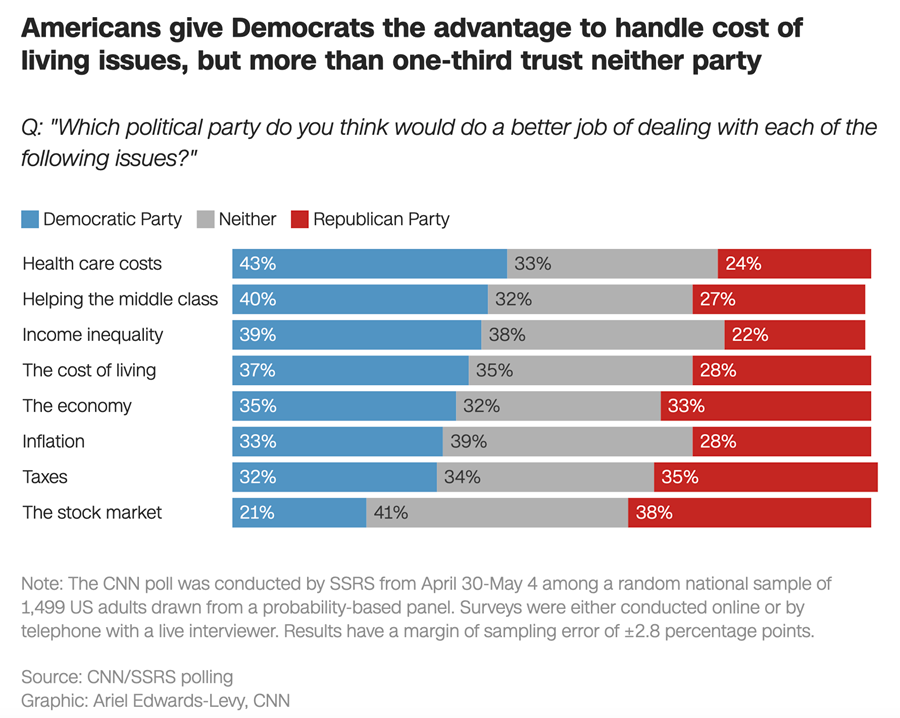
A new CNN/SSRS poll finds 77 percent of Americans, including a majority of Republicans, say Trump's policies have increased the cost of living, while his approval on the economy has fallen to 30 percent, a career low. Democrats now lead on trust to handle the cost of living by 9 points and hold double-digit advantages on income inequality, healthcare costs, and helping the middle class, reversing the GOP's 15-point edge on economic issues in 2022.

With 55 percent of Americans naming the economy as the country's most important issue and Democrats leading 45-42 on the generic ballot, the data signals a structural realignment of which party voters trust on pocketbook concerns. The shift is particularly significant given that Republicans built much of their post-Biden coalition on inflation frustration.
Read More.

HOUSE HIGHLIGHTS

Polling At A Glance

House
RCP Average Generic Ballot: 48.8 Dem - 41.6 GOP (D +7.2)
On this day in:
2022: 45.4 GOP - 43.2 Dem (R+2.2)
2018: 45.0 Dem - 40.3 GOP (D+4.7)


Recent Polls
Quantus (KY-04 GOP Primary): Gallrein 53, Massie (i) 45
Big Data Poll (KY-04 GOP Primary): Massie (i) 50, Gallrein 50
SoCal Strategies (KY-04 GOP Primary): Gallrein 49, Massie (i) 42


Cook Ratings
Recent changes:
MO-05 (Cleaver): Solid Dem -> Solid GOP


Retirements

For context, during the first Trump term, there were 52 retirements from the House. 

Massie Faces Trump's Wrath in Most Expensive House Primary in History

Kentucky Rep. Thomas Massie faces voters Tuesday in a primary that has drawn more than $32 million in ad spending, the most ever in a House primary, according to AdImpact. Trump personally recruited challenger Ed Gallrein, a former Navy SEAL, after Massie voted against the Big Beautiful Bill, sponsored a war powers resolution against the Iran strikes, and joined the bipartisan push to release the Epstein files. Trump-aligned and pro-Israel groups have dominated the ad spending against Massie, while the libertarian congressman has retained a small bench of allies, including Sen. Rand Paul and Reps. Boebert, Davidson, and Spartz. The race serves as the next major test of Trump's intraparty retribution campaign after Saturday's Cassidy ouster, with Massie betting on younger voters and a generational divide to survive. Read More.

Philadelphia Primary Becomes Flashpoint as Congressional Black Caucus Faces Existential Threat

The Democratic primary to replace retiring Rep. Dwight Evans in Pennsylvania's 3rd District, the bluest in the country, has become a proxy fight over the future of Black political representation, with up to one-third of the 63-member Congressional Black Caucus potentially losing seats to red-state gerrymanders.


Three Black candidates are competing: state Rep. Chris Rabb, backed by progressives including AOC, Summer Lee, and Maxwell Frost; state Sen. Sharif Street, backed by Sen. Cory Booker, Philadelphia Mayor Cherelle Parker, and former Gov. Ed Rendell; and pediatric surgeon Ala Stanford, endorsed by Evans, Reps. Madeleine Dean and Chrissy Houlahan, and an outside STEM-focused super PAC.


The race highlights generational and ideological divides within the CBC, just as Reps. Jim Clyburn and Bennie Thompson face potential losses to GOP redistricting. The outcome will shape both the caucus's direction and the Democratic Party's broader debate over establishment versus progressive leadership. Read More.

Redistricting

Democrats Pivot to 2028 Maps After Virginia and Alabama Setbacks

Following the Virginia Supreme Court's rejection of the Democratic-drawn map and the U.S. Supreme Court's decision allowing Alabama to redraw minority districts, House Democrats are shifting their redistricting focus to 2028, with Minority Leader Hakeem Jeffries pushing blue states, including New York, Colorado, Oregon, and Washington, to act before the next cycle.


Maryland Gov. Wes Moore is publicly pressuring state Senate President Bill Ferguson, his lone Democratic holdout, to authorize a mid-cycle map that could add a seat. House Majority PAC, which spent $38 million on the failed Virginia effort, is now seeding ballot initiatives in Colorado and preparing for legal fights in GOP-redrawn states. The strategic shift acknowledges that Republicans may dominate the 2026 map war but signals Democrats intend to fight a longer battle for the 2028 cycle. Read More.

Supreme Court Vacates Mississippi Redistricting Ruling, Expanding VRA Rollback

The U.S. Supreme Court on Monday vacated a lower court ruling that had found Mississippi lawmakers unlawfully diluted Black voting strength and ordered the case reconsidered in light of the recent Callais decision, which weakened Voting Rights Act protections. Justice Ketanji Brown Jackson was the sole dissenter, noting the appeal had only raised a narrower question about private parties' standing under the VRA.


The original lower-court ruling had triggered special elections last year that flipped one Mississippi House seat and two Senate seats to Democrats, gains now potentially at risk. The high court's action signals a continuing pattern of vacating VRA-based rulings and gives Mississippi Republicans an opening to reinstate maps that had been struck down. Read More.

South Carolina Eyes 7-0 GOP Map, but Republican Doubts Surface

South Carolina House Republicans began debating a new congressional map Monday that could yield a clean sweep of the state's seven U.S. House seats by targeting Rep. Jim Clyburn's majority-Black district. Some Republicans, including state Rep. Nathan Ballentine, have voiced reservations, citing constituent opposition and concern that a 7-0 map could spread GOP voters too thin in currently safe districts.


House Republicans voted nearly unanimously to limit each member to one amendment and three minutes of debate after more than 600 amendments were filed. Nationally, Republicans believe they could gain as many as 15 seats from new maps across Texas, Missouri, North Carolina, Ohio, Florida, Tennessee, and Alabama, against six potential Democratic gains in California and Utah. Read More.

SENATE HIGHLIGHTS

Polling At A Glance

Recent Polls


Detroit Chamber/Glengariff (MI General): Rogers (R) 45, El-Sayed (D) 40
Detroit Chamber/Glengariff (MI General): Rogers (R) 43, McMorrow (D) 41
Detroit Chamber/Glengariff (MI General): Rogers (R) 44, Stevens (D) 42
MIRS/Mitchell Research (MI General): Rogers (R) 42, El-Sayed (D) 41
MIRS/Mitchell Research (MI General): Rogers (R) 42, Stevens (D) 39
MIRS/Mitchell Research (MI General): Rogers (R) 43, McMorrow (D) 41
MIRS/Mitchell Research (MI Dem Primary): El-Sayed 28, Stevens 18, McMorrow 17
Carolina Journal/Harper (NC General): Cooper (D) 50, Whatley (R) 39
Remington Research (AL GOP Primary): Moore 23, Hudson 20, Marshall 16, Deas 2, Walker 1
Insider Advantage (SC GOP Primary): Graham (i) 56, Lynch 13, Cowen 3, Mitchell 2, Dismukes 2, Herrmann 1
TSU/YouGov (TX General): Paxton (R) 45, Talarico (D) 45
TSU/YouGov (TX General): Cornyn (R-i) 45, Talarico (D) 44
Carolina Forward/Change Research (NC General): Cooper (D) 49, Whatley (R) 42


Retirements

So far, 11 Senators have announced their retirement from the chamber at the end of the current Congress.


Trump Endorses Paxton in Texas Senate Runoff, Reshaping the Race

President Trump on Tuesday endorsed Texas Attorney General Ken Paxton over Sen. John Cornyn in the May 26 GOP Senate runoff, capping more than a year of jockeying for the president's backing. The endorsement landed a day after early voting began, with the latest University of Houston poll already showing Paxton ahead 48-45 among likely runoff voters. Trump praised Paxton as a "true MAGA Warrior" who "knows how to WIN," while noting Cornyn was "very late in backing" his 2024 campaign. Paxton, who has consistently led with the GOP base and aligned closely with Trump's agenda, including the SAVE America Act, now heads into the final week with the most powerful endorsement in Republican politics.


The move is a significant boost for Paxton, who has cast Cornyn as a creature of the Washington establishment despite the senator's late-cycle efforts to align with Trump, including the reversal of his longstanding defense of the filibuster. Democratic nominee James Talarico, who raised more than $27 million in the first quarter, has polled competitively against both Republicans, but Paxton allies argue his stronger connection to the GOP base will be decisive in a state Trump carried by 14 points. Coming three days after Sen. Bill Cassidy's Louisiana primary loss and on the same day as Rep. Thomas Massie's Kentucky primary, the endorsement underscores Trump's continued sway over Republican primaries heading into November. Read More.


Cassidy Loses Louisiana Primary as Trump's Retribution Campaign Advances

Sen. Bill Cassidy finished third in Louisiana's GOP Senate primary on Saturday, drawing roughly 25 percent of the vote behind Trump-backed Rep. Julia Letlow (45 percent) and former Trump administration official John Fleming (28 percent), who will advance to a June 27 runoff. Cassidy spent more than $21 million defending his seat but could not overcome Trump's targeting over his vote on the 2021 impeachment, his uneasy alliance with HHS Secretary Robert F. Kennedy Jr., and Louisiana's recent move to closed primaries. The loss leaves Sens. Susan Collins and Lisa Murkowski as the only remaining 2021 impeachment voters in the Senate and further consolidates the chamber behind the president.

Broader Context: Axios
reported earlier this week that Sen. Thom Tillis is privately fuming over the ouster and has warned that pushing this week's reconciliation package could similarly damage Sen. John Cornyn in next week's Texas runoff. Read More.

EMERGING NARRATIVES

AI Industry Targets Manhattan Primary in First Major Test of Political Muscle

State Assemblyman Alex Bores, running in a crowded 12-candidate Democratic primary for Rep. Jerry Nadler's open Manhattan seat, has become the first major target of a new AI super PAC called Leading the Future, which has spent more than $2 million on attack ads against him. Bores authored a New York AI safety bill signed into law by Gov. Hochul last year, drawing the ire of OpenAI and Andreessen Horowitz, whose principals anchor Leading the Future's $125 million war chest.

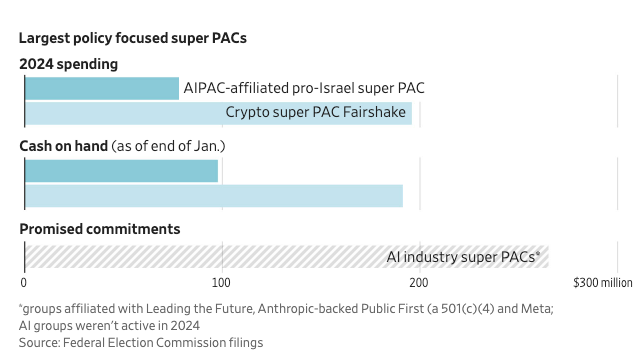
AI companies have collectively pledged about $265 million for super PACs ahead of the midterms, modeled on crypto's $200 million 2024 spending blitz, while Anthropic has seeded $20 million into a counter-group, Public First Action. The race will establish whether AI industry money can take out a regulation-friendly candidate, mirroring the playbook that helped crypto secure favorable federal policy under the Trump administration.
Read More.

Polling Suggests Trump's Endorsement Could Hurt Battleground Republicans

A new POLITICO Poll experiment finds that while Trump's endorsement increases support among 2024 Trump voters by 22 percent, it makes 2024 Harris voters 55 percent less likely to support a candidate, yielding a net negative effect across the full electorate. The findings echo prior research showing endorsements often generate stronger backlash than support, particularly when the endorser is divisive.


The polling also found that endorsements from pro-cryptocurrency and pro-deregulation AI groups are toxic to voters of both parties, while Medicare for All and stronger AI regulation produced net positive reactions. The data suggests Trump's primary kingmaking power could become a liability in the general election, and helps explain why outside super PACs, particularly in the crypto and AI industries, typically spend on messaging that obscures their underlying agenda rather than openly endorsing candidates. Read More.

Data Centers Become Political Flashpoint as Opposition Hits 70 Percent

A new Gallup survey finds seven in ten Americans oppose building data centers in their communities, with 56 percent of Democrats expressing strong opposition. Half of opponents cite the drain on water and energy resources, while another 22 percent cite quality-of-life concerns, and one in five raise cost worries.


The numbers underscore why data centers have become a bipartisan target as states from Maine to Maryland weigh moratoriums and restrictions, and why tech companies are scrambling to soften the projects' image. The growing backlash positions data centers as a midterm-cycle wedge issue with crossover appeal in suburban and rural districts alike. Read More.

ON THE HORIZON

Upcoming Elections:


May 19:
Alabama Primary
Georgia Primary
Idaho Primary
Kentucky Primary
Oregon Primary
Pennsylvania Primary


May 26:
Texas Runoff


June 2:
California Primary
CA-01 Special Primary
Iowa Primary
Montana Primary
New Jersey Primary
New Mexico Primary
South Dakota Primary


June 9:
Maine Primary
Nevada Primary
North Dakota Primary
South Carolina Primary


June 16:
CA-14 Special Primary
Oklahoma Primary
Alabama Primary Runoff
Georgia Primary Runoff


June 2, 2026
SNAPSHOT
By Bob Salera June 2, 2026
President Ashlee Rich Stephenson joined Steve Scully on SiriusXM POTUS to discuss the latest political developments, including the Maine Senate race, the emerging field for the 2028 presidential election, and renewed scrutiny of President Biden's 2024 campaign. The conversation covered former Vice President Mike Pence's political future, the growing attention surrounding Vice President JD Vance and Secretary of State Marco Rubio as potential Republican standard-bearers, and former First Lady Jill Biden's recent reflections on the 2024 election cycle.  Listen to the full conversation here:
By Bob Salera May 11, 2026
A Spring Congressional Update: What to Watch in the Months Ahead After a busy first four months of the year and with the remaining legislative calendar shrinking, it’s time to take a fresh look at the outlook for the three-month Congressional sprint to August. Appropriations: A Fresh Start — and Early Pressure In our January outlook , Congress was staring down a January 30th funding deadline. After one of the most turbulent funding cycles in recent memory — including a 43-day government shutdown last fall that became the longest in modern history — Congress managed to complete 11 of the 12 FY2026 appropriations bills. Congress recently released funding for the Department of Homeland Security – sans ICE and CBP – but only after swiftly approving a budget resolution to tee up a second reconciliation bill intended to provide multi-year funding for the immigration and border enforcement agencies. Now the clock is already ticking on FY2027 funding. The House is well underway, having reported out five Appropriations bills in the last two weeks of April. The House Appropriations Committee has laid out an ambitious markup schedule to complete its committee work by June. On the other side of the Hill, the Senate has held a flurry of hearings in April to examine the Administration’s budget request, with Administration officials making regular appearances before the Committee as the Senate charts its path for FY2027 funding bills. Whether Congress can complete some or any of these bills before the October 1 deadline, or whether the government once again stumbles into another continuing resolution or shutdown, remains the central fiscal question of the year. Whether it’s Vegas or Kalshi, the safe money is on a continuing resolution at least through the end of the year in order to avoid a messy spending fight a month before the midterm elections. Defense: Boosting the Budget, Expanding Priorities Boosting defense spending remains a top Administration priority, which has taken on increased importance as the military engagement with Iran has dragged on and strained military stockpiles. The Administration's new budget request proposes boosting defense spending to roughly $1.5 trillion — a sharp increase that Congress will have to grapple with as it approaches the NDAA and Appropriations bills this year. Traditionally, Congressional Appropriators tee up the defense funding bill early in the process, but in the House, it is currently scheduled to be the last bill to move through Committee, reflecting uncertainty over how to tackle the Administration’s request. A third reconciliation or a separate bipartisan supplemental funding bill are also options but face significant headwinds in the near term. The FY2027 NDAA is on the (short) list of bills Congress should get done this year with a June 4th mark-up scheduled in the House. The question is whether it becomes a lame duck Christmas tree. Transportation: A Must-Pass Deadline Looms Aside from the annual defense and appropriations work, the biggest legislative item on Congress's plate is the surface transportation reauthorization. The current authorization expires on September 30, 2026. Congress must either pass a new multi-year highway bill or risk leaving states without the long-term funding certainty they need to execute major infrastructure projects. Transportation Secretary Sean Duffy has been vocal about his "America is Building Again" agenda, pushing to streamline permitting and give states more control over environmental reviews. On the Hill, all eyes are on House Transportation and Infrastructure Committee Chairman Sam Graves and Ranking Member Rick Larsen as speculation over a markup date and an impending deal continues to dominate conversations in transportation circles. Optimists (me included) believe that the Graves-Larsen dynamic duo will strike a deal that will bring along a bipartisan coalition and reinvigorate business and labor stakeholders, and that a bill is possible this year. The theory goes that momentum from the House could spur action in the Senate, yet every week that passes makes it more difficult.  Additionally, water infrastructure, aviation safety and additional funding for air traffic control are on the agenda, and Congress is likely to act on these issues before the year concludes. The Bottom Line Congress enters the second half of the fiscal year with a full agenda and real deadlines but as the saying goes, the outlook is as clear as mud. A second and possibly third reconciliation bill shows that Republicans are looking to create additional pathways to advance their remaining priorities. A possible surface transportation bill, defense authorization, and end of year funding will all be big targets as the ‘last trains to leave the station’ after the midterms.
May 5, 2026
SNAPSHOT
By Bob Salera May 5, 2026
AxAdvocacy President Ashlee Rich Stephenson joined SiriusXM POTUS to discuss the midterm elections. "As we look toward the midterms, it’s important to remember there are always ebbs and flows. Right now, economic pressure, especially gas prices, is driving much of the conversation. If costs stay high through key moments like the Fourth of July and Labor Day, that creates a challenging environment for many candidates. At the end of the day, it comes down to a familiar reality, voters will side with whoever they believe is better for their pocketbook." Watch the full interview:
By Bob Salera April 30, 2026
Caught in the Red Tape? How to Use Effective Advocacy to Get Things Moving When a state regulation, policy, or licensing requirement is standing in the way of your business, don’t just get frustrated: get strategic. My dad always said, “You’ve got to know the rule to get around it.” That does not mean breaking the rules. It means understanding exactly what the law or policy says, why it exists, and how to work within the system to find a solution. Regulations can be complicated and changing them is not easy, but knowing the rules is the first step to effective advocacy. Here are five steps to help navigate state government and remove unnecessary barriers. Know the Rule Start by identifying the exact policy, regulation, or law creating the problem. You can do this by: Asking the regulator or government official to cite the exact rule they are enforcing Searching on the agency’s website, where most rules and policies are published Submitting a Freedom of Information request if needed Just as important as identifying the rule is understanding its history. Ask: What problem was this originally designed to solve? Knowing the intent behind the policy often reveals whether it is still relevant or if it has outlived its usefulness. Build Support Reach out to other similar businesses to see if they are experiencing the same issue. Even one or two additional voices can strengthen your position. Real stories, real costs, and real-world examples help decision-makers understand the impact. Stay Focused Once you understand the rule and have identified others with the same issue, develop a clear and simple message. Be able to explain: What the rule is How it is impacting your business Why it is unnecessary or unreasonable in today’s context What outcome would solve the problem Clarity matters. A focused message with a practical solution is far more effective than a long list of complaints. Work with the Agency Start where the issue lives, inside the agency. Speak first with the staff or office handling the matter. If you are not getting traction, identify agency leadership, including division directors, board members, or Governor-appointed agency heads. Request an in-person meeting when possible. Many issues improve significantly when decision-makers hear directly how the policy is affecting real businesses. Contact Your Elected Officials If working through the agency does not resolve the issue, loop in your state representative or senator. It is often best to begin by trying to work directly with the agency first, but keep your legislator informed along the way so they understand the issue if escalation becomes necessary. Elected officials can help connect you to the right people, ask questions on your behalf, and push for broader policy changes when needed. Key Takeaways Most people skip the first step of identifying the rule and miss opportunities to resolve the issues quickly. Many times, policies and laws are misunderstood or misapplied. Progress rarely comes from frustration alone, it comes from clarity, persistence, and collaboration.