AxIndex, Edition 17
SNAPSHOT
Our Top 3:
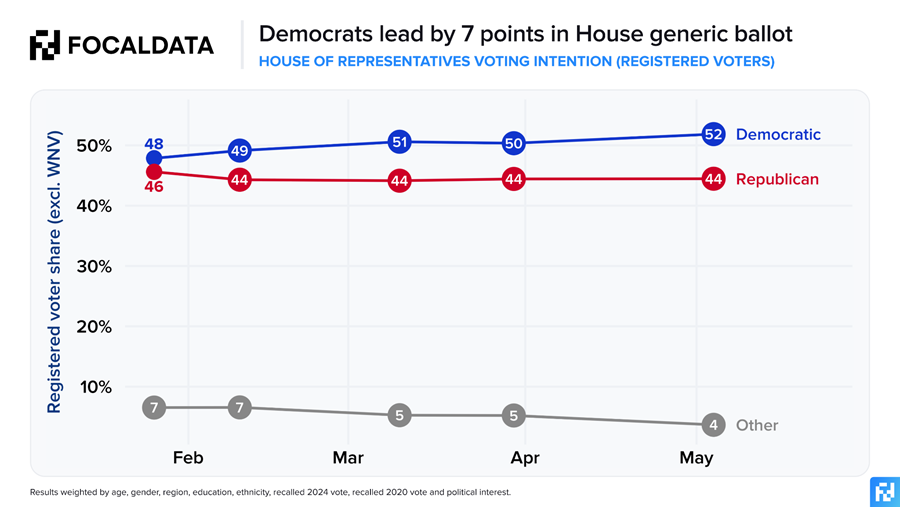
1) Economic Anxiety Is Rewriting the Midterm Map: A new monthly Focaldata/Financial Times tracker shows Democrats erasing a 28-point 2024 deficit on the economy, now leading Republicans 41% to 36% among voters who cite inflation as a top concern, while their generic ballot lead has climbed to 7 points. Focus groups of undecided voters in the Iowa and Georgia Senate races corroborate the shift on the ground: all but one of a dozen panelists, most of whom backed Trump in 2024, say the economy will be a major factor in their vote, and eight of twelve disapprove of his handling of it. Trump's approval has ticked down to a net -18, his worst mark of the year. The economy, not immigration or foreign policy, has become the dominant midterm narrative, and it is currently breaking against the party in power.
2) The Left Flank Is Taking Down the Establishment, Not Just the GOP: Democratic primary voters have ousted a string of high-profile "Resistance 1.0" figures this cycle, with DSA-aligned or Mamdani-endorsed challengers defeating Reps. Dan Goldman, Shri Thanedar, and Diana DeGette, and democratic socialist Angie Nixon upsetting impeachment-witness Alex Vindman in Florida's Senate primary despite being outraised nearly 19-to-1. It's part of a broader wave of congressional turnover, with at least 83 House and Senate incumbents not returning next year, the most since 2000, and a postwar-record pace of primary defeats. The pattern signals that impeachment credentials and institutional standing no longer inoculate Democratic incumbents; primary voters now demand sharper economic and foreign-policy positioning. The open question is whether this energizes the base for November or hands Republicans an opening to brand the party as out of the mainstream.
3) Trump's Endorsement Power Faces Its Sharpest Test of the Cycle: In South Carolina, MAGA Inc. poured over $827,000 into a tied runoff between Trump-backed Sen. Darline Graham and Rep. Ralph Norman, after Trump made a rare in-person campaign stop, with strategists warning a Graham loss would be "a massive embarrassment." Meanwhile in Pennsylvania, Republican voters now view Democratic Sen. John Fetterman more favorably (73%) than they do their own GOP Sen. Dave McCormick (63%), even as Fetterman's standing with Democrats has collapsed. Both data points point in the same direction: traditional partisan loyalty is fraying at the edges, with voters increasingly willing to cross party lines based on individual brand rather than label. For a president whose political capital rests on the strength of his endorsement, a stumble in a deep-red state runoff would be a notable signal heading into November.
National Sentiment Tracking
Democrats Widen Edge in New Focaldata/FT Monthly Tracker
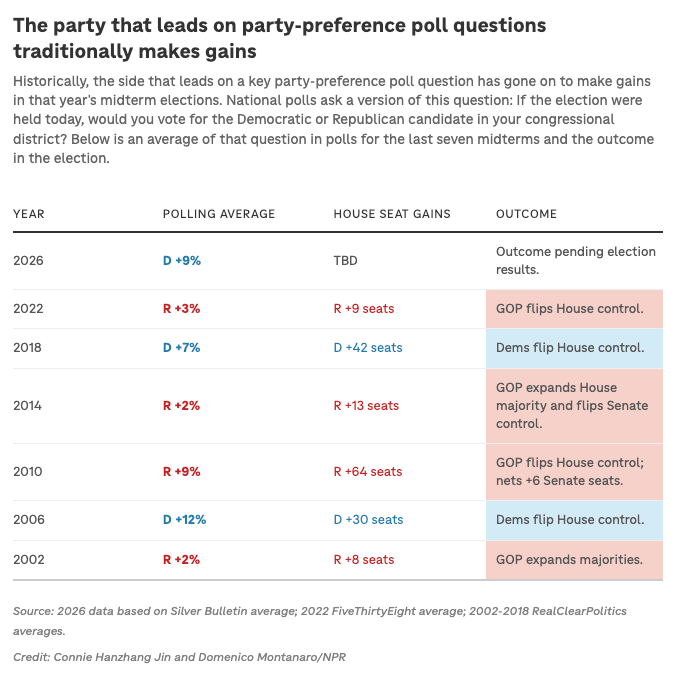
Democrats hold a 7-point lead in the House generic ballot, 52% to 44% among registered voters, their highest share yet in a new monthly Focaldata-Financial Times poll launched for the 2026 midterm cycle. The party has also erased what was a 28-point GOP advantage on the economy in 2024, now leading 41% to 36% among the 47% of voters who name inflation and cost of living a top issue. Trump's approval sits at 37%, with disapproval at 55%, his highest negative net rating of the year.
Immigration remains Republicans' strongest issue, but has fallen from the second- to the fifth-most salient concern as economic and foreign policy dominate. Kamala Harris and JD Vance lead their parties' respective 2028 primary fields. The survey polled 3,612 US adults May 1-5, with Focaldata continuing monthly waves through the midterms. Read More.
Undecided Voters in Iowa, Georgia Senate Races Driven by Economic Anxiety
Focus groups convened by Syracuse University with Engagious and Sago found deep economic anxiety shaping undecided voters in the Iowa and Georgia Senate races. Of the dozen panelists — six independents, five Republicans, one Democrat, nine of whom backed Trump in 2024 — all but one said the economy will be a major factor in their November vote, and eight disapprove of Trump's second-term performance. Moderator Rich Thau said economic anxiety, not immigration or foreign policy, is "the animating issue in the midterms."
Notably, several panelists have already settled on their gubernatorial picks even while undecided on Senate: four of five Iowa voters favor Democrat Rob Sand, while three Georgia voters back Republican Rick Jackson. The split suggests economic frustration is cutting across party lines in ways that could scramble down-ballot outcomes in two states central to Senate control. Read More.
HOUSE HIGHLIGHTS
Polling At A Glance
RCP Average Generic Ballot:
48.6 Dem - 41.6 GOP (D +7.0)
On this day in:
2022: 44.6 GOP - 44.5 Dem (R+0.1)
2018: 46.1 Dem - 40.1 GOP (D+6.0)
Retirements

For context, during the first Trump term, there were 52 retirements from the House.
Georgia Voters Pick Short-Term Successor to Late Rep. David Scott
Voters in Georgia's 13th Congressional District head to the polls Tuesday in a special runoff to fill the remainder of the late Rep. David Scott's term. Former Gwinnett County School Board Chair Everton Blair and Marcye Scott, the congressman's daughter, advanced after the July 28 special election, where Scott took roughly 46% to Blair's 38%, short of the majority needed to avoid a runoff. Neither candidate is running for the next full term beginning January 3, meaning the winner holds the seat only a few months.
The abbreviated tenure limits the seat's near-term legislative weight, but the race still carries symbolic stakes as a test of the Scott family's political brand in a longtime Democratic stronghold spanning parts of Clayton, DeKalb, Gwinnett, Henry, Newton, and Rockdale counties. A separate contest for the full term will follow before the seat's next occupant is seated in January. Read More.
SENATE HIGHLIGHTS
Polling At A Glance
Polling Averages
North Carolina: Cooper +8.0 (Flip)
Georgia: Ossoff +7.5
Minnesota: Flanagan +5.5
New Hampshire: Pappas +3.7
Maine: Jackson +2.3 (Flip)
Alaska: Peltola +2.0 (Flip)
Texas: Talarico +1.2 (Flip)
Michigan: El-Sayed +0.7--> Tipping Point
Ohio: Brown +0.6 (Flip)
Iowa: Hinson +0.7
Florida: Moody +9.5
Recent Polls
TIPP (MI General): El-Sayed (D) 45, Rogers (R) 42
Susquehanna (MI General): El-Sayed (D) 46, Rogers (R) 39
Fabrizio/Anzalone (MI General): El-Sayed (D) 48, Rogers (R) 47
KSTP/SurveyUSA (MN General): Flanagan (D) 46, Tafoya (R) 41
St. Anslem (NH General): Pappas (D) 48, Sununu (R) 41
St. Anslem (NH General): Pappas (D) 49, Brown (R) 37
High Point (NC General): Cooper (D) 50, Whatley (R) 45
Retirements
So far, 11 Senators have announced their retirement from the chamber at the end of the current Congress.

Trump's Endorsement Faces Its Toughest Test Yet in South Carolina Runoff
MAGA Inc., the pro-Trump super PAC, poured over $827,000 into text and phone outreach for Sen. Darline Graham in the final days of Tuesday's GOP Senate runoff against Rep. Ralph Norman, after largely sitting out the president's other midterm endorsements. A Trafalgar Group poll taken just before the vote showed the race essentially tied, with Graham at 47.9%. Trump also held a rare in-person rally for Graham in Myrtle Beach, a step he hasn't taken for other endorsed candidates this cycle.
Graham, appointed to fill her late brother Lindsey Graham's seat, has struggled to shake questions about her inexperience after stumbling on a foreign policy question during a debate, while Norman has leaned on nearly two decades in elected office. A Graham loss would mark a rare public rejection of Trump's midterm political capital, with strategists warning it could read as "a massive embarrassment" heading into the general election against Democrat Annie Andrews.
Read More.
DSA Member Nixon Stuns Vindman in Florida Senate Primary
Florida state Rep. Angie Nixon, a Democratic Socialists of America member, defeated Alex Vindman by a 56%-44% margin in the Democratic Senate primary, despite being outraised nearly 19-to-1. Vindman, who rose to prominence testifying in Trump's first impeachment, had built a war chest exceeding $16 million to Nixon's under $1 million. Her win was powered by lower-income, less-educated counties that don't typically favor progressive candidates, running on Medicare for All, universal child care, and a rent freeze amid the state's affordability crisis. She'll face appointed GOP Sen. Ashley Moody in November.
Nixon's upset adds to a rough primary stretch for Democratic establishment figures, following similar DSA-aligned defeats of Reps. Dan Goldman, Shri Thanedar, and Diana DeGette earlier this cycle. Cook Political Report and other forecasters still rate the general election as Safely or Likely Republican, with betting markets pricing a Moody win near 90%, underscoring that the primary result reshuffles the narrative more than the odds.
Read More.
IN THE STATES
The States With the Most to Lose in Trump's Mail Ballot Fight
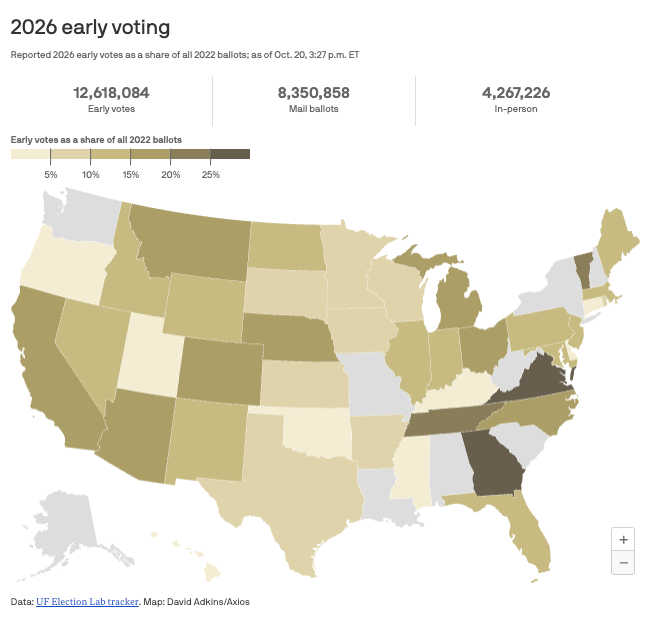
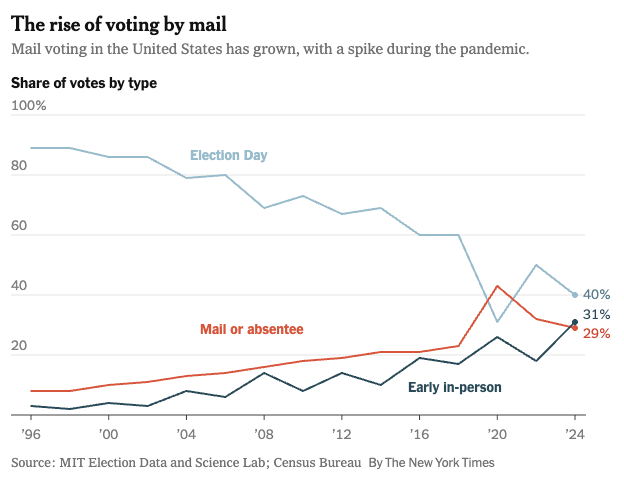
Nearly one in three voters nationally used mail ballots in the most recent midterm and general elections, though usage varies widely by state and has fallen from a pandemic-era peak above 40% in 2020. A Supreme Court ruling clearing the way for Trump's mail-voting restrictions carries outsized consequences for states with the highest mail-voting rates, many of which are part of a nearly two-dozen-state, mostly Democratic-run coalition suing to block the effort. The plan traces to a March executive order directing the Department of Homeland Security to build state-by-state citizen eligibility lists and instructing USPS to help determine which voters receive ballots; USPS published implementing regulations Friday requiring states to share voter data and meet new ballot-envelope standards.
Whether the restrictions apply to November remains unresolved, with a lower court still weighing their legality, and the compressed timeline is the real story here: several states begin mailing ballots within weeks, leaving little room to implement procedural changes even if courts ultimately allow them. The states most exposed are disproportionately those Trump's coalition of opponents represents, raising the stakes of the ongoing litigation for turnout in the very states likely to matter most in November. Read More.
Record Number of States to Vote on Voter ID This Year
Voters in at least six states will decide voter ID ballot measures this year, the most in a single year on record, according to Ballotpedia. Oklahoma votes first, on Tuesday's primary runoff ballot, on a measure codifying its existing voter ID policy into the state constitution. Arizona, Nevada, and North Carolina — all presidential battlegrounds — will vote this fall on measures toughening ID requirements, following eight other states that have already tightened voter ID rules legislatively this year, per the Voting Rights Lab.
The measures arrive after a Republican-backed federal election overhaul including proof-of-citizenship requirements stalled in Congress, pushing the fight to the state level instead. Other election-related measures on this fall's ballots include citizenship-only voting declarations in several states, Alaska's repeat referendum on ranked-choice voting, Maryland's Democratic-favoring redistricting rules, and Massachusetts votes on all-party primaries and same-day registration — signaling election administration itself is shaping up as a major midterm battleground alongside the races themselves. Read More.
EMERGING NARRATIVES
Congress Braces for Historic Wave of Turnover
At least 83 sitting House and Senate members won't return next year, the highest turnover since 2000, according to a TIME analysis. The breakdown includes 70 House members (30 Democrats, 40 Republicans) and 13 senators not seeking reelection, plus 12 incumbents who have already lost primaries — a figure that already exceeds the postwar average of 6.5 House primary losses per cycle. Ten senators have announced retirements, including Mitch McConnell and Thom Tillis, while 28 members left their seats to seek other office, with Democrats so far 0-for-6 in those bids.
The turnover reflects two distinct dynamics playing out in each party. Democratic incumbent losses are concentrated among establishment figures challenged from the left — DSA-aligned or Mamdani-endorsed candidates have now toppled Reps. Dan Goldman, Adriano Espaillat, Shri Thanedar, and Diana DeGette. Republican losses, by contrast, are almost uniformly loyalty tests: Reps. Thomas Massie and Dan Crenshaw lost after breaking with Trump, while Sen. Bill Cassidy fell after his 2021 impeachment conviction vote. With several primaries still pending through September, the total is likely to climb further before Election Day.
Read More.
Resistance 1.0 Meets Its Expiration Date
Impeachment credentials, once the fastest track to Democratic stardom, are becoming a liability in 2026 primaries. Alexander Vindman, the retired lieutenant colonel who testified in Trump's first impeachment and raised over $16 million, lost Florida's Senate primary to DSA member Angie Nixon's sub-$1 million campaign (read more). He's not alone: Rep. Diana DeGette, a 2021 impeachment manager, fell to a DSA-aligned challenger in June, as did Rep. Shri Thanedar and lead impeachment counsel Rep. Dan Goldman, both unseated by progressive rivals this cycle.
The pattern points to a deeper realignment in what Democratic primary voters are rewarding. "In Trump's first term, grassroots anger was primarily focused on Donald Trump and Republicans," said MoveOn's Joel Payne. "This time around, that anger extends to the Democratic establishment as well." House Democrats increasingly describe accountability messaging as insufficient on its own, with primary voters demanding sharper positioning on affordability, Medicare for All, and foreign policy.
The trend carries implications beyond primary season. Several House Democrats told Axios the losses are sapping momentum behind a potential 2027 impeachment push if the party retakes the House, even as others argue the results reflect weak individual campaigns more than a referendum on impeachment itself. Either way, the establishment's old currency is buying less than it used to.
Read More.
ON THE HORIZON
Upcoming Elections:
August 25:
Oklahoma Primary Runoff
South Carolina Special GOP Senate Primary Runoff
September 1:
Massachusetts Primary
September 8:
New Hampshire Primary
September 15:
Delaware Primary